[Update: This post deals with the difficult issue of racial anger. I've revised it somewhat in light of reader comments below, but I'm still not sure it says what it says accurately and fairly, especially in my efforts to account for common forms of black feelings and behavior. I do think there are common white and common black differences in this area, and I'm trying to spell out, especially, some common and domineering white modes of thought and behavior that often arise during conversations about race with non-white people. Finally, I'll add here that in a post entitled "The Privilege of Politeness" at Angry Black Woman, Naamen Gobert Tilahun says some of things I was trying to say here better than I did.]
Because black people have long had to study white people if they want to be safe and successful, and because white people rarely have to study black people if they want to be safe and successful, whites tend to have a harder time understanding blacks than most blacks do understanding whites.
White people also usually have a hard time realizing that in some ways, black people tend to see the world differently from how they do. Consequently, white people often get confused, dismissive, or frustrated if black people insist that they experience the world differently, and therefore see it differently.
If black people also insist that a historical legacy of mistreatment at the hands of whites also has a lingering effect on how they see the world, things can get so far beyond the range of white ways of seeing the world that they usually change the subject, or throw their hands up and turn away, or even leave the room.
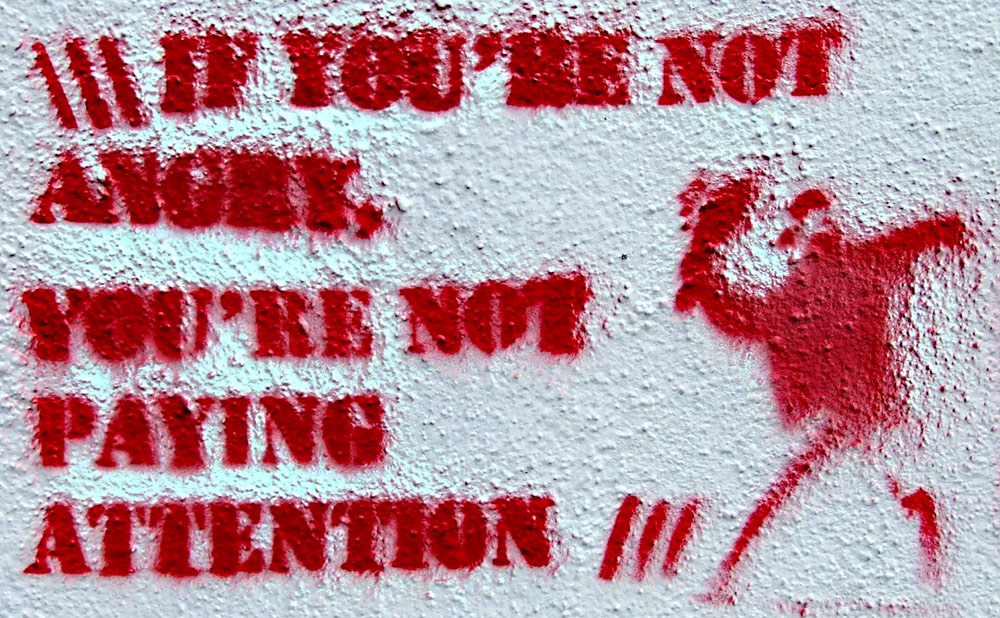
As they do so, over these and other racial disagreements, these white people often say something like, "If you're going to get emotional, then I can't discuss this with you." For white people in such discussions, anger tends to be a dangerous force that blows out the light of reason. They may not realize it (middle-class ones, especially), but white people often insist that such discussions be conducted in their way. Their calm, rational way, that is, and if they're talking to someone raised to discuss "hot topics" in an more emotionally engaged way, they not that way. (And guess who's automatically at an advantage in calm, rational discussions, if they've been raised to discuss controversial issues in a calm, rational way?)
So white people can get confused or fed up in discussions about things that make some black people angry. That's understandable, really, when you realize that whites have been trained to think that the way they see the world is pretty much the normal way--the way everyone else does, unless there's something wrong with them. Unless they're "biased," or "subjective," something that (from a white perspective) being white supposedly doesn't do to a person, and something that being black supposedly does do to a person.
This unconscious presumption of white objectivity, as opposed to supposed non-white subjectivity, is also why white people who talk about racial issues get a lot more attention and credit from white listeners than people of color who say the same damn thing. This is the kind of blindly applied double standard that also happens with supposedly objective male speakers or discussants and supposedly subjective female speakers or discussants.
So because whites tend to be wrapped up this way--in their supposedly objective, ironically racialized perspective--one of the things that they never seem to quite get is collective black anger (which is not to say, by the way, that there are no common forms of collective white anger, such as ill-informed notions about affirmative action). This common white obstinacy became openly apparent when Barack Obama's pastor, Reverend Wright, expressed anger at America, and made an emotional call to God to "damn America" unless it started treating black people better.
Reverend Wright later said things that struck most white folks as so outlandish that Obama finally bowed to pressure by repudiating both the words and the man. The supposedly important connection between Wright and Obama is old news by now (not that some white people are going to let Wright and his words go away), but many white people still wonder—if Wright said things like that in church, then why did Obama attend that church for twenty years? I think it's probably because in that church, Obama cut Reverend Wright some slack.
I think that if Obama was in church on that particular day, he and the other people there would've understood that Wright wasn't actually asking God to damn America. Instead, one of a black reverend's functions in such moments, in many black churches, where people aren't so pent up and repressed that they've pretty much separated their emotional life from their religious life (if they have a religious life)--in those kinds of moments, what Wright may have been doing was helping his congregation express some of its anger. (Or maybe not--this is conjecture on my part.)
And as I understand it, yes, black people still do have a lot to feel angry about, and no, many of them won’t just bury or try to forget that anger like white people wish they would. Sometimes they let it out, which is probably healthy, and sometimes when they do so, they say things they wouldn’t say at other times.
White people often forgive their own friends or family members for saying things in anger that they wouldn't say otherwise. Why can't they do the same for black people?
I think they can't because it is "black anger," which as I wrote above, white people don’t understand, and sometimes don’t want to face up to, especially if they feel like a target for that anger. But white people also find it difficult to overlook black anger in a collective sense because white anger, when it's expressed, is more contained, more localized, and, from a white perspective, more individualized.
Most white people don't have a collective sense of themselves as a group nearly as much as many black people do (thanks largely to whites grouping blacks together for several centuries now, in order to treat them accordingly). So while white people get angry at work, or on the road, or in their homes or during a baseball game, they rarely get angry together as a racial group. That's because white solidarity has been atomized into supposedly non-white individuality. And also, after all, considering that as a group, whites are still by and large on top in American society, what do whites realitically have to get angry together over, as a racial group?
Again, black people understand white people better than the other way around, and one of the things they usually know is what I'm basically trying to say here--that whites don't understand collective black anger. White people don't understand the causes that justify it, so they don't understand most of what gets said, nor the ways in which it gets said. And finally, if that anger gets expressed in a manner or "tone" that differs from their own, they're apt to turn away, unless the discussion can be conducted in their preferred manner, instead of someone else's.


