This is a follow-up to the previous swpd post, in response to many of the readers' comments there.
Here's something that I as a white person can never really know -- what's it like for non-white children when they have to sit through an education system that still normalizes and glorifies white people and white ways, more or less all of the time? A system that also still denigrates the contributions and lived experiences of people of color, more or less all of the time?
How, for instance, do non-white students reconcile what they probably perceive at times as a contradiction, a paradox, when they're being taught that some work of unspokenly white art is "great," and yet they know at some level that it's also racist? And worse yet, that the teacher isn't even acknowledging the racism, and can't even seem to see it?
In a YouTube clip, damali ayo (author of such satiric takes on whiteness as How to Rent a Negro and Obamistan!: Land without Racism) describes her experience in class with the n-word, and with hearing it so many times during discussions of Harper Lee's To Kill a Mockingbird. Embedding of the clip has been "disabled by request," so here's what ayo says while discussing two "n-words," including responses to the word "negro" in her first book's title:
[After the book and web site appeared,] license to use the word "negro" grew dramatically in my life. People started calling me negro all the time, and it's like, "No, you guys, it's satire and, you're not supposed to say that." . . . So like, I have to explain, the idea is that the stuff on the site is as archaic, and as outdated as this word.
I remember being in class and reading To Kill a Mockingbird. . . . and I don't remember what that book is about. No clue, zero.
What I think the book is about is the word "ni**ger-lover," because that's all I heard for like, days on end in my classroom, was the teacher going, "Ni**ger-lover, ni**ger-lover, ni**ger-lover, ni**er-lover, ni**er-lover!" And then the kids, "Oh! Ni**ger-lover, ni**ger-lover, ni**ger-lover, ni**ger-lover!"
And I remember looking at Kim Yates . . . she was badass. And I remember looking across the table at her, and we just, our faces sank. And I started to see the other white kids follow suit. She was older than me, and I didn't know if she was going to do something, so I was just looking at her like, "What do we do?" I think we were both just overwhelmed with the inability to control the situation that was being led by the teacher.
Of course, a lot of other "great literature" -- which by default tends to mean "great white literature" -- that gets taught also has racist effects. Toni Morrison wrote a whole book about that, and I'm sure others have written about it too. In that book, Playing in the Dark, Morrison points out that understanding what's racist about great white literature doesn't necessarily diminish it, nor its authors. Instead, such deeper understandings can enrich the literature, further demonstrating how it represents and illuminates human experience, including racism. In other words, such materials don't need necessarily need to be banned; they can be taught in better ways, and they can also be taught alongside other art, created by people who understand racism differently, and better, because they're not white.
Still, so many teachers continue to handle racist material badly, much to the detriment of students of color. Should teachers no longer subject them, and white students, to great literature that's also racist? Maybe it depends on how they teach it.
At any rate, many are clearly not teaching it well. As swpd commenter Jane Laplain wrote about her own Mockingbird experience,
I remember this was everybody's favorite "Race" book in my highschool english class. That and "Huck Finn." Both of these novels made me feel like I wanted to shrivel up and die, just wordless humiliation. What with the teacher and the kids all crowing about how much they loooooved the message. I could never quite put my finger on why I was so uncomfortable. The protagonists after all were AGAINST racism... shouldn't I be happy about that? I just didn't have the tools to dissect the hidden messages then.
Commenter Bingo offered some suggestions for how to better teach the novel -- these and other methods might help to prevent non-white students from feeling the ways that damali ayo and Jane Laplain did:
If I had to teach TKAM I'd...
1. Use the Innocence Project to show how innocent black men STILL lose their lives and freedom due to racism.
2. Ditto for Oscar Grant and other instances of police brutality.
3. Analyze the similarities between Mel Gibson's recent racist statement and the way the defendant is framed in TKAM.
4. Show how treatment of blacks as animals in the media (i.e. Obama monkey toys) ties into dehumanization of blacks in TKAM -- to Atticus blacks are mockingbirds, in the courtroom the defendant is referred to as a "buck."
It seems to me that teachers (white or non-white) who do such things do so because they're more sensitive to the differing effects that racially charged materials and discussions can have on differently raced students. Hopefully, they're also aware that racism has by no means gone away, and part of what they're ultimately doing as teachers is trying to fight it.
What were your experiences in school with racist white literature, and with other forms of great-but-actually-racist art? Did you have any teachers who handled such materials and discussions especially well? And is there any hope that teachers and the education system in general will do better?
h/t: RVCBard and sanguinity. For more on damali ayo at swpd, see "think that apologizing officially for slavery makes a big difference"; an swpd interview with her; and an insightful excerpt from her book, How to Rent a Negro.
Showing posts with label white books. Show all posts
Showing posts with label white books. Show all posts
Tuesday, July 13, 2010
force non-white students to read "great literature" that demeans them


Sunday, July 11, 2010
warmly embrace a racist novel (to kill a mockingbird)

(source)
I refuse to go along with this week's warm, feel-good celebrations of Harper Lee's novel (published fifty years ago today), To Kill a Mockingbird. Simply put, I think that novel is racist, and so is its undying popularity. It's also racist in a particularly insidious way, because the story and its characters instead seem to so many white people like the very model of good, heartwarming, white anti-racism.
A few days ago, NPR (National
The segment begins,
Harper Lee had the kind of success most writers only dream about. Shortly after her novel, To Kill a Mockingbird, came out in the summer of 1960, it hit the bestseller lists, then it won a Pulitzer Prize, and then was made into an Oscar-winning movie. Her novel has never gone out of print.
But, in a move that's unheard of in this age of celebrity writers, Lee stepped out of the limelight and stopped doing interviews years ago -- she never wrote another book. Still, her influence has endured, as we mark the fiftieth anniversary of its publication.
NPR's print version (entitled "50 Years On, 'Mockingbird' Still Sings America's Song") goes on to say,
For the high-schoolers reading To Kill a Mockingbird today, America is a very different place than it was when Lee wrote her novel 50 years ago. Lee's story of Scout Finch and her father, Atticus -- a small-town Southern lawyer who defends a black man unjustly accused of rape -- came out just as the nation was fighting over school desegregation.
That's right, dear, lily-white NPR fans. Things were sooooo different back then, weren't they? Thank God racism is dead!
Actually, that right there is the first reason I think this novel is, in effect, racist -- it allows, indeed encourages, today's well-meaning white people to think that "America is a very different place" than it was when Lee wrote her novel, and thus to think that widespread and deeply entrenched racism died a long time ago.
The novel came out, you see, "just as the nation was fighting over school desegregation." Back in the bad old days, when "the nation" was "fighting"; why not say that mainstream white supremacists, with the support of most white Americans, were keeping black kids out of school while bashing in the heads of their adult parents and relatives? And come to think of it, the heads of those black kids too? But nowadays, you see, "the nation" embraces its black kids.
By way of driving home that particular, comforting implication -- "Fortunately, we all pretty much get along now!" -- Neary sets her story in a racially mixed, seemingly postracial classroom:
Today, in a 10th grade English class at T.C. Williams High School in Alexandria, Va., students of many different races and ethnicities are studying the book together. Their teacher, Laurel Taylor, says that the story still resonates -- and with students of all backgrounds.
"Trying to find your identity and realizing that your society doesn't always tell you the right thing" is a particularly profound message for teens, Taylor says. "Sometimes you have to go against what everyone else says to do the right thing. All that kind of resonates no matter where you come from."
This part of Neary's segment clarifies the second problem I have with how the novel comes across to so many American readers -- its messages get read as "universal" -- "To Kill a Mockingbird can teach anyone how to be a better person!" I suppose that's a nice message, but when people claim that the novel's messages can be embraced by anyone, the realities of white supremacist violence, past and present, fade from view.
Neary carries on about the book's widespread appeal -- which somehow circles right back to white people:
"The story of Scout's initiation and maturing is the story of finding out who you are in the world," says author Mary McDonagh Murphy. "And at the same time, the novel is about finding out who we are as a country."
Murphy's new book, Scout, Atticus & Boo, is based on interviews about To Kill a Mockingbird with well-known writers, journalists, historians and artists. Murphy says the novel, narrated from a child's point of view, gave white people, especially in the South, a nonthreatening way to think about race differently.
Yes, "we" wouldn't want white people, the principle enactors of racism, to feel at all "threatened" when we try to talk to them about racism. I guess if we did, they'd just up and run away!
Anyway, I could go on dissecting the saccharine nostalgia of this NPR piece (and I should add that, to Neary's credit, she does get around to injecting some realism, especially by mentioning the horrific and iconic death of Emmett Till). But I'd rather turn to a more critical and insightful view, of both the novel and its effects on different readers.
In a 2003 academic article (published in Race and Class), Isaac Saney wrote about successful black efforts against Lee's novel in Nova Scotia, efforts undertaken because it's a racist novel. In 1996, "intense community pressure" by the African Nova Scotian population managed to remove the novel from the Department of Education's list of recommended, authorized books; in 2002, a committee consisting of parents and educators, seconded by members of the Black Educators' Association (BEA), recommended that the book "be removed from school use altogether."
A report (by the African Canadian Division of the Nova Scotia Department of Education) "laid out the community's concerns":
In this novel, African-Canadian students are presented with language that portrays all the stereotypical generalizations that demean them as a people. While the White student and the White teacher many misconstrue it as language of an ealier era or the way it was, this language is still widely used today and the book serves as tool to reinforce its usage even further. . . .
The terminology in this novel subjects students to humiliating experiences that rob them of their self-respect and the respect of their peers. The word 'Nigger' is used 48 times. . . .
There are many available books which reflect the past history of African-Canadians or Americans without subjecting African-Canadian learners to this type of degradation. . . We believe that the English Language Arts curriculum in Nova Scotia must enable all students to feel comfortable with ideas, feelings and experiences presented without fear of humiliation . . . To Kill a Mockingbird is clearly a book that no longer meets these goals and therefore must no longer be used for classroom instruction.
So aside from the multiple usages of the n-word, what exactly is it about the book that provoked such a strong black revulsion? (And I do not mean to imply with this question, of course, that I think all black readers respond to the book in just one way.)
After reviewing common white distortions in the media of this collective African-Canadian complaint,* Saney goes on to offer three primary and compelling reasons of his own for knocking To Kill a Mockingbird from its lofty perch:
1. A common reading of its central symbol (mockingbird = black people) degrades black people.
Is not the mockingbird a metaphor for the entire African American population? [The metaphor says] that Black people are useful and harmless creatures -- akin to decorous pets -- that should not be treated brutally. This is reminiscent of the thinking that pervaded certain sectors of the abolition movement against slavery, which did not extol the equality of Africans, but paralleled the propaganda of the Society for the Prevention of Cruelty to animals, arguing that just as one should not treat one's horse, ox or dog cruelly, one should not treat one's Blacks cruelly.
By foisting this mockingbird image on African Americans, it does not challenge the insidious conception of superior versus inferior 'races', the notion of those meant to rule versus those meant to be ruled. What it attacks are the worst -- particularly violent -- excesses of the racist social order, leaving the racist social order itself intact.
2. The novel's noble, white-knight hero has no basis in reality, and the common white focus on the heroism of Atticus Finch distracts attention from the pervasiveness of 1930s white-supremacist solidarity among ordinary white people.
Central to the view that To Kill a Mockingbird is a solid and inherently anti-racist work is the role of Atticus Finch, the white lawyer who defends Tom Robinson, the Black man wrongly accused of raping a white woman. Atticus goes so far as to save Tom from a lynching. However, this act has no historical foundation.
The acclaimed exhibition Without Sanctuary: lynching photography in America . . . documented more than 600 incidents of lynching. This landmark exhibition and study established that 'lynchers tended to be ordinary people and respectable people, few of whom had any difficulties justifying their atrocities in the name of maintaining the social and racial order and the purity of the Anglo-Saxon race'. In two years of investigation, the exhibit researchers found no evidence of intervention by a white person to stop even a single lynching.
(In sum, the noble, persistent, obstinate activism of Atticus Finch -- which garners the collective respect of the town's black people -- is a soothing white fantasy.**)
3. The novel reduces black people to passive, humble victims, thereby ignoring the realities of black agency and resistance.
Perhaps the most egregious characteristic of the novel is the denail of the historical agency of Black people. They are robbed of their role as subjects of history, reduced to mere objects who are passive hapless victims; mere spectators and bystanders in the struggle against their own oppression and exploitation.
There's the rub! The novel and its supporters deny that Black people have been the central actors in their movements for liberation and justice, from widespread African resistance to, and revolts against, slavery and colonialism to the twentieth century's mass movements challenging segregation, discrimination and imperialism. . . . The novel portrays Blacks as somnolent, awaiting someone from outside to take up and fight for the cause of justice.
It was African North Americans who took up the task of confronting and organising against racism, who through weal and woe, trial and tribulation, carried on -- and still carry on -- the battle for equal rights and dignity. Those whites who did, and do, make significant contributions gave, and give, their solidarity in response.
Yes, in response. I put those words in bold print because when I first read them, I realized just how white-centered the novel and movie are. I think that had it not been for the movie, especially Gregory Peck's depiction of Atticus Finch, the novel would not have the status it has today. Peck's Finch, in his upright disdain for racism, fully embodied a particularly white and male aspiration of liberal nobility. But he does it all on his own; it's white individualism all over again. And, ironically, non-white people are part of that portrait, but only as props, as accouterments that flesh out the portrait. Any black unrest and activism that would no doubt have inspired and aided any such white crusader is entirely erased.
Despite these faults, and others, To Kill a Mockingbird continues to be among the top three most-taught novels in American middle and high schools (another, The Adventures of Huckleberry Finn, tends to be taught in similarly fantasized terms). Saney makes the sensible suggestion of supplanting such white-centric readings on racism with some more honest and black-affirming books, such as Ellison's Invisible Man, Hurston's Their Eyes Were Watching God, Morrison's The Bluest Eye and Beloved, and many others. I would add that many worthy novels were written throughout the twentieth century by other non-white writers as well.
So, what do you think? Do you have warm memories of this (white) "masterpiece," or not-so-warm memories? If you have read it, do you think your race had anything to do with your reaction to it?
Also, should teachers should stop teaching it? Or teach it differently? And do you know of other worthy replacements/successors?
* Saney writes that in the white-dominated Canadian press,
The arguments advanced by the Black community were consistently presented in a non-serious, even risible, light so as to give the impression that the Black educators and parents are ignorant of the merits of literature, mere emotional whiners and complainers, belonging to a hot-headed fringe. For example, after the decision was made to keep the books in the curriculum, the Halifax Daily News in an editorial was 'relieved cooler heads have prevailed', reproducing the racist notions of inherent Black emotionality versus the rationality of white society.
** In a New Yorker piece published last year, Malcolm Gladwell claims that Finch did resemble an actual white antiracist of sorts, Alabama Governor Jim Folsom. Even so, since Folsom was a sort of wishy-washy populist of all the people, rather than a genuinely dedicated reformer, the parallel still leaves Atticus Finch looking less than worthy of emulation. As Gladwell writes, "If Finch were a civil-rights hero, he would be brimming with rage at the unjust verdict [against Tom Robinson]. But he isn’t. He’s not Thurgood Marshall looking for racial salvation through the law. He’s Jim Folsom, looking for racial salvation through hearts and minds."
Tuesday, June 15, 2010
quotation of the week (w.e.b. du bois)

(a currently available t-shirt,
at a site to which I will not link --
In 1920, in the aftermath of World War I, W.E.B. Du Bois published a searing essay, "The Souls of White Folk." The following excerpt seems especially relevant in light of today's "news" (even as fools rush in to deny the relevance of this "news"). Du Bois describes how white people considered the "world war" an especially horrible war in part because the white people in it killed other white people -- instead of just exploiting, abusing, and killing the usual victims, darker peoples. Du Bois also had a clear eye for how darker peoples fit into the standard white logic of war:
War is horrible! This the dark world knows to its awful cost. But has it just become horrible, in these last days, when under essentially equal conditions, equal armament, and equal waste of wealth white men are fighting white men, with surgeons and nurses hovering near?
Think of the wars through which we have lived in the last decade: in German Africa, in British Nigeria, in French and Spanish Morocco, in China, in Persia, in the Balkans, in Tripoli, in Mexico, and in a dozen lesser places -- were not these horrible, too? Mind you, there were for most of these wars no Red Cross funds.
Behold little Belgium and her pitiable plight, but has the world forgotten Congo? What Belgium now suffers is not half, not even a tenth, of what she has done to black Congo since Stanley's great dream of 1880. Down the dark forests of inmost Africa sailed this modern Sir Galahad, in the name of "the noble-minded men of several nations," to introduce commerce and civilization. What came of it? "Rubber and murder, slavery in its worst form," wrote Glave in 1895.
Harris declares that King Leopold's regime meant the death of twelve million natives, "but what we who were behind the scenes felt most keenly was the fact that the real catastrophe in the Congo was desolation and murder in the larger sense. The invasion of family life, the ruthless destruction of every social barrier, the shattering of every tribal law, the introduction of criminal practices which struck the chiefs of the people dumb with horror -- in a word, a veritable avalanche of filth and immorality overwhelmed the Congo tribes."
Yet the fields of Belgium laughed, the cities were gay, art and science flourished; the groans that helped to nourish this civilization fell on deaf ears because the world round about was doing the same sort of thing elsewhere on its own account.
As we saw the dead dimly through rifts of battle smoke and heard faintly the cursings and accusations of blood brothers, we darker men said: This is not Europe gone mad; this is not aberration nor insanity; this is Europe; this seeming Terrible is the real soul of white culture -- back of all culture -- stripped and visible today. This is where the world has arrived -- these dark and awful depths and not the shining and ineffable heights of which it boasted. Here is whither the might and energy of modern humanity has really gone. . . .
Manifestly it is expansion overseas; it is colonial aggrandizement which explains, and alone adequately explains, the World War. How many of us today fully realize the current theory of colonial expansion, of the relation of Europe which is white, to the world which is black and brown and yellow? Bluntly put, that theory is this: It is the duty of white Europe to divide up the darker world and administer it for Europe's good.
This Europe has largely done. The European world is using black and brown men for all the uses which men know. Slowly but surely white culture is evolving the theory that "darkies" are born beasts of burden for white folk. It were silly to think otherwise, cries the cultured world, with stronger and shriller accord. The supporting arguments grow and twist themselves in the mouths of merchant, scientist, soldier, traveler, writer, and missionary. Darker peoples are dark in mind as well as in body; of dark, uncertain, and imperfect descent; of frailer, cheaper stuff; they are cowards in the face of Mausers and Maxims; they have no feelings, aspirations, and loves; they are fools, illogical idiots -- "half-devil and half-child."
Such as they are civilization must, naturally, raise them, but soberly and in limited ways. They are not simply dark white men. They are not "men" in the sense that Europeans are men. To the very limited extent of their shallow capacities lift them to be useful to whites, to raise cotton, gather rubber, fetch ivory, dig diamonds -- and let them be paid what men think they are worth -- white men who know them to be well-nigh worthless.
Such degrading of men by men is as old as mankind and the invention of no one race or people. Ever have men striven to conceive of their victims as different from the victors, endlessly different, in soul and blood, strength and cunning, race and lineage. It has been left, however, to Europe and to modern days to discover the eternal worldwide mark of meanness -- color!
There is a chance for exploitation on an immense scale for inordinate profit, not simply to the very rich, but to the middle class and to the laborers. This chance lies in the exploitation of darker peoples. It is here that the golden hand beckons. Here are no labor unions or votes or questioning onlookers or inconvenient consciences. These men may be used down to the very bone, and shot and maimed in "punitive" expeditions when they revolt. In these dark lands "industrial development" may repeat in exaggerated form every horror of the industrial history of Europe, from slavery and rape to disease and maiming, with only one test of success -- dividends!
This theory of human culture and its aims has worked itself through warp and woof of our daily thought with a thoroughness that few realize. Everything great, good, efficient, fair, and honorable is "white"; everything mean, bad, blundering, cheating, and dishonorable is "yellow"; a bad taste is "brown"; and the devil is "black." The changes of this theme are continually rung in picture and story, in newspaper heading and moving picture, in sermon and school book, until, of course, the King can do no wrong -- a White Man is always right and a Black Man has no rights which a white man is bound to respect.
There must come the necessary despisings and hatreds of these savage half-men, this unclean canaille of the world -- these dogs of men. All through the world this gospel is preaching. It has its literature, it has its priests, it has its secret propaganda and above all -- it pays!
There's the rub -- it pays. Rubber, ivory, and palm oil; tea, coffee, and cocoa; bananas, oranges, and other fruit; cotton, gold, and copper -- they, and a hundred other things which dark and sweating bodies hand up to the white world from their pits of slime, pay and pay well, but of all that the world gets the black world gets only the pittance that the white world throws it disdainfully.
Small wonder, then, that in the practical world of things-that-be there is jealousy and strife for the possession of the labor of dark millions, for the fight to bleed and exploit the colonies of the world where this golden stream may be had, not always for the asking, but surely for the whipping and shooting. It was this competition for the labor of yellow, brown, and black folks that was the cause of the World War. Other causes have been glibly given and other contributing causes there doubtless were, but they were subsidiary and subordinate to this vast quest of the dark world's wealth and toil.
Colonies, we call them, these places where "niggers" are cheap and the earth is rich; they are those outlands where like a swarm of hungry locusts white masters may settle to be served as kings, wield the lash of slave drivers, rape girls and wives, grow as rich as Croesus and send homeward a golden stream. They belt the earth, these places, but they cluster in the tropics, with its darkened peoples: in Hong Kong and Anam, in Borneo and Rhodesia, in Sierra Leone and Nigeria, in Panama and Havana -- these are the El Dorados toward which the world powers stretch itching palms.
cf. the apostasy of John Perkins and Major General Smedley Darlington Butler. Can you recommend others?
Saturday, June 5, 2010
rush to the aid of crying white instigators of racism, instead of the victims
William Ayers recently published a comic book, To Teach: The Journey, In Comics (illustrated by Ryan-Alexander-Tanner). At one point, Ayers pauses to describe the classroom of this teacher, Avi Lessing:

Ayers then describes (and Alexander-Tanner illustrates) the following, relatively common incident, which happens while a white student of Lessing's is presenting a story that takes place at a skating rink.
What happens here is a common form of white solidarity:


It's worth noting that the victim of racism here -- a double victim, actually -- is a black woman. Given the images of black women that commonly lurk in the white imagination, I wouldn't be at all surprised if such white bumblers would be less likely to spark such incidents with their tears if the victim of their actions were another sort of person of color. I think even the tears themselves would be less likely.
In a blog entry on some differences between white women and women like herself, Dr. Renita J. Weems writes of "the vivid memories lots of black women have of white women whose tears promoted their causes over that of the black women":
Many of us, myself included, have stories to tell of white women crying and taking on postures of weakness to avoid conflict with black women. They cried, they shut down, they ran out the room, and feigned helplessness -- especially when confronted with the criticisms black women had about their racism. It’s almost a rule of thumb that senior black women pass along to younger black women to expect white women to faint, get weepy, and come up with stories about their one black friend when the time comes to talk openly and honestly about their complicity in the status quo. Watch for the dagger that follows, I was once told by my own mentor.
Beliefs informed by stereotypes can be so strong that we take them for granted. As black women we know what it is to be saddled with the stereotype of being strong, aggressive, and animalistic in our sexuality. Stereotyping and projecting our worst memories on each other allow both white women and black women to maintain our places in the status quo. It keeps us from finding common ground and from joining forces to battle against the forces bent keeping women sex objects and breeders.
But when is something a stereotype, and when is it true? Not every white woman you and I know has used tears to get her way. Just a lot. Just one too many. Just enough to keep the stereotype alive, I guess.
Yes, this common white tendency -- and I'm sure there are white male versions as well -- is really a way of avoiding conflict, isn't it? And when it's a black woman, a seemingly (O noes!!) Angry Black Woman, then acting as if you're the injured party can seem especially, and ridiculously, prudent. The tears* can function like a false flag, which that loudly signals "Injury!", but also hides fear. I was about to surmise that running away in tears at such moments is also a way of maintaining dignity, but I think what's actually being maintained is a white sense of superiority.
It seems to me that white people who recognize how they're continuously encouraged to be racist by the world around them should prepare themselves for this kind of moment -- a moment in a discussion of racism when someone white suddenly claims that they've been hurt. We should think about how something like a reflex may well lead us to jump to the aid of the perpetrator of racism, instead of helping out or standing by the victim.
I think we should ask ourselves how, instead of expressing solidarity with the white "victim," we could instead express solidarity with the real victim. We should also think about why the latter doesn't immediately feel right. Until it does immediately feel right.
* I like the name that Ayers gave to the crying white girl -- "Misty." What Misty does in that cartoon, of course, is a classic form of a white pathology, widely known as White Women's Tears.

Ayers then describes (and Alexander-Tanner illustrates) the following, relatively common incident, which happens while a white student of Lessing's is presenting a story that takes place at a skating rink.
What happens here is a common form of white solidarity:


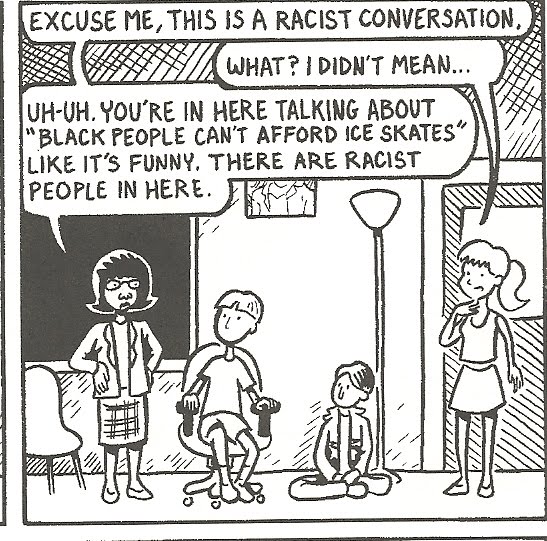


(source)
It's worth noting that the victim of racism here -- a double victim, actually -- is a black woman. Given the images of black women that commonly lurk in the white imagination, I wouldn't be at all surprised if such white bumblers would be less likely to spark such incidents with their tears if the victim of their actions were another sort of person of color. I think even the tears themselves would be less likely.
In a blog entry on some differences between white women and women like herself, Dr. Renita J. Weems writes of "the vivid memories lots of black women have of white women whose tears promoted their causes over that of the black women":
Many of us, myself included, have stories to tell of white women crying and taking on postures of weakness to avoid conflict with black women. They cried, they shut down, they ran out the room, and feigned helplessness -- especially when confronted with the criticisms black women had about their racism. It’s almost a rule of thumb that senior black women pass along to younger black women to expect white women to faint, get weepy, and come up with stories about their one black friend when the time comes to talk openly and honestly about their complicity in the status quo. Watch for the dagger that follows, I was once told by my own mentor.
Beliefs informed by stereotypes can be so strong that we take them for granted. As black women we know what it is to be saddled with the stereotype of being strong, aggressive, and animalistic in our sexuality. Stereotyping and projecting our worst memories on each other allow both white women and black women to maintain our places in the status quo. It keeps us from finding common ground and from joining forces to battle against the forces bent keeping women sex objects and breeders.
But when is something a stereotype, and when is it true? Not every white woman you and I know has used tears to get her way. Just a lot. Just one too many. Just enough to keep the stereotype alive, I guess.
Yes, this common white tendency -- and I'm sure there are white male versions as well -- is really a way of avoiding conflict, isn't it? And when it's a black woman, a seemingly (O noes!!) Angry Black Woman, then acting as if you're the injured party can seem especially, and ridiculously, prudent. The tears* can function like a false flag, which that loudly signals "Injury!", but also hides fear. I was about to surmise that running away in tears at such moments is also a way of maintaining dignity, but I think what's actually being maintained is a white sense of superiority.
It seems to me that white people who recognize how they're continuously encouraged to be racist by the world around them should prepare themselves for this kind of moment -- a moment in a discussion of racism when someone white suddenly claims that they've been hurt. We should think about how something like a reflex may well lead us to jump to the aid of the perpetrator of racism, instead of helping out or standing by the victim.
I think we should ask ourselves how, instead of expressing solidarity with the white "victim," we could instead express solidarity with the real victim. We should also think about why the latter doesn't immediately feel right. Until it does immediately feel right.
* I like the name that Ayers gave to the crying white girl -- "Misty." What Misty does in that cartoon, of course, is a classic form of a white pathology, widely known as White Women's Tears.
Wednesday, May 5, 2010
refuse to acknowledge racism when it's pointed out to them
In the following CNN segment (sorry if a commercial appears first), Tim Wise briefly summarizes his most recent viral-post, "What If the Tea Party Were Black?" A Tea Party leader, Jenny Beth Martin, then enacts a common white tendency -- refusing to acknowledge the racism that someone else is pointing out -- by spilling a bunch of Tea Party talking points instead.
As Wise points out, the topic of this CNN segment is actually the topic of his post -- the differential treatment of differently raced protesters -- but that topic just doesn't interest Martin. As usual for white folks, other things seem more important than racism, which I guess is just, you know, a kind of side issue, something for the minorities to whine about in their limited way, something that actually died a long time ago, and if it didn't die then, it certainly died on that fateful, hopey-changey day that Barack Obama became president (and so on, etcetera, ad nauseam). And just because I as a white person am almost completely surrounded by other white people, and just because practically no white people, including the white-framed corporate media (with the kudo-worthy exception of Don Lemon), find that a racial problem, when it would find similar crowds of non-white people a racial problem, well, that's nothing alarming, or even worth pointing out, really. Unless you've got some kind of old-fashioned ax to grind. Or race-card to play. Or pet cause to promote, because you're really trying to hypocritically advance your own self-interest.
Ad nauseam. I sometimes get nauseous from trying to get obstinate white people to see racism. Do you?
[transcript below]
Transcript:
TIM WISE, AUTHOR, "COLOR BLIND" (via telephone): Well, the premise is very simple. We, as a country, tend to view white political anger very differently than anger or even just, you know, activism when it's evidenced or evinced by people of color. I just wanted people to think about, for example, you know, what would the public perception be? What would the discussion be on FOX News, for example, if thousands of mostly black protesters who were angry about some particular bill that was being considered by the Congress went to Washington, surrounded lawmakers on their way to work and yelled at them? Forget the whole spitting or the racial slur piece of it, just the yelling at them to do what they wanted? How would that be perceived? The fact is we know the civil rights movement knew they couldn't act like that. A, they had too much class. B, they realized that if they had done that, they would have been viewed as an insurrectionary mob. Likewise, the comments made by, you know, traditional mainstream conservative talk show hosts are the kinds of things that no black or brown commentator could get away with.
LEMON: I want to let Jenny Beth get in here. Does what Tim says make any sense to you? Does the racial makeup of the movement make any difference in terms of your tea party message?
JENNY BETH MARTIN, CO-FOUNDER, TEA PARTY PATRIOTS: We're ordinary citizens standing and we're standing up for three things -- fiscal responsibility, constitutionally limited government and free markets. And these three principles, they transcend race and they apply to everyone. The out-of-control spending the government is doing right now, it's going to affect our children and our grandchildren. Regardless of race, it's going to affect all of them, and that's what we're concerned about.
LEMON: So you don't think that the racial makeup, you don't think Tim's argument has any credence? You don't buy into it?
MARTIN: I don't -- I don't think so. We don't have --- we don't tolerate racism within tea party patriots. We focus on those core values. And when people aren't listening, sometimes you have to raise your voice.
LEMON: Yeah.
MARTIN: There's anger out there right now, and anger is OK as long as it's channeled in the appropriate manner.
WISE: You know what, Don? Don, there is a lot of anger on the part of Arab-Americans who are being profiled all the time since 9/11. But you and I both know, and I think Jenny would agree, that if Arab- Americans were to voice their displeasure at racial profiling, and frankly the way in which neither party, Democrat or Republican, have taken it very seriously, and were to go and yell at lawmakers to pass some type of anti-profiling bill, that they would be seen as terrorists. They would be seen as insurrectionary. I mean, that's the difference. And so, Jenny, you know, is talking about her movement not being racist, that's not the topic this evening. The topic is do we perceive mostly white folks' anger over whatever topic, whatever the issue is differently than we would if it was people of color? I think the answer to that question is obvious.
LEMON: Tim, you have a new book coming out, Color Blind, and I think it's very interesting. It's a very provocative point in your book that President Obama, and maybe some Democrats, might be doing the country a disservice when it comes to matters of race. What do you mean by that?
WISE: Well, the argument in the book is a little bit deeper than that. What I talk about in the book is that unless we are willing to call out the problem of racism in housing, in education, in health care, actual acts of discrimination, which I document fully in the book, what ends up happening is that, number one, by not calling it out, we reinforce the denial that is so prevalent, particularly among white America, that the problem is real. The second thing we do is in the case of the president, if he's not willing to call out some of the blatant racism, which I think is behind, for example, the Arizona SB 1070 or the blatant racism which occasionally manifests in some of that tea party opposition, the more radical edge of it, he's not willing to call it out. I think it actually undermines his credibility. When things are that obvious and you're not willing to -- some credibility in the public and that's one of the points I wanted to make.
LEMON: John is sitting here. I don't think John agrees with you.
RIDLEY: I don't quite agree. I do think when there's racism, you've got to call it out. And you see what's going on in Arizona. I don't think anyone has a problem saying that there are elements of this law that are clearly racist. But I do think one of the big problems that we're facing moving ahead in the 21st century, it's more socioeconomic. If you are a person of color --
LEMON: Hang on. Hang on. I'm going to let you finish your point. I'm going to let you finish your point. But even the Congressional Black Caucus and some very prominent leaders, Cornel West, Tavis Smiley, a number of people are saying the president is not focusing on issues that are important to African-Americans. Some are saying the president is not focusing on issues, including immigration is not strong enough on issues,
WISE: Don, it's not just -- it's not just that.
LEMON: Or for brown people. Go ahead, Tim, real quick.
WISE: Don, it's not just that, I mean, the claim that it is mostly socioeconomic. Let's take health care.
I document in the book specifically how the racial disparities in health care between whites and people of color are not mostly about economics. It is not mostly about do you have coverage or do you not. The studies are very clear that the reason people of color, especially black folks, have worst health outcomes are two things. Number one, the cumulative effect of racial bias over time and secondly, the actual dispensation of unequal care by doctors.
RIDLEY: Tim, I would just jump in very quick.
LEMON: John, go ahead.
RIDLEY: Sometimes when we start to segregate some of these issues and say they are merely black issues or white issues, you start to go away from the fact that they are our issues. Again, for people of color who are not economically challenged or doing well, those issues are very different from anyone who is economically challenged and facing those same issues. So I think as we move ahead, yes, we should call it racism when it's there. Again, in Arizona, we see folks doing that, but I think that we do get into a rut as people when they start saying, this is merely a black issue, this is merely a white issue, and not -- and President Obama is president of the United States.
LEMON: And he does have to walk a tightrope when it comes to this.
RIDLEY: I think he does have to walk a tightrope, but he is our president.
LEMON: Yes, yes.
[full transcript here]
As Wise points out, the topic of this CNN segment is actually the topic of his post -- the differential treatment of differently raced protesters -- but that topic just doesn't interest Martin. As usual for white folks, other things seem more important than racism, which I guess is just, you know, a kind of side issue, something for the minorities to whine about in their limited way, something that actually died a long time ago, and if it didn't die then, it certainly died on that fateful, hopey-changey day that Barack Obama became president (and so on, etcetera, ad nauseam). And just because I as a white person am almost completely surrounded by other white people, and just because practically no white people, including the white-framed corporate media (with the kudo-worthy exception of Don Lemon), find that a racial problem, when it would find similar crowds of non-white people a racial problem, well, that's nothing alarming, or even worth pointing out, really. Unless you've got some kind of old-fashioned ax to grind. Or race-card to play. Or pet cause to promote, because you're really trying to hypocritically advance your own self-interest.
Ad nauseam. I sometimes get nauseous from trying to get obstinate white people to see racism. Do you?
[transcript below]
Transcript:
TIM WISE, AUTHOR, "COLOR BLIND" (via telephone): Well, the premise is very simple. We, as a country, tend to view white political anger very differently than anger or even just, you know, activism when it's evidenced or evinced by people of color. I just wanted people to think about, for example, you know, what would the public perception be? What would the discussion be on FOX News, for example, if thousands of mostly black protesters who were angry about some particular bill that was being considered by the Congress went to Washington, surrounded lawmakers on their way to work and yelled at them? Forget the whole spitting or the racial slur piece of it, just the yelling at them to do what they wanted? How would that be perceived? The fact is we know the civil rights movement knew they couldn't act like that. A, they had too much class. B, they realized that if they had done that, they would have been viewed as an insurrectionary mob. Likewise, the comments made by, you know, traditional mainstream conservative talk show hosts are the kinds of things that no black or brown commentator could get away with.
LEMON: I want to let Jenny Beth get in here. Does what Tim says make any sense to you? Does the racial makeup of the movement make any difference in terms of your tea party message?
JENNY BETH MARTIN, CO-FOUNDER, TEA PARTY PATRIOTS: We're ordinary citizens standing and we're standing up for three things -- fiscal responsibility, constitutionally limited government and free markets. And these three principles, they transcend race and they apply to everyone. The out-of-control spending the government is doing right now, it's going to affect our children and our grandchildren. Regardless of race, it's going to affect all of them, and that's what we're concerned about.
LEMON: So you don't think that the racial makeup, you don't think Tim's argument has any credence? You don't buy into it?
MARTIN: I don't -- I don't think so. We don't have --- we don't tolerate racism within tea party patriots. We focus on those core values. And when people aren't listening, sometimes you have to raise your voice.
LEMON: Yeah.
MARTIN: There's anger out there right now, and anger is OK as long as it's channeled in the appropriate manner.
WISE: You know what, Don? Don, there is a lot of anger on the part of Arab-Americans who are being profiled all the time since 9/11. But you and I both know, and I think Jenny would agree, that if Arab- Americans were to voice their displeasure at racial profiling, and frankly the way in which neither party, Democrat or Republican, have taken it very seriously, and were to go and yell at lawmakers to pass some type of anti-profiling bill, that they would be seen as terrorists. They would be seen as insurrectionary. I mean, that's the difference. And so, Jenny, you know, is talking about her movement not being racist, that's not the topic this evening. The topic is do we perceive mostly white folks' anger over whatever topic, whatever the issue is differently than we would if it was people of color? I think the answer to that question is obvious.
LEMON: Tim, you have a new book coming out, Color Blind, and I think it's very interesting. It's a very provocative point in your book that President Obama, and maybe some Democrats, might be doing the country a disservice when it comes to matters of race. What do you mean by that?
WISE: Well, the argument in the book is a little bit deeper than that. What I talk about in the book is that unless we are willing to call out the problem of racism in housing, in education, in health care, actual acts of discrimination, which I document fully in the book, what ends up happening is that, number one, by not calling it out, we reinforce the denial that is so prevalent, particularly among white America, that the problem is real. The second thing we do is in the case of the president, if he's not willing to call out some of the blatant racism, which I think is behind, for example, the Arizona SB 1070 or the blatant racism which occasionally manifests in some of that tea party opposition, the more radical edge of it, he's not willing to call it out. I think it actually undermines his credibility. When things are that obvious and you're not willing to -- some credibility in the public and that's one of the points I wanted to make.
LEMON: John is sitting here. I don't think John agrees with you.
RIDLEY: I don't quite agree. I do think when there's racism, you've got to call it out. And you see what's going on in Arizona. I don't think anyone has a problem saying that there are elements of this law that are clearly racist. But I do think one of the big problems that we're facing moving ahead in the 21st century, it's more socioeconomic. If you are a person of color --
LEMON: Hang on. Hang on. I'm going to let you finish your point. I'm going to let you finish your point. But even the Congressional Black Caucus and some very prominent leaders, Cornel West, Tavis Smiley, a number of people are saying the president is not focusing on issues that are important to African-Americans. Some are saying the president is not focusing on issues, including immigration is not strong enough on issues,
WISE: Don, it's not just -- it's not just that.
LEMON: Or for brown people. Go ahead, Tim, real quick.
WISE: Don, it's not just that, I mean, the claim that it is mostly socioeconomic. Let's take health care.
I document in the book specifically how the racial disparities in health care between whites and people of color are not mostly about economics. It is not mostly about do you have coverage or do you not. The studies are very clear that the reason people of color, especially black folks, have worst health outcomes are two things. Number one, the cumulative effect of racial bias over time and secondly, the actual dispensation of unequal care by doctors.
RIDLEY: Tim, I would just jump in very quick.
LEMON: John, go ahead.
RIDLEY: Sometimes when we start to segregate some of these issues and say they are merely black issues or white issues, you start to go away from the fact that they are our issues. Again, for people of color who are not economically challenged or doing well, those issues are very different from anyone who is economically challenged and facing those same issues. So I think as we move ahead, yes, we should call it racism when it's there. Again, in Arizona, we see folks doing that, but I think that we do get into a rut as people when they start saying, this is merely a black issue, this is merely a white issue, and not -- and President Obama is president of the United States.
LEMON: And he does have to walk a tightrope when it comes to this.
RIDLEY: I think he does have to walk a tightrope, but he is our president.
LEMON: Yes, yes.
[full transcript here]
Thursday, April 22, 2010
try to learn about racism from PoC who haven't volunteered to educate them, while ignoring the vast amount of literature PoC have voluntarily written on the subject
This is a guest post by Belinda, who writes of herself, "I'm a white, early-20s person from Australia, working, studying, and moving between Sydney, Melbourne and London. I lurk around swpd without saying too much, but I'd like to be able to say more."
I nominate my own behaviour here. Repeatedly on this blog, and all too often in real life, PoC are requested to, or feel compelled to, school ignorant WP on topics of racism and privilege. Just how obnoxious and exhausting that kind of work can be has been discussed a lot on this blog, and on others.
It seems to me the irony and insult of that dynamic is that so many PoC, now and throughout history, have already written and published extensively on the topic. These writers have effectively volunteered to educate white people, or to share their experiences of racism, or to further the ideas, language, and dialogue needed to combat racial privilege and disadvantage. These authors are academics, activists, historians, journalists, artists, etc, etc. There is a vast body of work out there. (macon has covered a related topic here -- about PoC who understand and write on whiteness, but don't get much credit for it).
How many white people here have bothered to read any books written about racism and privilege by non-white authors? Or even by white authors?
I know I haven't read many at all. While I think swpd and other blogs about race are invaluable for learning, as they allow communication between people who otherwise would never interact, I feel they are best used in addition to other resources (including real-life communication and conversation). I can only speak for myself, but I feel much more confident when speaking up or acting about something when I feel I have a strong understanding of it.
I'd love to know if anyone can suggest authors or books they have read that are relevant to topics discussed on this blog. While I am building up a long, long reading list of my own that I'm slowly getting through (before anyone says it, yes, I know how to use Google -- and my local library ), I guess I'm asking for anything that anyone has read that has had a profound or changing effect on them, or that any PoC have felt a strong identification with. Or that are just illuminating or educating. Anything from university subject readers to poetry.
I know a lot of people in general like to read books that family, friends, or others recommend to them, not out of laziness I think, but out of a sense of sharing. I like reading things that I know have touched others.
I'd love to hear any suggestions, especially as this is an international collective of people (I'm from Australia). Perhaps it could end up being a good newbie resource too?
I nominate my own behaviour here. Repeatedly on this blog, and all too often in real life, PoC are requested to, or feel compelled to, school ignorant WP on topics of racism and privilege. Just how obnoxious and exhausting that kind of work can be has been discussed a lot on this blog, and on others.
It seems to me the irony and insult of that dynamic is that so many PoC, now and throughout history, have already written and published extensively on the topic. These writers have effectively volunteered to educate white people, or to share their experiences of racism, or to further the ideas, language, and dialogue needed to combat racial privilege and disadvantage. These authors are academics, activists, historians, journalists, artists, etc, etc. There is a vast body of work out there. (macon has covered a related topic here -- about PoC who understand and write on whiteness, but don't get much credit for it).
How many white people here have bothered to read any books written about racism and privilege by non-white authors? Or even by white authors?
I know I haven't read many at all. While I think swpd and other blogs about race are invaluable for learning, as they allow communication between people who otherwise would never interact, I feel they are best used in addition to other resources (including real-life communication and conversation). I can only speak for myself, but I feel much more confident when speaking up or acting about something when I feel I have a strong understanding of it.
I'd love to know if anyone can suggest authors or books they have read that are relevant to topics discussed on this blog. While I am building up a long, long reading list of my own that I'm slowly getting through (before anyone says it, yes, I know how to use Google -- and my local library ), I guess I'm asking for anything that anyone has read that has had a profound or changing effect on them, or that any PoC have felt a strong identification with. Or that are just illuminating or educating. Anything from university subject readers to poetry.
I know a lot of people in general like to read books that family, friends, or others recommend to them, not out of laziness I think, but out of a sense of sharing. I like reading things that I know have touched others.
I'd love to hear any suggestions, especially as this is an international collective of people (I'm from Australia). Perhaps it could end up being a good newbie resource too?
Wednesday, March 24, 2010
describe racism as political incorrectness
[A] couple of years ago here in Michigan -- there was a coffee shop chain called "Beaners" that ended up renaming itself Bigby's. The coffee still sucks, but at least it's politically correct.
Why do a lot of white people shy away from using the word "racist" to describe something that is, indeed, racist? What's up with the preference that many have for euphemisms like "politically incorrect"?
These questions arose for me again as I read one of my favorite down-time sites, BoingBoing. In a brief post entitled "Vintage Sambo's restaurant photos," Mark Frauenfelder linked to a photographer's web site containing such photos. He also wrote the following:
Sambo's is a politically incorrect name for a business, but these vintage photos of the chain restaurant are wonderful.
Before going on to look at the photos, I had to pause and wonder, why did Frauenfelder write "politically incorrect" instead of "racist"? After all, as I'll explain in a moment, what's wrong with the name of that restaurant -- the only reason to call it anything like "politically incorrect" -- is that it's just that, racist.
Here's one of the restaurant photos, which also appears in the BoingBoing post; notice the painting on the wall, an image of a tiger chasing a boy (for a larger image, click here):

The Sambo's restaurant chain began in 1957, and it flourished into 1200 establishments during the Sixties and Seventies; apparently only one remains, in Santa Barbara, California (here's there, um, interesting site). The chain was started by Sam Battistone and Newell Bohnett, whom everyone called Bo -- thus the name, Sambo's. Which certainly doesn't seem like a racist beginning for the restaurant chain's name, buuuuuuut . . .
As Sam and Bo decided how to distinguish the look of their restaurants from others, they also decided to play up the echoes in the name "Sambo" of a famous children's story, The Story of Little Black Sambo. This was a book published in 1899 by a Scottish woman, Helen Bannerman, who lived for many years in Southern India.
The story is familiar to many people, even today -- basically, a very dark, or "black," Indian boy named Sambo goes into a wooded area, loses his clothing to some tigers, who then jealously chase each other around a tree until they turn into butter. Sambo then enjoys this butter on some pancakes made by his mother.
So, if you did look closely at the photo above, Sambo is depicted in the restaurant's paintings in some sort of "traditional Indian" garb, and he's not dark enough that most people would call him "black." The restaurant's decorators lightened the skin of "Little Black Sambo" -- perhaps in deference to the Civil Rights era? -- though I'm not sure if they did so at the outset.
Aside from the stereotypical representation of mildly exotic "Indian-ness," a bigger problem for the restaurant chain is that when Bannerman's book was published in America, various versions depicted the protagonist with features that echoed other stereotypes about African American children, all of which have been summed up as the "picaninny caricature." By 1932, the writer Langston Hughes was pointing out that Little Black Sambo was "amusing undoubtedly to the white child, but like an unkind word to one who has known too many hurts to enjoy the additional pain of being laughed at."

This 1935 American cartoon, also entitled "Little Black Sambo," retells the story in a way that shows the American transmogrification of Bannerman's Indian boy into a bumbling, grinning, idiotic and racist caricature, whose mother is also another American caricature -- the mammy figure.
When I was a (white) boy, my parents adopted a black dog. We ended up choosing the name that my mother came up with, Sam. She explained that the dog reminded her of a childhood story, and I remember her using that phrase, "little black Sambo." Come to think of it, that was actually the dog's full name, Sambo; we just called him Sam because it was shorter and easier.
The idea in America that a "Sambo" is a certain image of a black child, or sometimes a child-like adult, lives on. In the movie The Green Mile, for instance, the character Wild Bill calls a prison guard "Little Black Sambo," right after blackening his face by spitting an entire chewed-up Moon Pie on him.
All of which is to say that the name of Sambo's restaurant is thus not "politically incorrect," it's "racist." That's because in its particular cultural and societal context, the name "Sambo's" evokes and perpetuates the Sambo/picaninny stereotype -- no matter how the restaurant owners originally meant that name.
According to a CNN story from 1998, on efforts to revive the faded restaurant chain,
"The cultural understanding of 'Little Black Sambo' is a negative," says Professor Frank Gilliam of UCLA. "It's meant to suggest that people of African descent are childlike, that they're irresponsible, that they're not fully developed human beings."
Carol Codrington of Loyola Law School said the character was used to stereotype African Americans as shiftless and lazy.
So why, as in the case of Frauenfelder's BoingBoing post, and in so many others, do white people use "politically incorrect" to describe that which is actually racist (or sexist, or classist, or heterosexist), and so on?
They often do it, of course, because they just don't agree that this or that action or thing is racist. However, I think they sometimes do it instead because they don't like having their buzz harshed. Or their squee. Or they don't like having their parade rained on, or however you want to put it.
In my experience, saying that something is politically incorrect instead of racist is often a way of avoiding racism, instead of denying it. It can be a way of saying in effect, "Yes, some would say that's bad, or 'racist,' but pausing to really consider that, and all of its implications, isn't something I want to be bothered with right now, because it's really just too much trouble, thank you very much."
In the case of the BoingBoing post, Mark Frauenfelder may well have used "politically correct" instead of "racist" to describe the Sambo's decor because the latter term might have interrupted his reader's ability to, as one commenter puts it, "GROOVE AWAY on the orange/purple/yellow schemes!"
The concept of political correctness, or PC, has of course been discussed and analyzed ad nauseam, and I'm not sure that I'm adding anything new to the discussion here. I do think, though, that Frauenfelder is using the concept in a different way than it's usually used. As with other posters at BoingBoing, I don't detect a reactionary streak in this post by him, nor in his other ones; he doesn't seem like the sort who would complain about "not being able" to use racial or sexist slurs, because he thinks being asked to use less hurtful terms is an infringement on his free speech, and so on. I actually suspect that if Frauenfelder were asked whether Sambo's restaurants are "racist," he would agree.
So, again, I think the use of "politically incorrect" in that post to describe the racism perpetuated by Sambo's restaurants is a way of keeping the taint of that racism out of an otherwise fun and pleasant post about groovy vintage retro restaurant decor. It's almost as if directly acknowledging racism would be like acknowledging a bad smell in the room -- as if that would be a rather rude way of spoiling all the fun.
I've actually noticed this tendency many times among middle-class, college-educated white people. If I bring up or point out something racist, it's often like I burped or farted. In many situations, it's just not a welcome subject for conversation. And if such a subject does come up, describing it as "politically incorrect," or in some other vague, euphemistic terms, and then quickly dismissing it, is much more common than directly describing and discussing it as "racist."
That said, I do think this use of "politically incorrect" as a euphemism for "racist" is similar to other, more reactionary or "conservative" complaints about PC in terms of race in one significant way -- they're both expressions of white privilege. And maybe class privilege as well. People who bear the brunt of oppression usually don't have the luxury of just waving it away like that.
Have you seen or heard "politically incorrect" used as a way of avoiding more direct or blunt terms like "racist"? And have you been in situations where even bringing up racism is considered inappropriate or impolite? If so, do you go along with that, or do you get blunt and impolite?
--a commenter at BoingBoing
Why do a lot of white people shy away from using the word "racist" to describe something that is, indeed, racist? What's up with the preference that many have for euphemisms like "politically incorrect"?
These questions arose for me again as I read one of my favorite down-time sites, BoingBoing. In a brief post entitled "Vintage Sambo's restaurant photos," Mark Frauenfelder linked to a photographer's web site containing such photos. He also wrote the following:
Sambo's is a politically incorrect name for a business, but these vintage photos of the chain restaurant are wonderful.
Before going on to look at the photos, I had to pause and wonder, why did Frauenfelder write "politically incorrect" instead of "racist"? After all, as I'll explain in a moment, what's wrong with the name of that restaurant -- the only reason to call it anything like "politically incorrect" -- is that it's just that, racist.
Here's one of the restaurant photos, which also appears in the BoingBoing post; notice the painting on the wall, an image of a tiger chasing a boy (for a larger image, click here):
The Sambo's restaurant chain began in 1957, and it flourished into 1200 establishments during the Sixties and Seventies; apparently only one remains, in Santa Barbara, California (here's there, um, interesting site). The chain was started by Sam Battistone and Newell Bohnett, whom everyone called Bo -- thus the name, Sambo's. Which certainly doesn't seem like a racist beginning for the restaurant chain's name, buuuuuuut . . .
As Sam and Bo decided how to distinguish the look of their restaurants from others, they also decided to play up the echoes in the name "Sambo" of a famous children's story, The Story of Little Black Sambo. This was a book published in 1899 by a Scottish woman, Helen Bannerman, who lived for many years in Southern India.
The story is familiar to many people, even today -- basically, a very dark, or "black," Indian boy named Sambo goes into a wooded area, loses his clothing to some tigers, who then jealously chase each other around a tree until they turn into butter. Sambo then enjoys this butter on some pancakes made by his mother.
So, if you did look closely at the photo above, Sambo is depicted in the restaurant's paintings in some sort of "traditional Indian" garb, and he's not dark enough that most people would call him "black." The restaurant's decorators lightened the skin of "Little Black Sambo" -- perhaps in deference to the Civil Rights era? -- though I'm not sure if they did so at the outset.
Aside from the stereotypical representation of mildly exotic "Indian-ness," a bigger problem for the restaurant chain is that when Bannerman's book was published in America, various versions depicted the protagonist with features that echoed other stereotypes about African American children, all of which have been summed up as the "picaninny caricature." By 1932, the writer Langston Hughes was pointing out that Little Black Sambo was "amusing undoubtedly to the white child, but like an unkind word to one who has known too many hurts to enjoy the additional pain of being laughed at."

(McLoughlin Bros., 1938)
This 1935 American cartoon, also entitled "Little Black Sambo," retells the story in a way that shows the American transmogrification of Bannerman's Indian boy into a bumbling, grinning, idiotic and racist caricature, whose mother is also another American caricature -- the mammy figure.
When I was a (white) boy, my parents adopted a black dog. We ended up choosing the name that my mother came up with, Sam. She explained that the dog reminded her of a childhood story, and I remember her using that phrase, "little black Sambo." Come to think of it, that was actually the dog's full name, Sambo; we just called him Sam because it was shorter and easier.
The idea in America that a "Sambo" is a certain image of a black child, or sometimes a child-like adult, lives on. In the movie The Green Mile, for instance, the character Wild Bill calls a prison guard "Little Black Sambo," right after blackening his face by spitting an entire chewed-up Moon Pie on him.
All of which is to say that the name of Sambo's restaurant is thus not "politically incorrect," it's "racist." That's because in its particular cultural and societal context, the name "Sambo's" evokes and perpetuates the Sambo/picaninny stereotype -- no matter how the restaurant owners originally meant that name.
According to a CNN story from 1998, on efforts to revive the faded restaurant chain,
"The cultural understanding of 'Little Black Sambo' is a negative," says Professor Frank Gilliam of UCLA. "It's meant to suggest that people of African descent are childlike, that they're irresponsible, that they're not fully developed human beings."
Carol Codrington of Loyola Law School said the character was used to stereotype African Americans as shiftless and lazy.
So why, as in the case of Frauenfelder's BoingBoing post, and in so many others, do white people use "politically incorrect" to describe that which is actually racist (or sexist, or classist, or heterosexist), and so on?
They often do it, of course, because they just don't agree that this or that action or thing is racist. However, I think they sometimes do it instead because they don't like having their buzz harshed. Or their squee. Or they don't like having their parade rained on, or however you want to put it.
In my experience, saying that something is politically incorrect instead of racist is often a way of avoiding racism, instead of denying it. It can be a way of saying in effect, "Yes, some would say that's bad, or 'racist,' but pausing to really consider that, and all of its implications, isn't something I want to be bothered with right now, because it's really just too much trouble, thank you very much."
In the case of the BoingBoing post, Mark Frauenfelder may well have used "politically correct" instead of "racist" to describe the Sambo's decor because the latter term might have interrupted his reader's ability to, as one commenter puts it, "GROOVE AWAY on the orange/purple/yellow schemes!"
The concept of political correctness, or PC, has of course been discussed and analyzed ad nauseam, and I'm not sure that I'm adding anything new to the discussion here. I do think, though, that Frauenfelder is using the concept in a different way than it's usually used. As with other posters at BoingBoing, I don't detect a reactionary streak in this post by him, nor in his other ones; he doesn't seem like the sort who would complain about "not being able" to use racial or sexist slurs, because he thinks being asked to use less hurtful terms is an infringement on his free speech, and so on. I actually suspect that if Frauenfelder were asked whether Sambo's restaurants are "racist," he would agree.
So, again, I think the use of "politically incorrect" in that post to describe the racism perpetuated by Sambo's restaurants is a way of keeping the taint of that racism out of an otherwise fun and pleasant post about groovy vintage retro restaurant decor. It's almost as if directly acknowledging racism would be like acknowledging a bad smell in the room -- as if that would be a rather rude way of spoiling all the fun.
I've actually noticed this tendency many times among middle-class, college-educated white people. If I bring up or point out something racist, it's often like I burped or farted. In many situations, it's just not a welcome subject for conversation. And if such a subject does come up, describing it as "politically incorrect," or in some other vague, euphemistic terms, and then quickly dismissing it, is much more common than directly describing and discussing it as "racist."
That said, I do think this use of "politically incorrect" as a euphemism for "racist" is similar to other, more reactionary or "conservative" complaints about PC in terms of race in one significant way -- they're both expressions of white privilege. And maybe class privilege as well. People who bear the brunt of oppression usually don't have the luxury of just waving it away like that.
Have you seen or heard "politically incorrect" used as a way of avoiding more direct or blunt terms like "racist"? And have you been in situations where even bringing up racism is considered inappropriate or impolite? If so, do you go along with that, or do you get blunt and impolite?
Thursday, March 18, 2010
stumble around aimlessly when they talk about the history of their people
Here's some lighter fare for a Friday -- Stephen Colbert interviewing Nell Irvin Painter, author of a fascinating book that I happen to be reading these days, The History of White People.
Colbert plays his usual bumbling role here, parodying in the process how poorly most white people talk about being white (while also highlighting how a person like himself is "the default American"). Painter gets in a few words edgewise about her book, and I suppose the best thing about the segment is that it brought some well-deserved attention to that book.
[If anyone knows of a transcript of this interview, I would appreciate a link]
National Public Radio interview (includes a brief book excerpt)
From a review of Painter's The History of White People --
As Nell Irvin Painter, a professor of history emerita at Princeton University, reminds us, theories of race, grounded in heredity, that today seem bizarre, confusing and contradictory, were widely accepted throughout most of American history. And, although biologists and geneticists no longer believe in the physical existence of "races," the concept lives on, along with racism.
Designed for a popular audience, Dr. Painter's book is a useful synthesis of the evolution of ideas about "white races" from the ancient Greeks to the modern age.
Taxonomists, she demonstrates, never clearly defined race. They sometimes acknowledged the role culture and climate played in determining physical appearance, even as they claimed that the distinctive characteristics of groups were fixed and unalterable.
Sometimes, following the lead of Johann Friedrich Blumenbach, who in 1795 gave us the term "Caucasian," they transformed their own standards of beauty (like blue eyes and blond hair) into scientifically certified racial traits.
And sometimes, "even when the judgment of sound scholarship did not suffice," they turned languages into peoples, applying the word "arya," meaning noble or spiritual in Sanskrit, to an imagined superior race of Aryans.
Dr. Painter doesn't hide her contempt for her subjects. With the possible exception of Ralph Waldo Emerson, most of them deserve it.
Colbert plays his usual bumbling role here, parodying in the process how poorly most white people talk about being white (while also highlighting how a person like himself is "the default American"). Painter gets in a few words edgewise about her book, and I suppose the best thing about the segment is that it brought some well-deserved attention to that book.
| The Colbert Report | Mon - Thurs 11:30pm / 10:30c | |
| Nell Irvin Painter | ||
[If anyone knows of a transcript of this interview, I would appreciate a link]
National Public Radio interview (includes a brief book excerpt)
From a review of Painter's The History of White People --
As Nell Irvin Painter, a professor of history emerita at Princeton University, reminds us, theories of race, grounded in heredity, that today seem bizarre, confusing and contradictory, were widely accepted throughout most of American history. And, although biologists and geneticists no longer believe in the physical existence of "races," the concept lives on, along with racism.
Designed for a popular audience, Dr. Painter's book is a useful synthesis of the evolution of ideas about "white races" from the ancient Greeks to the modern age.
Taxonomists, she demonstrates, never clearly defined race. They sometimes acknowledged the role culture and climate played in determining physical appearance, even as they claimed that the distinctive characteristics of groups were fixed and unalterable.
Sometimes, following the lead of Johann Friedrich Blumenbach, who in 1795 gave us the term "Caucasian," they transformed their own standards of beauty (like blue eyes and blond hair) into scientifically certified racial traits.
And sometimes, "even when the judgment of sound scholarship did not suffice," they turned languages into peoples, applying the word "arya," meaning noble or spiritual in Sanskrit, to an imagined superior race of Aryans.
Dr. Painter doesn't hide her contempt for her subjects. With the possible exception of Ralph Waldo Emerson, most of them deserve it.
Sunday, March 14, 2010
falsely distinguish between (white) expats and (non-white) immigrants
This is a guest post by Daniel Cubias, who blogs at The Hispanic Fanatic. Cubias also writes a column for the Huffington Post, and he writes of the Hispanic Fanatic, who may or may not be an alter-ego, that he "has an IQ of 380, the strength of twelve men, and can change the seasons just by waving his hand. . . . the Hispanic Fanatic is a Latino male in his late thirties. He lives in California, where he works as a business writer. He was raised in the Midwest, but he has also lived in New York."
The waiter approached our table and recited the specials in a flowery French accent. Because I live in Los Angeles, I assume that every waiter is an actor, especially ones who are speaking with outrageous inflections.
But as it turned out, he was the real deal. Over the course of the dinner, he informed us that former Parisians constituted most of the restaurant’s staff. Evidently, the owner was from France, and he liked to help his fellow countrymen get started in this country.
“So you’re an expatriate,” I said.
“Oui,” he answered.
Now, I’m certainly not going to claim that the French are wildly popular with Americans. After all, it wasn’t so long ago that people in this country were ordering freedom fries.
Strangely enough, I don’t recall anybody asking for a freedom kiss. But I digress.
The point is we can all agree that Europeans, in general, receive kinder greetings here than do people from Latin America. In fact, it’s in the very terms we use.
The French waiter was an expat. It’s a word that evokes a daring and exotic nature, an upscale sensibility. It’s a positive term.
In contrast, we refer to Guatemalans and Colombians and Ecuadorians as immigrants. That word conjures up a lot of connotations, but most of them, alas, are not positive.
What is the reason for this dichotomy?
Certainly, legality has something to do with it. I presume that the French waiter has a work visa. The Mexican busboy, in contrast, may not. But as I’ve written before, the self-righteous screeching over the “illegal” part of the phrase “illegal immigrant” doesn’t stand up to scrutiny. It’s a point, yes, but a minor one.
The differentiation, according to one unimpeachable source, “comes down to socioeconomic factors… skilled professionals working in another country are described as expatriates, whereas a manual laborer who has moved to another country to earn more money might be labeled an ‘immigrant.’”
It’s an arbitrary, even unfair, definition. But it’s accurate.
Still, that doesn’t explain the difference fully. For example, we would never call someone a Mexican expatriate, even if she were a successful businessperson like the owner of the French restaurant. She is forever an immigrant.
At its most basic level, the reason that we view Frenchman and German women and British people as expats, rather than as immigrants, is because we like them better. We respect them more.
It’s right there in the language.
It works the other way too. Any American adult who chooses to live abroad is an expatriate (with the possible exception of Peace Corps volunteers). It really doesn’t matter if you bum around Europe for years or head up the international office in Hong Kong. If you’re an American living in a foreign land, you’re an expat. You won’t be called an immigrant unless a native resents your presence, and even then, you’re more likely to be called “gringo,” “yanqui,” or “member of the invading imperialist army.”
There is, of course, a long history of Americans moving abroad to have their art better appreciated, or at least to sleep with people who have more interesting accents. It’s the Lost Generation of Hemingway, and the Beat Generation of Kerouac, and the Brooding Generation of Johnny Depp (he lives in France, you know).
So perhaps I will do my part and live out that dream I have about moving to London. It might be amusing to see the British try to figure out if I’m an American expatriate or a Latino immigrant.
Perhaps I would be both.
The waiter approached our table and recited the specials in a flowery French accent. Because I live in Los Angeles, I assume that every waiter is an actor, especially ones who are speaking with outrageous inflections.
But as it turned out, he was the real deal. Over the course of the dinner, he informed us that former Parisians constituted most of the restaurant’s staff. Evidently, the owner was from France, and he liked to help his fellow countrymen get started in this country.
“So you’re an expatriate,” I said.
“Oui,” he answered.
Now, I’m certainly not going to claim that the French are wildly popular with Americans. After all, it wasn’t so long ago that people in this country were ordering freedom fries.
Strangely enough, I don’t recall anybody asking for a freedom kiss. But I digress.
The point is we can all agree that Europeans, in general, receive kinder greetings here than do people from Latin America. In fact, it’s in the very terms we use.
The French waiter was an expat. It’s a word that evokes a daring and exotic nature, an upscale sensibility. It’s a positive term.
In contrast, we refer to Guatemalans and Colombians and Ecuadorians as immigrants. That word conjures up a lot of connotations, but most of them, alas, are not positive.
What is the reason for this dichotomy?
Certainly, legality has something to do with it. I presume that the French waiter has a work visa. The Mexican busboy, in contrast, may not. But as I’ve written before, the self-righteous screeching over the “illegal” part of the phrase “illegal immigrant” doesn’t stand up to scrutiny. It’s a point, yes, but a minor one.
The differentiation, according to one unimpeachable source, “comes down to socioeconomic factors… skilled professionals working in another country are described as expatriates, whereas a manual laborer who has moved to another country to earn more money might be labeled an ‘immigrant.’”
It’s an arbitrary, even unfair, definition. But it’s accurate.
Still, that doesn’t explain the difference fully. For example, we would never call someone a Mexican expatriate, even if she were a successful businessperson like the owner of the French restaurant. She is forever an immigrant.
At its most basic level, the reason that we view Frenchman and German women and British people as expats, rather than as immigrants, is because we like them better. We respect them more.
It’s right there in the language.
It works the other way too. Any American adult who chooses to live abroad is an expatriate (with the possible exception of Peace Corps volunteers). It really doesn’t matter if you bum around Europe for years or head up the international office in Hong Kong. If you’re an American living in a foreign land, you’re an expat. You won’t be called an immigrant unless a native resents your presence, and even then, you’re more likely to be called “gringo,” “yanqui,” or “member of the invading imperialist army.”
There is, of course, a long history of Americans moving abroad to have their art better appreciated, or at least to sleep with people who have more interesting accents. It’s the Lost Generation of Hemingway, and the Beat Generation of Kerouac, and the Brooding Generation of Johnny Depp (he lives in France, you know).
So perhaps I will do my part and live out that dream I have about moving to London. It might be amusing to see the British try to figure out if I’m an American expatriate or a Latino immigrant.
Perhaps I would be both.
Saturday, November 28, 2009
consume racially themed entertainment that makes them feel good (instead of challenged)

If you're thinking about holiday gifts these days, and if you ever give books, here's a popular, race-related novel that I recommend against buying -- Kathryn Stockett's The Help. This fictional depiction of Deep-South interracial harmony was one of this year’s bestsellers; it's currently Amazon.com’s seventh bestselling book, with a five-star rating generated by almost 1200 customer reviews.
If you want to give a white reader a book that has anything to do with race, why not instead support non-white writers? Author Carleen Brice’s blog is a great place to look for ideas: White Readers Meet Black Authors. If you have other suggestions, please let us know in a comment.
When a white friend suggested that we read The Help together, I hesitated, like I always do with a new "bestseller." Like Hollywood movies, bestselling fiction almost always sells well by playing up to stereotypes and preconceptions commonly held by middle-class white people; if a novel deeply challenges such notions instead, it almost never makes the bestseller lists. Since I had some free time this week, I decided to see why this white author’s book about black maids in the early-1960s has been pleasing so many readers. I was entertained at times by The Help, and I’m grateful to my friend for suggesting it, but as I said, I can’t recommend it.
The Help is told from the point of view, and in the voices of, three different women living in Jackson, Mississippi. Two of them, Aibileen and Minny, are veteran maids working for relatively wealthy white housewives, while Skeeter is a young white woman on the cusp of becoming such a housewife. Skeeter has other ambitions, though, writerly ones; she draws the two maids into a secret scheme of producing a racially explosive book, consisting of Skeeter’s interviews with black maids who describe and expose the abject conditions of their servitude.
Among the book's many problems, I continually balked at Stockett's efforts with what amounts to literary blackface. Writing in alternating first-person sections, Stockett renders the voices of Aibileen and Minny with mostly complete, mostly grammatical sentences; they’re also tinged with just enough Ebonics-like touches to make them sound "black." I don't know what black maids talked like in the early 1960s, but I’ve read both white Southern readers and black readers of this novel online, and some say that the voices of Aibileen and Minny are accurate, while others say they’re inaccurate. At any rate, I found all the non-standard verbs, and the “a’s” instead of “of’s,” and so on, annoying, especially because Stockett apparently made no attempt to similarly mark the narrative voice of her one white protagonist.
Since Stockett attempted racial and regional ventriloquism with her black narrators, I continually wondered why she didn't do so with her white one, Skeeter. As a product of her time and place, the speech and internal dialogue of a person like Skeeter would likely have some regional features. However, nothing that I could detect in Skeeter’s narration varies much at all from standard American English.
Actually, in this and other ways, Skeeter struck me as anachronistic, a white Southern women more of our time than her own. Maybe that’s why so many white women like this novel -- because they can easily identify with this deregionalized white character? Aside from her relatively standardized English, Skeeter’s thoughts and actions seem too thoroughly uninfected by her white supremacist surroundings. She’s too willing to cross racial lines, and too disgusted with those whites who are infected by white supremacy. In overly stark contrast to most of the other white women around her, she treats "the help" just like she would any other (white) people -- even better, actually. There is one other white woman in the novel who seems similarly at ease with crossing and/or ignoring racial lines. Celia is the child-less, layabout white woman who’s recently hired Minny, and Minny repeatedly feels taken aback by the way this white woman, who has “white trash” roots, treats her like another white woman, instead of a black one.
I found the nearly total abandonment of common white customs and habits by both of these white women in their interactions with black people, during the Jim Crow era in the deep South no less, implausible. As a writer, Skeeter is a stand-in of sorts for Kathryn Stockett, who was also once an aspiring writer living in Jackson, Mississippi. I find it telling that when an interviewer asked Stockett if Skeeter is an autobiographical character, she replied, "Absolutely not. I was never that brave. Frankly, I didn't even question the situation down there. It was just life, and I figured that's how the whole world lived. It wasn't until I was about 30 years old that I started looking back on it."
Exactly. And that’s exactly what’s wrong with the thoroughly non-racist Skeeter. I’m not surprised that it took moving away from Mississippi, in terms of both distance and time, for Kathryn Stockett to “question the situation down there,” and I’m certainly glad she’s now “questioning” it. Racist thought and behavior on the part of whites during the Jim Crow era was just the norm back then, so seeing the evil in that, let alone thoroughly resisting it, would likely be very difficult while living in the thick of it, and while enjoying the privileges of membership in the white club.
And so, again, it seems implausible that someone like Skeeter, having been born and raised at that time in Mississippi, would be so completely outside of that norm, so different from other white people. And again, it does seem plausible that Stockett (and perhaps her editors) portrayed her that way so that white readers can more readily see themselves in Skeeter. In this sense, and others, this novel is thoroughly white-framed entertainment, designed to appease, rather than challenge, the ostensibly liberal sentiments of white consumers.
Unfortunately, then, while The Help is about people who risk their lives to challenge the status quo of their day, the book itself does very little to challenge the status quo of its own day. A particular norm of today that The Help fails to challenge, and instead reinforces, is the tendency of white consumers to favor racially themed entertainment that makes them feel good about the victims of white supremacy, and about the few good white people who resisted it. Ultimately, such entertainment -- from Driving Miss Daisy and The Shawkshank Redemption to Gran Torino and The Blind Side, and many, many more -- also makes white audience members feel good about themselves, which they do when they distinguish themselves from the bad, racist white characters, and when they feel good about the connections that they imagine they’re making with the noble, forgiving, goodhearted characters of color.
Over a decade ago, Benjamin DeMott spelled out the problems with a long parade of such media-generated friendships in his book, The Trouble with Friendship: Why Americans Can’t Think Straight about Race. DeMott demonstrated that this seemingly white liberal impulse -- to reach across racial lines toward the common humanity in all races of people – springs from fundamentally conservative sources. When white people see black people as “just like us,” they overlook the institutional and systemic barriers that hinder black lives, leading them to embrace those black people who seem pretty much like friendly white people underneath it all, and to blame those black people who don't seem that way, because they "insist on" living in bad conditions, which they supposedly bring on themselves by failing to pull themselves up by their proverbial (but basically nonexistent) bootstraps.
Such cultural products usually have a character at the center that white readers can identify with, a goodhearted white character. Black people in particular are portrayed in such entertainment as also goodhearted, suffering (but strong), noble, and most important of all, forgiving. These qualities are drawn out of The Help's black characters by a white woman, Skeeter, as she gets to know them through the interview process for her book, which is called, more simply, Help. And although (spoiler alert!) Skeeter publishes the book anonymously, and shares the royalties with her black co-authors, it is her book, since its publication helps her flee Mississippi. Skeeter heads for New York City and leaves Aibileen, Minny and the other maids behind, to continue sorting through the threatening disturbances caused by the publication and popularity of Help.
This novel is only about the black women who are “the help” on its surface. Despite the three-dimensionality of Aibileen and Minny, the real stories are those of the white women -- the cartoonishly evil ones who abuse the help (and their own children, mostly through neglect), and the implausibly innocent ones who humanize the help. In the case of Skeeter, even a good white character ultimately ends up using the help, for her own purposes and advancement, by publishing a self-serving book about them. Not unlike, it seems, Stockett herself.
I made it all the way through The Help, and I was even entertained along the way. I also found the characters and story believable much of the time, despite the mostly cartoonish cast of characters. Nevertheless, I also realized as I read that for all of that to happen -- for the story to work well for me, as an engaging story that I could ride along with and fall into -- I had to suspend my awareness of just how this book's racial dynamics work for most white readers.
Those readers have basically been trained to enjoy cozy, fantasy-driven entertainment about interracial harmony. This training has included a long procession of previous feel-good tales about friendship between goodhearted white folks and forgiving black folks (a tradition that stretches at least as far back as The Adventures of Huckleberry Finn), and also by a white-framed culture in general, which discourages us from seeing that racism remains a problem that is much deeper and more enduring than any personal friendship could ever be.
Wednesday, November 11, 2009
reap the benefits of affirmative action for whites
Ever since the mid-1950s, the United States has used November 11th to honor its military veterans. Prior to that time it was called Armistice Day, a "day to be dedicated to the cause of world peace," according to a Congressional Act. In 1953, a shoe-store owner in Emporia, Kansas named Al King promoted the idea of focusing the holiday on military veterans; the U.S. government eventually agreed, and the day is now officially labeled Veterans Day.
As a white American who fights off a steady barrage of inducements to forget about my whiteness, this day reminds me of the Servicemen's Readjustment Act of 1944, a massive government program more commonly know as the GI Bill. Millions of white Americans today continue to enjoy benefits handed out under this bill, benefits that were by and large denied to non-white Americans.
In fact, these benefits of the GI Bill have been so generous and extensive that Sociologist Karen Brodkin has aptly labeled the Bill the "biggest and best affirmative action program in the history of our nation." Brodkin also points out that the GI Bill "was for Euromales. That is not how it was billed, but it is the way it worked out in practice."
As Brodkin goes on to explain in her book, How Jews Became White Folks & What That Says About Race in America, the GI Bill's extensive benefits helped returning WW II veterans re-integrate themselves into society -- certain veterans, that is. Jewish American veterans had been recently welcomed into an expanding notion of American whiteness, so Jewish American men reaped benefits that they would have had trouble garnering in the more overtly anti-Semitic American climate before the war.
Unfortunately, the benefits were basically denied to returning non-white veterans, including many white and non-white women. Gains made by women and non-white workers in the war-time industrial boom were also retracted, as de facto affirmative action for returning "Euromale" veterans meant firing such people to provide jobs for white men.
As Brodkin explains in her book,
The GI Bill of Rights . . . is arguably the most massive affirmative action program in American history. It was created to develop needed labor force skills and to provide those who had them with a lifestyle that reflected their value in the economy.
The GI benefits that were ultimately extended to 16 million GIs (of the Korean War as well) included
The reason I refer to educational and occupational GI benefits as affirmative action programs for white males is because they were decidedly not extended to African Americans nor to women of any race. Theoretically they were available to all veterans; in practice, women and black veterans did not get anywhere near their share. . . .
During and after the war, there was an upsurge in white racist violence against black servicemen, in public schools, and by the Ku Klux Klan. It spread to California and New York. The number of lynchings rose during the war, and in 1943 there were anti-black riots in several large northern cities. Although there was a wartime labor shortage, black people were discriminated against when it came to well-paid defense industry jobs and housing. In 1946, white riots against African Americans occurred across the South and in Chicago and Philadelphia.
Gains made as a result of the wartime civil rights movement, especially in defense-related employment, were lost with peacetime conversion, as black workers were the first to be fired, often in violation of seniority. White women were also laid off, ostensibly to make room for jobs for demobilized servicemen, and in the long run women lost most of the gains they had made in wartime. . . .
Black GIs faced discrimination in the educational system as well. Despite the end of restrictions on Jews and other Euro-ethnics, African Americans were not welcome in white colleges. Black colleges were overcrowded, and the combination of segregation and prejudice made for few alternatives. About 20,000 black veterans attended college by 1947, most in black colleges, but almost as many, 15,000, could not gain entry. Predictably, the disproportionately few African Americans who did gain access to their educational benefits were able, like their white counterparts, to become doctors and engineers, and to enter the black middle class. . . .
Karen Brodkin's explanation of the racist effects of the GI Bill -- one among many examples of a long and ongoing history of affirmative action for whites -- is the best and clearest I've read so far. What I find especially valuable is how she illuminates the construction of some of the deeper underpinnings of "institutionalized racism," a reality that many white Americans seem to find too abstract to keep firmly in mind. Thanks to the generational transference of these benefits, the lives of vast numbers of white Americans continue to be buoyed up by the effects of the GI Bill; also, like other white privileges, this array of advantages has come at the ongoing expense of non-white Americans.
Regarding these broad and powerful institutional effects of the bill, Brodkin writes,
The record is very clear. Instead of seizing the opportunity to end institutionalized racism, the federal government did its level best to shut and double-seal the postwar window of opportunity to African-Americans’ faces. It consistently refused to combat segregation in the social institutions that were key to upward mobility in education, housing, and employment.
Moreover, federal programs that were themselves designed to assist demobilized GIs and young families systematically discriminated against African Americans. Such programs reinforced white/nonwhite racial distinctions even as intrawhite racialization was falling out of fashion. This other side of the coin, that white men of northwest European ancestry and white men of southeastern European ancestry were treated equally in theory and practice in regard to the benefits they received, was part of the larger postwar whitening of Jews and other eastern and southern Europeans.
As the title of Brodkin's book suggests, her interest in the effects of the GI Bill on Jewish Americans is personal -- it helps to explain the relatively greater success of her Jewish American family. However, I think that other white Americans should take her insights personally, by figuring out how this de facto white affirmative action program, like many others, has increased their own access to "the American Dream." As we white Americans continue attributing the relatively greater success that we and our ancestors have achieved to fighting off foreign enemies, to working hard, and to tugging on our proverbial bootstraps, we should also understand the institutional leg-ups that have been extended to us, but not to others.
As Brodkin writes of her own favorably whitened background,
To say that Jews pulled themselves up by their own bootstraps ignores the fact that it took federal programs to create the conditions whereby the abilities of Jews and other European immigrants could be recognized and rewarded rather than denigrated and denied. The GI Bill and FHA and VA mortgages, even though they were advertised as open to all, functioned as a set of racial privileges. They were privileges because they were extended to white GIs but not to black GIs. . . .
Jews and other white ethnics’ upward mobility was due to programs that allowed us to float on a rising economic tide. To African Americans, the government offered the cement boots of segregation, redlining, urban renewal, and discrimination.
PS -- for a look at how the GI Bill was explained to veterans at the time, here's a newsreel prepared for them by Army-Navy Screen Magazine:
As a white American who fights off a steady barrage of inducements to forget about my whiteness, this day reminds me of the Servicemen's Readjustment Act of 1944, a massive government program more commonly know as the GI Bill. Millions of white Americans today continue to enjoy benefits handed out under this bill, benefits that were by and large denied to non-white Americans.
In fact, these benefits of the GI Bill have been so generous and extensive that Sociologist Karen Brodkin has aptly labeled the Bill the "biggest and best affirmative action program in the history of our nation." Brodkin also points out that the GI Bill "was for Euromales. That is not how it was billed, but it is the way it worked out in practice."
As Brodkin goes on to explain in her book, How Jews Became White Folks & What That Says About Race in America, the GI Bill's extensive benefits helped returning WW II veterans re-integrate themselves into society -- certain veterans, that is. Jewish American veterans had been recently welcomed into an expanding notion of American whiteness, so Jewish American men reaped benefits that they would have had trouble garnering in the more overtly anti-Semitic American climate before the war.
Unfortunately, the benefits were basically denied to returning non-white veterans, including many white and non-white women. Gains made by women and non-white workers in the war-time industrial boom were also retracted, as de facto affirmative action for returning "Euromale" veterans meant firing such people to provide jobs for white men.
As Brodkin explains in her book,
The GI Bill of Rights . . . is arguably the most massive affirmative action program in American history. It was created to develop needed labor force skills and to provide those who had them with a lifestyle that reflected their value in the economy.
The GI benefits that were ultimately extended to 16 million GIs (of the Korean War as well) included
- priority in jobs -- that is, preferential treatment, but no one objected to it then
- financial support during the job search
- small loans for starting up businesses
- and most important, low-interest home loans and educational benefits, which included tuition and living expenses.
The reason I refer to educational and occupational GI benefits as affirmative action programs for white males is because they were decidedly not extended to African Americans nor to women of any race. Theoretically they were available to all veterans; in practice, women and black veterans did not get anywhere near their share. . . .
During and after the war, there was an upsurge in white racist violence against black servicemen, in public schools, and by the Ku Klux Klan. It spread to California and New York. The number of lynchings rose during the war, and in 1943 there were anti-black riots in several large northern cities. Although there was a wartime labor shortage, black people were discriminated against when it came to well-paid defense industry jobs and housing. In 1946, white riots against African Americans occurred across the South and in Chicago and Philadelphia.
Gains made as a result of the wartime civil rights movement, especially in defense-related employment, were lost with peacetime conversion, as black workers were the first to be fired, often in violation of seniority. White women were also laid off, ostensibly to make room for jobs for demobilized servicemen, and in the long run women lost most of the gains they had made in wartime. . . .
Black GIs faced discrimination in the educational system as well. Despite the end of restrictions on Jews and other Euro-ethnics, African Americans were not welcome in white colleges. Black colleges were overcrowded, and the combination of segregation and prejudice made for few alternatives. About 20,000 black veterans attended college by 1947, most in black colleges, but almost as many, 15,000, could not gain entry. Predictably, the disproportionately few African Americans who did gain access to their educational benefits were able, like their white counterparts, to become doctors and engineers, and to enter the black middle class. . . .
Karen Brodkin's explanation of the racist effects of the GI Bill -- one among many examples of a long and ongoing history of affirmative action for whites -- is the best and clearest I've read so far. What I find especially valuable is how she illuminates the construction of some of the deeper underpinnings of "institutionalized racism," a reality that many white Americans seem to find too abstract to keep firmly in mind. Thanks to the generational transference of these benefits, the lives of vast numbers of white Americans continue to be buoyed up by the effects of the GI Bill; also, like other white privileges, this array of advantages has come at the ongoing expense of non-white Americans.
Regarding these broad and powerful institutional effects of the bill, Brodkin writes,
The record is very clear. Instead of seizing the opportunity to end institutionalized racism, the federal government did its level best to shut and double-seal the postwar window of opportunity to African-Americans’ faces. It consistently refused to combat segregation in the social institutions that were key to upward mobility in education, housing, and employment.
Moreover, federal programs that were themselves designed to assist demobilized GIs and young families systematically discriminated against African Americans. Such programs reinforced white/nonwhite racial distinctions even as intrawhite racialization was falling out of fashion. This other side of the coin, that white men of northwest European ancestry and white men of southeastern European ancestry were treated equally in theory and practice in regard to the benefits they received, was part of the larger postwar whitening of Jews and other eastern and southern Europeans.
As the title of Brodkin's book suggests, her interest in the effects of the GI Bill on Jewish Americans is personal -- it helps to explain the relatively greater success of her Jewish American family. However, I think that other white Americans should take her insights personally, by figuring out how this de facto white affirmative action program, like many others, has increased their own access to "the American Dream." As we white Americans continue attributing the relatively greater success that we and our ancestors have achieved to fighting off foreign enemies, to working hard, and to tugging on our proverbial bootstraps, we should also understand the institutional leg-ups that have been extended to us, but not to others.
As Brodkin writes of her own favorably whitened background,
To say that Jews pulled themselves up by their own bootstraps ignores the fact that it took federal programs to create the conditions whereby the abilities of Jews and other European immigrants could be recognized and rewarded rather than denigrated and denied. The GI Bill and FHA and VA mortgages, even though they were advertised as open to all, functioned as a set of racial privileges. They were privileges because they were extended to white GIs but not to black GIs. . . .
Jews and other white ethnics’ upward mobility was due to programs that allowed us to float on a rising economic tide. To African Americans, the government offered the cement boots of segregation, redlining, urban renewal, and discrimination.
PS -- for a look at how the GI Bill was explained to veterans at the time, here's a newsreel prepared for them by Army-Navy Screen Magazine:
Thursday, October 29, 2009
fail to see how racism harms white people
The white community's first racial victim is its own child.
--Thandeka
These days, fewer and fewer white people think that non-white people suffer much racism at all anymore. They often think as well that if and when racism does happen to non-white people, it's a mere, temporary annoyance, and not the major set of hindrances it often is instead. And so, white people rarely consider the racism endured by non-white people worthy of much attention at all.
The "racism" that most white people attend to instead is that which they think they themselves suffer. They commonly call their grievances of this sort "reverse racism" -- the supposed slings and arrows flung at white people by affirmative action, for instance, or by the "real racists" who insist on keeping the idea of racism alive by "crying" about it so much.
What very few white people realize, beyond the fact that racism against non-whites remains insidiously pervasive, is that white racism has costs for white people -- a lot of them. But these costs of racism are not the ones that many white people think they suffer.
In his book Uprooting Racism: How White People Can Work for Racial Justice, Paul Kivel writes that while "racism does produce material benefits for white people . . . the costs of racism to white people are devastating":
They are not the same costs as the day-to-day violence, discrimination, and harassment that people of color have to deal with. Nevertheless, they are significant costs that we have been trained to ignore, deny, or rationalize away. They are costs that other white people, particularly those with wealth, make us pay in our daily lives. It is sobering for us as white people to talk together about what it really costs to maintain such a system of division and exploitation in our society. We may even find it difficult to recognize some of the core costs of being white in our society.
Here's a summary of the costs of racism that Kivel says white people commonly suffer.
Kivel points out that because of racism, white people tend to:
- lose contact with our ancestral traditions and cultures (and often romanticize other cultures as a result)
- receive and believe a false sense of history, one that glorifies and sanitizes white actions and leaves out non-white contributions
- "lose the presence and contributions of people of color to our neighborhoods, schools, and relationships"
- feel "a false sense of superiority, a belief that we should be in control and in authority, and that people of color should be maids, servants, and gardeners and do the less valued work of our society"
- live, work, and play in settings that are largely white, and are thus "distorted, limited, and less rich" environments
- suffer in our relationships, with both white and non-white others, because of racial tension and/or bigotry
- suffer stress and anxiety induced by unrealistic fears of non-white people (and suffer at times as well from injury at the hands of certain white people, whom we'd been led by racist fear of non-white people into perceiving as relatively trustworthy)
- fail to see that we're being economically exploited by those who divert our aggrieved attention and energies into mistrust and hatred of racialized scapegoats
- suffer spiritually, to the extent that we've lost touch with our people's original spiritual traditions -- and thus suffer morally and ethically, to the extent that those traditions no longer encourage us to intervene when we "witness situations of discrimination and harassment"
- feel a lowered sense of self-esteem, due to our "feelings of guilt, shame, embarrassment, or inadequacy about racism and about our responses to it"
- become cynical, despairing, apathetic, and pessimistic when we do acknowledge the ongoing existence of white racism, and then realize that it "makes a mockery of our ideals of democracy, justice, and equality"
Again, as Kivel points out, to say that whites suffer from racism is not to say their suffering is anywhere near the devastating effects that it still has for many non-whites. Also, there is at least one danger in this method of eradicating racism: it could be taken by white people engaged in discussions of racism as an invitation to make everything all about themselves again.
What do you think? Is it worthwhile to encourage white people to also think of white racism in terms of the harm that it does to themselves and other white people?
If you have additions to the above list, please let us know in a comment -- are there other ways that white racism costs or harms white people?
After offering an extensive checklist that white people can use to examine the costs of racism to themselves and other white people they know, Kivel ends his chapter on the topic this way:
Realizing what those costs are can easily make us angry. If we are not careful, we can turn that anger toward people of color, blaming them for the problems of white racism. Sometimes we say things like, “If they weren’t here we would not have these problems.” But racism is caused by white people, by our attitudes, behaviors, practices, and institutions.
How is it that white people in general can justify retaining the benefits of being white without taking responsibility for perpetuating racism?
How do you justify it for yourself?
Subscribe to:
Posts (Atom)

