This is a guest post by Abagond, who writes of himself, "I have lived most my life in or near New York City. Although I tend to think of myself more individually, I am in fact part of the wave of middle-class West Indians who left the city in the 1990s to bring up their children. . . . . My parents were writers, which meant we did not always have enough to eat. I have been writing 'articles' since I was six. I would look at the insides of worms and write about it."
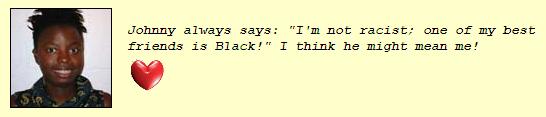
“Some of my best friends are black” is a phrase whites use to prove they are not racist. They also use it when they are about to say something racist: “Some of my best friends are black, but….” As if that gives them a green light to say any racist thing they want.
My first reaction is to doubt the quality of said friendships. But giving them the benefit of the doubt, it has become clear that black friendship has little effect on white racism:
A white Boston police officer said this in an email about the arrest of Henry Louis Gates, Jr, a black Harvard professor:
If I was the officer he verbally assaulted like a banana-eating jungle monkey, I would have sprayed him in the face with OC.
Later he said in his apology:
I have so many friends of every type of culture and race you can name and I am not a racist.
A white high school student who went to a whites-only prom did not think he was racist either:
I have as many black friends as I do white friends. We do everything else together. We hang out. We play sports together. We go to class together. I don’t think anybody at our school is racist.
A white commenter, the first I kicked off this blog, only called black commenters names, never white ones. To one black commenter he said:
That’s right. Go play on train tracks and get hit by a train. No one wants you alive.
But he did not think he was racist either. To prove it he said:
Oh and by the way, four of my best friends have been black… My brother is married to a black a girl, too. So you really have no argument kiddo.
If anything the black-best-friend argument shows that the speaker does not know much about racism and is blind to it.
I used to think that whites who marry black or live in black neighbourhoods were not all that racist. But even that is not true! While they do tend to have less stereotyped views of blacks, they still hold onto their sense of whiteness and the racist views used to defend it. They still see things from a self-serving white point of view.
Come to think of it, even blacks can be racist against blacks!
So having a black best friend proves little.
Racism in America is built partly on a separation of the races and the stereotypes that fill in the lack of first-hand experience. Like the sea monsters on the old maps of the Atlantic. A black best friend can help remove some of those sea monsters, but not if you think your friend “is not like other blacks”.
But more than stereotypes racism is also built on the need for whites to feel good about themselves living in an unequal society where blacks get screwed. Black friends, neighbours and lovers will not make that need go away.
Writing this blog for over a year now has helped me become much more alert to something that most white Americans rarely notice, let alone think about -- the social fact that they and other white people are just that, "white."
For example, as I watched the latest edition of "Target Women with Sarah Haskin's," in which she critiques the depictions of "Doofy Husbands" in TV commercials, I did take in the humorously insightful feminist message. But as I did so, I also kept a close eye out for any husbands, or other family members, who were not white.
For those who understand something about how whiteness operates in American society, a basic truism is that, as Toni Morrison succinctly put it, "American means white." The ordinary, normal, all-American person is typically imagined in countless situations and circumstances as a white person.
That generalized norm can be broken down further. An "all-American" girl, for instance, is in most American imaginations a white person, as is an "all-American" boy. And, as Sarah Haskins' video suggests, a competent wife and her "doofy husband" are both very white conceptions as well. To my ear, that adjective, "doofy," sounds very white as well. Middle-class white, actually (I have working-class relatives who use other words to describe clumsy or useless husbands).
Here's my count of this video's racial landscape:
total white doofy husbands: 23 total non-white doofy husbands: 0 total white media analyzers (i.e., Sarah Haskins): 1 total non-white media analyzers: 0
I do my best to avoid TV commercials, so I'm not sure about something here -- is this 23:0 ratio in terms of race a function of TV commercials, or of the people at Current TV who put together this video with Sarah Haskins?
Either way, this norm of a doofy husband and his recognizable, "normal" family exist in an overwhelmingly white universe. A universe increasingly at odds, of course, with reality; white Americans now make up about 70% of the population, and within several decades, as we hear more and more often these days, they will no longer be the majority.
How long will this fantasized, unmarked, hegemonic norm of white centrality persist?
One thing that might hasten its decline is for white people to simply notice and label whiteness more often. Would it not, for instance, make for a more insightful comment on TV commercials if Sarah Haskins had talked throughout this video about, instead of "wives" and "doofus husbands," "white wives" and "white doofus husbands"?
This is a guest post by Filthy Grandeur, who writes of herself, "I'm a writer still trying to figure out what I'm doing, so I'm trying to do a lot of different things. I'm a daydreamer who hates being social. I'm afraid I fit the stereotype of angry, loner writer who enjoys sitting in the dark writing about things that piss me off."
No Safety for Racism
I work with one of those people who says racist things, but is clearly oblivious to her own racism. After all, she's perfectly comfortable speaking to other white people, nonchalantly exuding her ignorance with thoughtlessly racist remarks. She's referenced "the ghettos" with upturned nose, and in that non-thinking privileged manner, states that she stays clear of those places and those people who apparently choose to live there.
I've seen her jaw drop when I mention going home to the Detroit area, and seen her face twist into judgmental disgust at the mention that I listen to rap. I've heard that sneering accusation of, "Oh, so your brother thinks he's black."
But -- for whatever reason -- it seems her comfort level with me has increased, because today she insisted on telling me about how an obnoxious black girl (she made a point to specify) was acting "disgraceful" at a public pool, apparently ruining her and her boyfriend's good time. I interrupted her, and said that in no way is the girl's annoying behavior attributed to her skin color -- but she was hearing none of it. I don't think it really even registered in her mind that I, a fellow white woman, could be offended by what she was saying about an annoying young black woman. Despite my interruption, she continued: "I mean, don't black people know how to behave? Why do they act like that?"
Now, another co-worker was witness to this story, and he said nothing. We both sort of gave each other that awkward look before walking away into the next aisle. I figured interrupting her didn't work, so I'd try ignoring her. But that didn't work very well either, and she kept on with her racist rant until the subject was changed.
This exchange reminds me of something I read recently at Fugitivus:
Now anybody who’s been in a school setting knows that you do occasionally run into students who drive you up the fucking wall. But anybody who’s been one form of privileged class or another also knows (if you don’t, think on this some) that if that person who drives you up the fucking wall is black/gay/female/feminist/(insert minority label here), their otherness becomes one of the things that drives you up the wall. Instead of being a person who you thinks speaks uncomfortably loud, they become a loud black person, a shrill woman, an in-your-face gay person. Their minority status becomes an integral part of what they do that pisses you off. I’ve done this, you’ve done this; let’s not fuck about.
Why do we do this? Because it's easy.
As for the other co-worker who also heard her ignorance? I mentioned it to him later, when she wasn't around. I told him how uncomfortable she makes me, spouting her racism without thinking or caring that I might be offended. He told me he finds it offensive too, but just ignores it.
Well, that's too easy. I am normally quiet and reserved, but I've resolved that I might as well speak up -- she seems comfortable saying these things around lots of people at our workplace, even a couple managers, and no one says a damn thing (guess what? I work with a bunch of white people). If we're ever going to achieve this "post-racial" ideal, then we need to challenge racism -- point it out, expose it. We can't be afraid of confrontation. I think part of this silence is that since this is a majority white workplace, no one wants to be the "odd" or "sensitive" one by pointing out another white person's racism -- I mean, there's no POC around, so who's offended, right? But that shouldn't matter. People need to know that racism is not appropriate or acceptable anywhere at any time in any company. Ever.
I'm tired of this "safe" feeling white people get when they're in the company of other white people, where they whip out their racism and prejudices in a blinding example of their white privilege. I want white people to lose that safe feeling. I want them to stop and think about what they're planning to say, and then not say it because they know it won't be tolerated. Because they know it's ignorant and hateful and racist.
Ignoring it won't make it go away. Which is why I interrupted her, and why, when she decides to say something else racist (from her record, I know she will), I will confront her, and tell her I am offended, and what she's saying is racist and ignorant and I shouldn't have to deal with that when I'm at work. And I'll probably be accused of oversensitivity, but that's okay, because maybe I'll make her as uncomfortable as she makes me, and it'll eat at her until she realizes that she's wrong; and if not, at least she will know that I will not be party to her ignorance, despite what she thinks my skin-color represents.
Personally, the writer of this book would rather see his race and his civilization blotted out with the atomic bomb than to see it slowly but surely destroyed in the maelstrom of miscegenation, interbreeding, intermarriage and mongrelization. The destruction in either case would be inevitable -- one in a flash and the other by the slow but certain process of sin, degradation, and mongrelization.
On August 6, 1945, the United States dropped an atomic bomb named "Little Boy" on Hiroshima, Japan. On August 9, "Fat Man" destroyed much of Nagasaki. An estimated 220,000 people were killed by those attacks, about half of them on the two bombing days. On August 15, Japan announced its surrender to the Allied Powers. So far, no other nation has attacked another with nuclear weapons.
In 1964, Stanley Kubrick released Dr. Strangelove, a scathing cinematic satire about the effects on global politics of something new in the world: "The Bomb." In Kubrick's view, the fact that humanity could obliterate life on earth with the push of a button made the whole idea of life on earth sort of absurd.
Also absurd, he realized, was something especially white American about The Bomb. In Dr. Strangelove, he emphasizes this whiteness with the character of Major T. J. "King" Kong, the pilot who guides the crew that drops the bomb that sets off a nuclear winter.
Kubrick highlights American whiteness by having Slim Pickens play Major Kong as a cussing, cowboy-hatted, good ol' boy, who mispronounces "nuclear" the same way that George Bush, Jr. did, and who rides the bomb on its journey to earth as if he's riding a rodeo bull.
With the characterization of cowboy Kong, and with that of Dr. Strangelove as a trusted, Nazi-worshiping adviser to U.S. President Merkin Muffley (both played by Peter Sellers), Kubrick satirized the ironic whiteness at the core of America's identity during World War II and the subsequent Cold War period. The irony is that while this white nationalist core helped to guide American policy both at home and abroad, American propaganda during World War II had emphasized the racist ideologies of Germany and Japan as fundamentally evil features of their "evil empires."
As Ken Cooper explains in an essay entitled "The Whiteness of the Bomb," various features of the American mindset that led to the dropping of actual nuclear bombs, on Hiroshima and Nagasaki, also reflected the general assumption that America was a "white" country. Because the Japanese were "non-white," dropping the Bomb on them wasn't as morally troubling to most Americans as it might have been. As it might have been, that is, if the question were instead whether to drop it on a "white" country.
In Hiroshima: Why America Dropped the Bomb, Japanese American historian Ronald Takaki writes about the man who made the final decision to destroy two Japanese cities, President Harry Truman. This was the same man who, when he was younger, wrote the following in a letter to his future wife, Bess:
I think one man is as good as another, so long as he’s honest and decent and not a nigger or a Chinaman. My uncle Will says that the Lord made a white man of dust, a nigger from mud, then threw up what was left and it came down a Chinaman. He does hate Chinese and Japs. So do I. It is race prejudice I guess. But I am strongly of the opinion that negroes ought to be in Africa, yellow men in Asia, and white men in Europe and America.
Elsewhere in his book, Takaki shows that while Truman did not order the use of nuclear weapons for the express purpose of killing Japanese people because they were Japanese, the fact that America and other Allied nations considered their non-white opponents subhuman clearly played a significant role in that decision. And thanks to the dehumanizing depictions of Japanese people in war-time propaganda, most Americans found the decision to target the civilian populations of two entire cities easier to accept.
As Ken Cooper notes, though, not all Americans were blind to the racism of dropping the Bomb on Japan. For instance, an editorial cartoonist for a leading black newspaper, the Chicago Defender, found it significant that right after the war ended,
occupying forces aboard the Mississippientered Japan with a Confederate flag flying and a band playing "Dixie." Langston Hughes wondered, by way of a conversation with his alter ego, Jesse ('Simple') Semple, whether America would have dropped the bomb on "white folks" like the Germans. Simple maintains that the United States has waited "until the war is over in Europe to try them out on colored folks."
Nowadays, it seems that the American keepers of the largest nuclear arsenal on earth still think of the Bomb in racial terms. While some non-white nations now have the Bomb, it would be useful to see the racial composition of nuclear arms bearing countries -- how many are primarily white versus non-white? Who has been "allowed" to have them, and who has done the allowing?
Apparently, among the many economic and geopolitical "concerns" of (primarily white) American leaders is the non-whiteness of those who might acquire nuclear weapons. Japan has not been allowed to have a nuclear weapon, perhaps because America fears retaliation, and George Bush breathed fire at "evil" North Korea when it threatened to build one (his administration later turned down the heat on North Korea, apparently because it went ahead and built one anyway).
The non-white countries of India and Pakistan now have nuclear weapons, as does the somewhat less non-white country of Israel, but they're American allies -- perhaps that's why drumming up a racist perception of them as a nuclear threat was therefore deemed unnecessary. The latest perceived non-white threat in these terms is Iran, a country that American leaders have lately been threatening to attack for the (perhaps ostensible) reason that it might acquire nuclear weapons.
Americans during World War II were likely more accepting of a Bomb drop on Japanese people than they would have been on German people because Japanese people were racially "different," and thus easier to dehumanize in propaganda efforts. Does today's new racist propaganda -- the endless stream of swarthy, grimacing, cartoonish Arab "terrorists" -- contribute to America's discontent with the idea of an Iranian nuclear state, by again dehumanizing an "enemy"?
As Americans remember the bombings of Hiroshima and Nagasaki and their people, will many at all remember how racist the decision to do so was? And how ironic and hypocritical that decision therefore was?
Here's something to look forward to, or not -- a movie coming out this fall, about a promising young black man taken in by a nice, conservative white family.
Looks like Hollywood's White Savior industry is branching out.
The Blind Side reminds me of Dedicated Teacher movies, especially the ones that depict a goodhearted white teacher wading into some urban decay and becoming an even better person. This happens when the white person convinces some dark kids that there's a whole world of opportunity just waiting for them out there, if they'd only realize that they're not really condemned to life in the ghetto. (For me, the classic of that white genre is the Michelle Pfeiffer vehicle Dangerous Minds.)
Here's a description of The Blind Side that appears at imdb.com, a description that I assume was supplied by the studio that made this movie. Notice the submerged racial assumptions at work here:
A disadvantaged teenager is taken in by a conservative family who see tremendous promise in the young man. Despite certain obstacles, the attention and inspiration he receives helps him mature into an athletically and academically successful NFL prospect.
Hollywood usually panders to its targeted audiences by regurgitating money-making characters and situations. If some of these are racist, well, what the hell, they still make money, eh? Or so the thinking seems to go. Or, maybe these moviemakers really don't realize that so many of their products are racist?
This is the kind of movie that brings tears to a lot of white eyes. But what do those tears really mean? What is it, really, that brings them on?
It's vacation time for me, so I'll be posting lightly for the next week or so, and with more excellent and gracious guest posters than usual.
As I travel, I will not be taking a break from thinking about and trying to counteract whiteness -- my own, and maybe other forms of it around me. My racial status follows me everywhere, but unlike many non-white people, I can forget that most of the time, if I want to. I can forget that as I'm out fishing somewhere, that somewhere is a place that my ancestors basically stole from other people, and that the theft was in part justified by an unwarranted belief in racial superiority.
I'll also be taken differently by others just because I'm white. When I vacation in The Great American Outdoors, almost all of the people I encounter doing the same thing out there, or working for those doing the same thing out there, are white. That won't even occur to most of us, but it will occur to me.
I'll also be welcome everywhere I go, in part because I'm white, and I'll feel I have a right to go anywhere I like, for the same reason. It won't occur to most of my fellow white vacationers that many non-white people would feel less than welcome in many of the places I'll be going, but that will occur to me.
As I'm fishing, it's not likely that I'll encounter any problems brought about by my being white. Since I'm not black, the lack of anxiety I feel about traveling probably stems from racially trouble-free experiences that go all the way back to childhood travels with my parents. Because I'm white, I have no memories of travel that compare to those recorded a long time ago by Countee Cullen, in his poem "Incident":
Once riding in old Baltimore, Heart-filled, head-filled with glee, I saw a Baltimorean Keep looking straight at me.
Now I was eight and very small, And he was no whit bigger, And so I smiled, but he poked out His tongue, and called me, “Nigger.”
I saw the whole of Baltimore From May until December; Of all the things that happened there That’s all that I remember.
Were I of, say, a traveling angler of Asian descent, I might have other things to worry about, such as roving gangs of white teenagers, who hope to find some fun in what they call "nipper-tipping":
Everyone in the area calls it the Blue Bridge. Formally called Mossington Bridge, it is a sturdy, small structure that leads to leafy and lavish Jackson's Point.
It's around these ostensibly bucolic parts that Torontonians -- Asians in particular -- have in recent years been driving up in droves to catch perch, rock bass or the occasional pike on Lake Simcoe's south shore. The angling here is best in the late evenings.
But the area around the Blue Bridge is one of those inevitable late-night magnets of teenage trouble that exist in almost any small town.
The long pier became the flashpoint of violence recently. Following three previous assaults involving Asians and anglers on a federally owned pier near the bridge, a confrontation last month left one young man in coma, another seriously injured and another in jail.
In reports that followed these events, an example of local vernacular emerged, a term teens in the area use to describe how they sneak up on Asian visitors, push them into the water and destroy their gear.
They call it "nipper-tipping" -- an amalgam of the Second World War-era epithet for a Japanese person and the practice of tipping over sleeping cows.
Outside a grim-looking tattoo parlour in the area, I asked a bunch of teenagers if any of them had ever heard of the phrase in question. One youth, who said the practice was for idiots, added he had seen it done to a white man.
Yet the impact of the "N" word has overshadowed the reality of the situation-- what residents say is a sense of lawlessness in the face of a day-tripping boom and bigoted, self-styled vigilantism.
In the past week, Mayor Robert Grossi, who represents the 42,000 residents in the area -- including the towns of Keswick, Sutton and Pefferlaw -- has been conveying his embarrassment to ethnic groups.
Still, he explained, racism is everywhere. "You can drill down into any community and find the same thing."
Though Mr. Grossi has been in serial-apology mode since the Sept. 16 attacks, there is evidence that not everyone in the town is so repentant.
Last week, swastikas, anti-Semitic and homophobic graffiti were spray-painted on houses and cars on a modest Keswick street. This week, just down the road at the Sutton District High School, a swastika was found on a wall and scrubbed off.
"It's seen as an isolated, singular act of mischief," said Ross Virgo, a spokesman for the York Regional District School Board. . . .
It may well be a great place to live, but there have been some, of late, who have found it not such a great place to visit.
Chinese Torontonians have been taking to local call-in shows, claiming that they have been victimized by Georginians.
One caller claimed he was threatened at gunpoint.
"What happens is locals see out-of-towners carrying coolers and coolers of rock bass, and they think it's coming from 'their' lake and that there are quotas," said Victor Wong, executive director of the Chinese Canadian National Council, who said there are no quotas.
"We really need a dialogue between the communities, and we're going to do that."
Maybe I should count my blessings because I don't have to worry about things like "nipper-tipping," nor other forms of harassment faced by non-white people in The Great American Outdoors.
I'll also be able to relax, if I want to, about the racism buried within the small, racially isolated, and largely white communities that I'll be passing through. Whiteness nurtured in relative isolation tends to be xenophobic in its own particular ways.
But then, I really can't relax about that anymore. As I've explained before, all-white places creep me out now. I know too much about how they got that way, and what kinds of racial attitudes fester in racially isolated places, and how non-white visitors could well be treated differently than myself.
At the same time, I'll be aware that merely being "aware" of these things isn't doing anyone but me all that much good. I'll most likely be riding the wave of my white, male, middle-class American privilege into a smooth, fun vacation, but couldn't I do another kind of vacation, one that somehow more actively counteracts such privilege?
Do any of you know of a better vacation for privileged people? for those among them who'd rather do something other than ride the wave comprised of their various privileges? I have family reasons for taking a fishing trip, but for future possibilities, I'd like to hear about options that are better in this sense.
And what about you? If you've done any vacationing this summer, was race a factor?
Actually, what I should ask is, how race is a factor. Because in anyone's vacationing experience, especially in the United States, it very likely is one.
UPDATE (8/23/09): Another maddening example of something that I don't have to worry about during my summer vacations: "76-Year Old MD Man Beaten While He Fished": Three white men shouting racial slurs beat a 76-year-old black man while he was fishing in a river early Tuesday, said Baltimore police, who were investigating the attack as a hate crime.
The assailants also stole the man's sport-utility vehicle, said Anthony Guglielmi, a police spokesman. Police caught up with the vehicle and arrested 28-year-old Calvin E. Lockner.
Late Tuesday, police said Lockner was charged with hate crime, attempted murder, first-degree assault and carjacking. During his interview with detectives, Lockner "admitted he does not like African-American people," Guglielmi said.
The person who posted this video on YouTube also wrote this about it: "Since the Harvard professor Gates says all black people are vulnerable in America, let's have some fun with that!"
The video is an attempt at humor, but I think it's humor with a point -- that is, satire. But then, I'm not quite sure what the point is.
What do you think?
For those who can't watch it, the video begins with a shot of Professor Gates explaining that his arrest made him realize how "vulnerable" all black and poor people are to "capricious forces like rogue policemen." Words are then superimposed on a freeze-frame of Gates that say, "Speak for yourself, Sissy . . . "
The rest of the video portrays a black man getting wired up for sound in front of a green screen by a white man. The black man gets nervous because he fears that the microphone wire will "shoot white people's instructions up my spine and take over my brain." He runs away and into a corporate setting full of white people, all of whom frighten him more and more. Especially when they turn into zombies, who say they want his "sense of rhythm," his "natural athletic ability," and so on. At the end of the video, the black man is found crouching and crying in a basement by another black man, who asks him what's wrong. He raises his head to choke out an explanation: "I see white people!"
Again, I don't think this video is just an attempt to "have some fun" with Professor Gates' point that black people (what happened to the "poor" people in his comment?) are "vulnerable." It's an effort to satirize that point, and to say that those who make it are paranoid "sissies." They must be sissies, you see, because white people (what happened to the "rogue policemen" in Gates' comment?) don't have anything against black people. I mean, come on, we're not like, freakin' flesh-eating zombies or something! Only a sissie would play the race card by claiming that in this post-racial society, things are any different for black people than they are for white people. Get real, bro!
By the way, this "humor" was produced by people working for an outfit with an explicitly political agenda -- Pajamas Media Television. This is the same crew that recently published an article by Roger L. Simon entitled "Gates and Obama’s nostalgia for racism." Simon's point is very similar to the one made by Pajamas Media Televsion.
Simon claims that all countries were racist in the past, including the U.S. However, because of its legacy of slavery, the U.S. has tried especially hard to eradicate racism, and it has succeeded. Nevertheless, some have found it difficult to accept this new reality:
. . . when the rules change, when values change, not everyone can adjust with it — not only the racist, but also those who depended on being victims of racism. For all his brilliance, Henry Lewis Gates is evidently such a man. Otherwise, why cry out about being victimized as a “black man in America” before there is any evidence that that is the case?
This is nostalgia for racism and our president probably suffers from it as well, although perhaps to a lesser degree, considering he clearly plunged into the fray without thinking [by saying that the Cambridge police acted "stupidly"]. The problem is that this nostalgia not only blames people unfairly, it also increases the very thing it pretends to oppose — racism itself. The unfair or inaccurate imputation of racism promotes racism.
This is, I think, a current, widespread conservative strategy for opposing a party that now has a black president. It has roots in real racism -- in common, long-standing white perceptions that black people are professional victimologists who can't think straight because they're so wrapped up in the past, and so on -- but I think there's something new about how this strategy is now playing out. In fact, conservatives seem to feel that they have to revamp their racial politics, because they're now faced with a black president.
Since we live in a society and power structure that is still, in an unspoken way, framed by white perceptions and attitudes, Barack Obama has continually backed away from contentious racial issues. I think he did so again in the Gates case, after initially pointing out, accurately, that racial profiling is still a problem, and I think he generally does so as a political necessity. And yet, conservatives keep stalking him with a giant tar brush, all the while claiming that he's the real racist.
The strategy now seems to be to convince America at large that racism is a thing of the past (and indeed, many white people do already believe that, and a few non-white people too), and that anyone who points to racism, of any sort at all, is therefore a paranoid race hustler. And more than that, not only are their claims that racism still matters unfounded -- to "cry racism" is itself racist.
I think this is what conservative crybaby Glenn Beck is basically up to, when he claims that Barack Obama is a "racist" with a "deep-seated hatred" for white people.
This is all sick, twisted stuff -- to not only deny a vast amount of evidence that racism still exists (let alone that it's a major problem), but then to add that those who point out that it does exist, and that it is a major problem, are doing so because they're nostalgic for the good old days of Jim Crow and slavery. And that they themselves are the "real racists."
I'm rarely speechless, but these claims, and the respectful attention they're given by the corporate media, are all just . . . wow.
Republicans are widely understood to be a largely white political party full of people who have little genuine interest in embracing people of color, the people that most Republicans suspect (sometimes unconsciously) are basically inferior, in a lot of ways.
Is this strategy -- of denying racial realities and trying to reverse things by affixing the label of "racist!" onto their opposition instead -- really going to work for them?
Here's a great moment from an old children's quiz show:
Go Jerry!
I've heard people of Asian descent, and especially people of various East Asian descents, referred to as "yellow." I also still hear such people referred to as "Orientals." In both cases, the speakers were older white Americans. Both usages should be at least as long gone and forgotten as the old TV show that this clip is from, but they're not yet.
I also found this exchange in the comments at YouTube interesting:
m4lvolio (2 days ago)
That asian kid is gonna go brucelee on his [sic] ass after the show.
rathrio (1 day ago)
you're as cliché-oriented as that little girl is.
m4lvolio (1 day ago)
The only difference being that I did it intentionally, as a joke. It kinda ruins the fun when you have to explain something like this.
"Ruins the fun"?
m4lvolio doesn't seem to realize that while acting racist in a joking, ironic manner may seem "fun," it's still racist. Not to mention, as rathrio points out, cliché oriented.
Some still wonder if "yellow" is a racist term. They should ask the Israeli Ambassador to Australia about it. In 2006, Naftali Tamir was "recalled" from his ambassadorship for making this loaded comment:
Israel and Australia are like sisters in Asia. We are in Asia without the characteristics of Asians. We don't have yellow skin and slanted eyes. Asia is basically the yellow race. Australia and Israel are not -- we are basically the white race.
Speaking of quiz shows, here's a quiz for this blog's many smart readers -- why is referring to people in racial terms as "yellow" considered racist, and yet, doing so with the terms "black" or "white" is not considered racist?
h/t: Angry Asian Man; the YouTube commeters write that the program this clip is from was aired in New Zealand in the 1980s, and was called "W3."
What would you do if a neighbor of yours put up a sign like the one that this woman has prominently displayed on her house?
I know what I would do -- call CNN and have them send out a reporter!
Actually, although I meant that last sentence facetiously, alerting the local and national media does seem like a good idea. Maybe CNN's report will bring enough attention to this sign to get that woman to take it down.
(For anyone who can't see the video, it's a brief report about a woman in Texas who has a very visible sign on her house that reads "HISPANICS KEEP OUT.")
Aside from what you might do if this were your neighbor, what do you suppose your neighborhood in general would do? Would they, like this woman's neighbors, decline to make any official complaints, because putting up with her sign is their way of practicing "tolerance"?
Is practicing tolerance for such intolerant speech really "tolerance"? I guess it is, technically, but it's not my kind of tolerance. Anyway, I don't even care much for the notion of tolerance itself in these matters -- what are really you saying about someone when you say that you're willing to "tolerate" them?
In a situation like this, if you or your neighbors were not Hispanic, would you or they find ways to reach out to any Hispanic families in the neighborhood?
This incident also makes me wonder about the dividing line between protected "free speech" and unprotected "hate speech." "Speech" of this sort -- not only things people say, but also what they display on signs, bumper stickers, t-shirts, coffee mugs, and so on -- often gets defended in the U.S. as "free speech." When Americans do that, they're basically saying, "Hey, you may not like it, but it's a free country. People can say whatever they want."
But if this kind of racist, hateful speech is protected by the United States' First Amendment, what kind of racist, hateful speech is not protected by it? I mean, how much worse than this woman's racist, highly visible sign does it have to get before such speech can be shut down?
My understanding is that for one thing, hate speech is not protected if it clearly and directly seeks to incite some sort of violence. But if that's the dividing line, isn't the definition of "violence" rather open to interpretation? If I saw such a sign in my neighborhood, telling Hispanics or any other group of people to "KEEP OUT," I'd consider my having to see it every time I go for a walk an act of violence. Not to mention the painful effects it would have on any non-white people driving by, or living in the neighborhood.
And surely this sign does encourage violence against any Hispanic families that might live in the neighborhood. But then, I suppose, it doesn't explicitly, directly encourage such violence. It just orders them to "KEEP OUT," as in, "stay off my property." It doesn't tell Hispanics to keep out of this neighborhood or town, although the "tolerance" of the neighbors for her sign may well do that.
Maybe the best cure for hate speech of this sort is, as they say, more speech. (Maybe that kind of cure should be called "love speech.") Should neighbors who find this woman's free speech a distressing, injurious disgrace find ways to drown hers out? Maybe by putting up signs of their own?
HISPANICS WELCOME HERE! EVERYONE ELSE TOO!
Maybe someone should print up a bunch of signs like that, and then go to that town at three in the morning, and stick one in everyone's yard (including this woman's, of course). Then come back in a day or two and see how many are still there.
That might also give a better idea of just how "tolerant" this neighborhood really is. And who knows, it might be even help to make it more tolerant.
This is a guest post by The Witty Mulatto, who blogs at Madness To The Method. She writes of herself, "I'm a piano student and radical left-wing critical race theorist in Our Nation's Capital, which is a good place to be both those things. Also, I'm a drag king. It doesn't get much cooler than that."
What do you think of when you hear the word 'diversity'? Maybe some multi-colored hand-holding? Maybe a bunch of happy children of all races and colors cavorting in rainbow shirts?
I’ll tell you what I think of when I think of diversity: I think of white people. Which is funny, because that’s exactly what you’re not supposed to think of when you think of diversity. But it’s true.
‘Diversity’ should be number one on the list of White People’s Favorite Words. It’s a word that people bandy about when they’ve noticed that their organization is overwhelmingly white, but aren’t really sure why or what to do about it. In the words of a former teacher of mine (one of the few clued-in white people I know), “Diversity basically means ‘let’s talk about black people’.” He means that when people speak of ‘diversity’, they rarely get to the meat of things.
White people’s idea of diversity is skewed. Like the aforementioned kids in rainbow shirts. That’s a freaking melting pot, is what that is. Heads up, gentlemen: only white people talk about a melting pot like it’s a good thing. Though they don’t mean it to be, ‘melting pot’ is synonymous with ‘assimilation’.
In a white organization's eyes, no “diverse” place is complete without a white woman, a Latino, an Indian, an Asian person, a Muslim, some Black folks, a gay man, a person in a wheelchair, and an old person. Preferably in cultural garb where applicable. This “collect them all” mentality actually takes away from diversity. What impact is one Latina gonna have in a roomful of non-Latinos?
Inevitably, this is an unintentional form of an old white standby: divide and conquer. And the end result is that once again, white people get the largest representation. The organization is still overwhelmingly white, even when they are technically outnumbered by POC’s.
Not only that, but white people also think an organization can’t be diverse without white people. I know this because I go to Howard University, the top Black school in the nation. (The only time I hear anybody say ‘diversity’ there is in the context of the white students.) On at least three separate occasions, white acquaintances have asked me if it bothers me to go to a school where there’s so little diversity. I’m like, “Yeah, it would bother me if I actually went to a school like that.” I mean, Howard’s got people from all fifty states and at least a hundred countries. We have a sizable African community and a giant Caribbean community. We have Latino and Asian students. We have more lower-class students than white schools do. But, because most students have black skin, most white people think that cannot possibly be “diverse”.
But the thing that really gets me about 'diversity' is that it’s such a euphemistic word. I hate it when people scoot around race. If you weren’t raised or immersed in American culture and ways, you would have no idea that when people say diversity, they mean race. Yeah, they throw in gender (meaning white women) and orientation (meaning gay men) every so often, but really mostly it’s about race -- and yet the word of choice is diversity, not race, as if race is a dirty word. I am continually and completely amazed by the complicated dances Americans perform around racial issues without even knowing it. ‘Diversity’ is just a header -- there’s a whole list of vocabulary that’s required to perform those dances.
White organizations everywhere create entire commissions and councils surrounding diversity. Their mission statements usually say things like, “We believe the University environment is greatly enriched by the presence of people with diverse backgrounds and cultural perspectives.” They have a lot of pretty words. But what they really mean is, “How can we reach out to people of color and make them want to join our organization?”
The question that logically comes next but is rarely asked is, “Why would people of color WANT to join our organization?”
If you asked THAT question, things would get interesting.
I had this experience when I first decided to get socially/politically active. I knew vaguely what I wanted to see happen, but I didn’t know the first thing about how to go about it. So I joined an organization I had read some about in my historical research: the National Organization for Women (NOW). (I didn’t know that they were once anti-dyke under Betty Friedan.)
NOW was thrilled, absolutely thrilled to have me. For a couple of months during my freshman year I went around campaigning for abortion rights. I carried signs. I even got to meet Hillary Clinton. (It was back when I still considered myself a Democrat, so I was elated.)
But something creeped me out. I knew it had something to do with the lack of POC’s, but that wasn’t all of it. I couldn’t put my finger on it at the time. Now, as the radical analyst that I like to be, I can jam my finger straight into its fleshy white stomach: NOW only wants people of color on their terms. Sure, they wanna hear what we have to say, but when it comes to making policy, you better be on board with them. They used to ask me, you know, “Why aren’t other Howard students interested in NOW?”
Because NOW doesn’t represent us. White organizations don’t want to represent people of color; they just want to include them.
So in a way, ‘diversity’, like ‘melting pot’, is just another word for ‘assimilation’.
Whenever somebody says that word, you can bet white people are calling the shots.
If you're a "white" person, what color are you really?
When I hold up my hand, or look into a mirror, I have to think beyond my fictional "whiteness" to see what color I really am.
My skin is not the color -- or lack of color -- of a piece of paper. I am not, literally, "white."
When I try to discern and label accurately the color of my skin, I come up with "pink, but then, kind of beige, too."
I'm a little darker in some places, a little lighter in others, but nowhere am I really "white."
I remember being in a used bookstore once and flipping through a book by Clarence Major called Black Slang: A Dictionary of Afro-American Talk. I was struck by the definition for the word "pink."
Now I can find this dictionary again on Google Books and easily look up that entry. So here it is:
Pink: (1900-40s) white person.
Major also included this, as the next definition:
Pink chasers: (1900-40s) black people who deliberately cultivate friendships with white people.
For several centuries now, "black" people have been pressed into daily contact with "white" people. As I've gradually come to understand, this proximity has afforded black people all sorts of secret knowledge about their supposed betters. That's obviously true of other groups excluded from whiteness as well, and I sometimes wonder whether different groups have gathered and shared among themselves differing examples of such subordinated knowledge.
Surely this usage of "pink" was something that black people carefully avoided uttering aloud whenever a white person might hear it. So what did its covert usage signal, or imply?
Maybe to call a white person a "pink" meant, in a deceptively simple way, "They may call themselves 'white,' but that's not what they are."
I like to think -- without actually knowing whether it's true -- that this common black term for white Americans signaled an oppressed people's collectively private recognition. This would have been the recognition of a singular, unwarranted, and really rather ridiculous arrogance among their self-appointed betters.
If the term "pink" was used to point out that those so-called white people are not actually "white," but closer instead to "pink," then racial whiteness itself was exposed as a fiction. And then, so were the presumptions of a people who had arrogated to themselves -- and thereby implied the opposite about others -- the pure, clean, unblemished, and uninfected connotations of the word "white." A word that falsely denotes a lack of something that the skin of so-called white people actually does not lack: color.
In other words, maybe black people called white people "pinks" because they knew that white people are delusional. I know that I am, because when I look in my bathroom mirror, I don't see my actual color as any particular, actual color. As I said above, I have to think about it, and then I'll think, and see, colors like "pink," or "beige," or during the summer, "tan."
And then when I step out into the world, if someone were to ask me what "color" or "race" I am, as various authority figures and official forms have asked me before, a false reality to which I normally subscribe would reassert itself.
I would say, in the usual, deluded manner of my tribe, "I'm white."
This is a guest post by Gary Collins, a white male, 25 years old, who lives in Brooklyn, New York City and produces short films for The Department of Public Subversion.
Michael Bay presents . . . The New Face of Black America
“If God made us in His image, who do you think made them?"
In the new Transformers: Revenge of the Fallen, the single black (human) male of the cast, USAF Master Sergeant Epps (Tyrese Gibson) utters that line by way of introducing the movie's towering title characters. It's a question that's perhaps more interesting than intended, given how unapologetically racist some of these new transformer personalities are. As for who made them, I blame the surrealistic but unwittingly white-minded director, Michael Bay, who presents throughout the movie a sort of minstrel laser light show.
Back in the summer of 2007 I decided that I would not be lured back for a second helping after my disappointment, as a fan and as a sentient human life form, over the first Transformers film.
Early reviews of the second installment promised more blacked-up robots, and after reading them I suddenly felt a responsibility to participate in the conversation. After all, discussion is a healthy step toward accountability. The reviews referenced the unnecessary racializing of superior alien beings traveling time and space to knuckle up on Earth. People talking about race is a good thing, but then, this is just a story about a space robot smackdown, right?
On opening day, a friend and I stood in a line stretching out of the theatre to the sidewalk in downtown New York City. Inside, an enthusiastic crowd of couples, families, and fanboys filled cinema four.
Throughout the show, the audience in the theatre was clearly satisfied, and I too was not above appreciating the entertainment objective of the filmmakers. My friend and I cheered along as Optimus Prime, the benevolent leader of the human-embracing Autobots, fought the good fight to save mankind from the Evil (capital E!) Decepticons.
But then, darkness (as it were) descended -- we became outnumbered in our section by laughs when the ridiculous twin Autobots, Mudflap and Skids, periodically rolled into the spotlight.
Think Jar Jar Bots. Remember the crows from Dumbo. Think Amos 'n’ Andy Meet R2D2 'n' C3PO. Picture an 11 foot, 1.2 metric ton, anthropomorphized Chevrolet with googly eyes, a protruding gold tooth, and an ape-like strut, spitting out "ghetto" slang. Now picture two of them, talkin’ that jive. By which I mean they 'gun on' one another, insulting their mutual inadequacy, their shared ignorance; it’s the incessant chattering of the monkey mind. The inflection is insulting to anyone with even a basic understanding of what a racist stereotype is. The attempt at humor is uncomfortable and not in any way suggestive of an enlightened wit on the part of its creators. These absurdly ghettoized characters add nothing to the story, except to provide some light moments between the 'splosions.
Director Michael Bay has defended Mudflap and Skids, claiming they "make the story more accessible to kids."
Yes, that’s right, he's coming for your kids. Did I mention that Tom Kenny provides the voice for Skids, the robot with a single gold tooth? He's Sponge Bob Squarepants.
A black couple in their early thirties to my left chuckled when the twins protest a human's suggestion that they even know how to read. Super-advanced alien robots with impossible amounts of moving parts and processing power. . . but they don't know how to read. Not that they can't, not that they're incapable, but they simply have not yet taken the opportunity to download that application. Because, you see, they're black-ish, which I guess means that when it comes to some important things, like say, reading, they’re too lazy to get that going for themselves. They talk black, they walk black, and they're even on CP Time -- they show up late for apocalyptic battles.
Mudflap and Skids mostly lope around behind the more important characters, mumbling constantly with unsubtle, "ass-bitch-shi-mutha" interjections.
Reno Wilson, the voice of Mudflap, suggests in his own interpretation of the characters, "It's an alien who uploaded information from the Internet and put together the conglomeration and formed this cadence, [this] way of speaking and body language that was accumulated... and that's what came out. If he had uploaded country music, he would have come out like that."
Wilson added, rather improbably, that he never imagined viewers might consider the twins to be objectionable racial caricatures. Nevertheless, Michael Bay unpacked his action figures and built some straight up hood rats. The result is a steady stream of ignorant, bickering, hateful epithets, puked out onto the audience in the name of comedy.
And black minstrelsy isn't the only sort on display; there's a heavy load of brownface too. The twins take particular issue with the human protagonist's roommate and unhappy sidekick, Leo Spitz (Ramon Rodriguez), the film's representative Latino and Conspiracy Theorist. The Latino family in our section, two generations deep, roared as Skids suggests, in a moment of frustration, "Hey! Let's bust a cap in [Leo's] butt!" And the collective audience of the entire theatre released a wall of audible approval later in the story when Leo admits, ashamed, "I think I'm having a nervous breakdown. . ." In response Mudflap suggests, "That's cause you're a pussy!" and then, to Skids, reaches out for the unspoken bond of a knuckle five.
Following in an American cinematic tradition that just won't die, these two black characters are left for dead. Mudflap and Skids are simply tossed off after their usefulness has been consumed, much like the Mandingo Autobot Jazz of the first Transformers installment, a breakdancing black gangster robot, and subsequently the first to be ripped apart. It's suggested that they're merely unconscious with battle fatigue, but the storytellers give no definitive explanation. "Who cares?" the message seems to be, "they're just the black comic relief.”
Nevertheless, I couldn't help but notice that the packed, multicultural, multiracial opening-day audience seemed to enjoy the entire spectacle very much, spilling out of the theatre with an energetic buzz. Aside from the surprise my friend and I shared, there didn't seem to be any murmuring or confusion, no sort of indignant "did you catch that?!" that another friend of mine reported experiencing throughout the film when he saw it two weeks later at the same crowded theatre.
I was left to wonder, had I experienced a sort of opening-day audience solidarity? Had we seen it all before, too often, to expect better, and instead thoughtlessly appreciated what’s really a terribly pandering movie? Or worse, is it what we knowingly came and paid and gave our time to absorb, digest, and take home with us, in our brains, in our kids?
For me the answer is, "Certainly." It was what I had read about and what I was expecting. I still can’t really believe just how far they pushed these ideas without the studio, Paramount, putting a stop to it.
Most of the frame is dedicated to the relentless spectacle unfolding, really beating down on the audience with sensory over-stimulation. As viewers go along for the roller-coaster ride, they should keep in mind then that the storytellers garnish this beast with homophobic, racist, misogynistic, militaristic content, portrayed as comedic entertainment to benefit you, the audience.
They expect you to appreciate it, to laugh at it, in those moments when you come up for air. Especially if you're white.
This is a guest post written for swpd by bookpenporch, who describes herself as a writer and graduate student based in the U.S. Midwest. She reads, writes and thinks about growing up in the rural U.S. South, and about race in literature and public discourse.
At my undergraduate institution in the U.S., 60% of the students “study abroad.” I was among this 60%, studying history in Prague and Shakespeare at Oxford. At some point, consciously or unconsciously, I did many of the things that make people in Europe annoyed with U.S. American college students: I made too much noise in my residential apartment building, refused to attempt more than a few words in the national language, and ate pizza and McDs instead of potato dumplings and blood sausages. I wasn’t the worst, though, and I knew that the less noise I made, the more I would learn, and the more respectful I would be of the people around me who happened to live in a popular tourist spot for privileged U.S. students.
Some of my college friends went to countries and cities in impoverished regions of the world on their international trips. Some had grants, some had Daddy’s Amex, some were conducting research, some were with NGOs, church missions groups, medically-focused non-profits, but almost all had a need for an interesting grad school essay or job interview topic.
And, like me, all of them returned to the U.S. with hundreds of pictures to post on Facebook. My pictures were of the ridiculously beautiful architecture in Prague and Oxford. Cultural appropriation, check. I was taking such photos from a position of privilege, but the friends and classmates I mentioned above came back with pictures that somehow grated on me much more than my 50 shots of the Charles Bridge.
You see, these pictures -- and there are hundreds of them on Facebook, and elsewhere on the net -- feature adorable children. Real children. Children that bear no relation to the owner of said picture. Children looking lost or reluctantly smiling at the beaming white person that, so this white person would like to imagine, Saved Them From The Jungles/Deserts of Africa/the Caribbean/South America/Southeast Asia. You know, for a week. And then left for a day of lounging on the country’s beautiful coast, and then for a cushioned airplane seat, and then for a comfortable desk in an air-conditioned home, where they uploaded the pictures of the poor, poor children whose lives they changed forever in just one day/week/month.
And it’s not just college students. I know many working adults who do this, too.
Wait a minute, you might say, that’s harsh. They were probably delivering medical supplies, building a school, delivering mosquito nets. Surely these photos are not evidence of a thinly veiled excuse for an “exotic” (ooh, there’s that word) vacation; this is philanthropy, global community service, not a tourism trend!
Don’t worry, I know that nonprofits sometimes perform wonders. My own husband is a medical professional engaged in public health research. Good people with good intentions often do good things for others. Got it.
But I sometimes want to say to such travelers, try to turn the tables for a moment. Imagine that a stranger that does not speak your language walks into your community and starts taking pictures of and with your cousins, the kids you babysit, and your own little ones. Also, imagine that this stranger is well dressed and the kids in your neighborhood do not have shoes. And then imagine that these pictures of your children will be posted online for everyone to see, but you don't have the internet. Nor a camera for that matter.
Then, imagine that these strangers taking pictures would feel some sense of nobility, of self-worth, of an earned knowledge about your community and life, just by owning and displaying said pictures.
To most if not all white folks reading this, and maybe even to most U.S. Americans, this reversed scenario is almost impossible to fathom, and even brings to mind the number for the local Neighborhood Watch and NBC’s “To Catch a Predator.”
Speaking of white folks, how many times have you seen a picture of a person of color with his/her arms around destitute white children in Eastern Europe? Hugging white kids at a free clinic in rural Kentucky? A white person holding a cute Parisian child she saw on the street during her business trip to the City of Love? If these pictures are out there, I haven’t seen them.
Why, faithful readers of this excellent blog, do white folks travel to exotic locations, meet adorable children, and shoot them? Is this trend, in fact, another example of the stuff white people do? I’ll offer a few reasons why I think it is, but I’m mostly interested in what you think.
Here are my thoughts:
Appropriation and exploitation -- As a white person living in the U.S., it is not only my privilege but my feel-good habit/hobby/vacation option to swoop into a country about which I know nothing, drop a few boxes of shoes, take pictures with children while their parents/aunts/cousins/grandparents watch, and to in the process somehow claim these children as my own. I vicariously experience their suffering, capture it in a still frame, and somehow feel more alive in my neoliberal, disconnected, consumerist living experience. I, the almighty white woman, have been to Africa and nursed her children out of the throes of malnutrition and disease. Her children are my children. Madonna, meet Malawi.
In these photographs, children are exploited to build social capital. It is so last year, so K-mart middle America to take a vacation; real liberals wouldn’t do that. I can’t help but think of the commercials for Sasha Cohen’s new movie, Bruno, in which he adopts an African baby because Angelina and Madonna have one, and in which he also states, “I’m really into issues. Darfur’s a big one. So what’s next, what’s Dar-five?” Your “experience” in South America can become just another item to check off the bucket list, a line on your resume, fodder for a great graduate school application.
Assuagement of our dear friend, White Guilt -- Sometimes I think this phenomenon is another one of those things we white folks do to feel better about our privilege, a visual reminder that, though we might not be able to do much about the fact that we like our Nikes and we like them cheap, we can sleep in the only concrete room in a village for a week, drop a few boxes of malaria meds, and call it even. And even come home with invaluable souvenirs to remind us of just how much those sweet little children looked up to us! I have four cars while a billion people (most of whom don’t happen to be white) on the planet are starving, but I went on a missions trip, and look how happy I made this malnutritioned little boy!
All of the above reminds me of the quote that macon borrowed about a year ago for a rather similar post, from bell hooks’ essay “Eating the Other”:
The desire to make contact with those bodies deemed Other, with no apparent will to dominate, assuages the guilt of the past, and even takes the form of a defiant gesture where one denies accountability and historical connection. Most importantly, it establishes a contemporary narrative where the suffering imposed by structures of domination on those designated Other is deflected by an emphasis on seduction and longing where the desire is not to make the Other over in one’s image but to become the Other.
And yet, in these photographs one doesn’t just become the Other; s/he becomes in a sense the source of the Other, the womb from which the life of the Other springs, the nurturer, protector, guardian and savior of the Other. A white woman holding a Honduran child like she conceived, birthed, and nursed him assuages white guilt. It also exploits the Other by reestablishing the hierarchy in which white people are the source of all that is good in life, including both the poor, suffering, adorable Other-child, and the aid that will end his/her suffering.
I'm sure that by now, most of my readers have heard about the arrest (and subsequent dropped charges) of the most famous black professor in America, and perhaps the whole world, Henry Louis Gates, Jr.
Given my blog's topic, what interests me as much as the question (which to me is not a question) of whether his arrest was racist, are the reactions to it that I'm hearing and reading from white people. Those who seem to know a thing or two about how racism really works in America are mostly either as outraged as I am, or withholding complete judgment until more facts come in.
Many others, though, seem to lack the understanding that because they're white, they'll simply never know what it's like to be black in America. To have to be aware of that, so much of the time, while navigating largely white spaces. Like say, a wealthy neighborhood near Harvard University. Even if it's your own damn neighborhood.
So, you finally pull up to your house after a fifteen-hour flight from China, and then your front door is stuck. Damn! Then you ask the man who drove you home for assistance in getting it open, aware as you do so that your white neighbors' eyes are probably on you, feeling physically exhausted from your travels and now suddenly tense about this damn door. Eventually you manage to get inside, and then a police officer is knocking on the door and expressing doubts that you're the real resident of your own house! When you go to get the ID that he demands, he follows you inside, and when you show it to him, he turns around to leave with nary a word, let alone a respectful or regretful one. And then when you get to your front door, you see a whole bunch of other police on your doorstep!
Well then, after all that, who wouldn't start yelling things about what so often happens to black people in America? (Assuming he actually did start yelling -- it does look like he was yelling after getting handcuffed for being "loud and tumultuous.")
But here I am as I write this, imagining what it must've been like for Professor Gates that day. I think I should stop right there, and I probably should've stopped sooner. I should stop because I'm white, and he's black, and I'll just never know what such moments are like for black people.
So I shouldn't say, as a lot of white people are saying, that Gates should've shown some restraint, and then everything would've been all right. Or that the actions of the police had nothing to do with his being black, and that he should've instead been "grateful that somebody was investigating a possible break-in at his home." Or that his acting in any other way than completely calm and obedient was what caused his arrest for "disorderly conduct." Or that he probably made a ruckus because he knew it would get national attention, and so he "played the race card."
Because I'm white, I shouldn't say things like what this white columnist says, in a completely white-framed discussion of the arrest of Dr. Henry Louis Gates, Jr.:
This doesn't appear to be racism. It sounds to me like a colossal case of extraordinarily bad judgment on the part of a distinguished African American historian who happens to teach at Harvard, and who certainly should've known better.
That right there. That too is so white, isn't it? Talking about a black man with a PhD, a Harvard professorship and a mile-long list of accomplishments about how he "should've known better." Talking about him like he's little more than a child.
To think that if I were in a black man's shoes in a moment like that, I would act differently, more "sensibly," seems ridiculous. To think that my perspective is basically the same as his. To think that I could really have much of any idea at all what it's like to be black in such all-too-familiar (for black people) moments. And yet, I think we white people do that all the time.
Having read the police report and a lot of insightfuldiscussions of this event, it seems very likely to me that the police did act in racist ways, whether consciously or unconsciously. And then, so did a lot of white people when they heard about this event, as they also do when they hear about others like it.
I think that the moment when their racism kicks in, and causes them to say naive, foolish things, is right when they think they know what that would be like, because they're basically imagining themselves in that moment. But then, because they're white, they really have no clue about what it's like to be on the wrong side in such moments. And so, they should stop thinking and talking as if they do.
 (source: Black People Love Us!)


