In her book The Rooster's Egg, legal scholar Patricia J. Williams offers several examples of the ways economic class matters when white people assess their black colleagues and acquaintances. More often than not, she observes, white people force black people into neatly compartmentalized categories of class.
In one instance, a candidate for a high Massachusetts public office publicly asks why he should bother to go campaigning among the "welfare mothers and drug addicts" of Roxbury. Roxbury, however, is not the decrepit ghetto of his fantasy; it is, in fact, a fairly sedate, middle-class black community. . . .
White people are often invested in the myth that African Americans are either impoverished or belong to an elite of celebrities, politicians, and athletes. In this mythic, either-or view of black life, African Americans are rarely understood to share the middle- and working-class allegiances of most whites. Such myths about race and class selectively come into play to disguise or justify negative or ambivalent views of blackness.
Well-meaning white people, trying to fit their black acquaintances and colleagues into "some preconceived box of blackness," often search for the ghetto child behind the successful adult. The writer and editor Brent Staples, for example, suspected what he was really being asked about his past when he was interviewed for a job with The Washington Post: "[The interviewer] wanted to know if I was faux, Chevy Chase, Maryland, Negro or an authentic Nigger who grew up in the ghetto besieged by crime and violence. White people preferred the latter, on the theory that blacks from the ghetto were the real thing."
Williams herself remembers being asked about her background by one of her white students, culminating in the bizarre question of whether the house she had grown up in was freestanding.
The comforting idea of the black middle class--an amorphous designation into which other economic categories of black life in America, from working class to wealthy, are merged--allows white people to distance themselves from their own racist feelings. White people often think that middle-class blacks no longer suffer the indignities of prejudice.
Unlike their less fortunate ghetto brothers and sisters, the reasoning goes, middle-class blacks have economic and social standing to insulate them from crude attacks, insults, and slights. As Williams suggests, white people point to the black middle class to comfort themselves with the notion that racism isn't so bad anymore, that "but for a few rabble-rousing rioters . . . the black middle-class is so darn happy, so well-off, so privileged it positively whines."
Extending this idea of the contented black middle-class further, white people (as well as many African Americans) often see middle-class blacks as the antidote for the ills of black America--lifesaving role models who can inspire the less fortunate to transcend their malaise and dispossession.
The myth that the problems of the inner-city are due to a lack of middle-class role models, however, ignores the well-documented sociological and economic reasons for urban poverty. The effects of urban blight and displacement, of the legacy of slavery and institutionalized racism that decimated millions of black people's lives, and of the still relentless if passive racism that damages black people's sense of security and power: these cause harm that is unlikely to be cured by parading middle-class exemplars before poor people.
The white person's belief that any black person who works hard enough can succeed and subsequently transcend the harsh realities of poverty and racism was made clear by the reactions of white viewers to The Cosby Show, the highest-rated situation comedy of the 1980s. In an insightful survey of the program's fans, Sut Jhally and Justin Lewis reported that many white people felt the series, which portrayed a successful upper-middle-class black family, showed a "world where race no longer matters"--a hopeful view that enable whites to "combine an impeccably liberal attitude toward race with a deep-rooted suspicion of black people."
In other words, Bill Cosby's reassuring portrayal of hardworking, upstanding obstetrician Dr. Cliff Huxtable and his respectable brood did little to dispel the myth that most other, less fortunate black people are bad or lazy, or that well-to-do blacks are somehow unfairly benefiting from white benevolence, affirmative action, and quotas. The Huxtable family became white America's model of upper-middle-class black self-sufficiency and transcendence; if only poorer blacks could follow their example!
The opposition between the black underclass and the black middle-class tends to leave out the working-class or lower-middle-class people who make up a majority of the black population. Most blacks are not different from their white counterparts in terms of the sacrifices they make to remain economically solvent. Most black men and women work hard to feed and clothe their families and themselves. Their lives are far different from those of the coterie of famous and wealthy black men and women--Cosby, Colin Powell, Oprah Winfrey--whose status in the media triggers admiration and, at the same time, overshadows the real problems and success of middle-class and working blacks.
Maurice Berger is the author of eleven books on American art, culture, and race. His 1999 memoir, White Lies: Race and the Myths of Whiteness (excerpted above) helped to explore the idea of "whiteness" as a racial concept for a broader audience, beyond the readership of academic "critical whiteness studies." Berger, a cultural historian, art critic, and curator, is a Senior Research Scholar at the Center for Art, Design and Visual Culture at the University of Maryland, and Senior Fellow at The Vera List Center for Art and Politics, The New School. Among the exhibitions he has curated is "White: Whiteness and Race in Contemporary Art," which includes artists whose works (as he says in this audio-visual commentary) "make whiteness visible, and thus available for discussion."
Thanks to their schooling and to the broader culture that surrounds them, American children become familiar with a rather contradictory characterization of their country. They're encouraged to see it as both a benevolent, freedom-loving nation and as a "superpower." What in the world, some kids might wonder, does America do with all of that "power"?
Some of these children grow up to realize that America does a lot with that power, much of it in its own, abusive self-interest. However, despite the awareness that some Americans have of their country's global abuses, very few think of the United States as an "empire." In my experience, using that word to describe their country strikes most Americans as bizarre.
American children usually gather that the word "empire" has old-fashioned connotations, bringing to mind such former empires as those of Rome, Spain, and England. Empires, we're told, turn other countries into colonies, and their people into slaves, all for the selfish, resource-grabbing benefit of those in the central, ruling country, the "seat of empire."
On the other hand, teachers and textbooks say, America began its very existence in resistance to colonial subjugation. And when America later exerted its military might overseas, it did so primarily to defeat the empire-building efforts of other nations--such as Germany, Japan, and the Soviet Union--and not to further its own imperial ambitions.
Few Americans now doubt the claims that their leaders have always made on this subject, that when America intervenes overseas, it does so reluctantly, and because it's a democratic, "freedom-loving" nation. Most hear nothing wrong with comments like this one, by former Secretary of Defense Donald Rumsfeld: "We don't seek empires. We're not imperialistic. We never have been."
American children do usually learn that America has a long and steady history of aggressive involvement, military and otherwise, in the affairs of other nations, especially in two World Wars. However, the general impression they gather is that because America is a benign force in the world, these interventions are always driven by the purely altruistic motive of spreading freedom and democracy.
More recently, America is thought to have been drawn into its first war with Iraq, led by the first George Bush, because Kuwait needed our help after Saddam Hussein invaded it. George the Second was thought to have justifiably invaded Afghanistan because it was sheltering the mastermind of the 9/11 attack, Osama bin Laden, and the second war with Iraq supposedly started because Hussein was somehow threatening his neighbors and America with hidden weapons of mass destruction and plans for nuclear weapons.
Many Americans now realize that the recent claims about Iraq were false, and that their country acts on its own interests in that "region," especially energy interests. But since Saddam was so easy to portray as a dictator who "gassed his own people," the current conflict in Iraq is still seen by many as a defensible demonstration of America's freedom-loving, democracy-spreading intentions. And as with the ongoing American efforts in Afghanistan, that conflict is certainly not widely understood as the racist, resource-grabbing attempt of an empire to permanently occupy and control another country.
That American efforts in both countries aren't going well is attributed not to general, justifiable resistance to U.S. occupation and control. Nevermind, we're led to think, that American forces toppled the governments of those two (and many other) countries, and is currently building permanent bases in both countries, and is thus "occupying" them instead of fighting a war with them. Those two conflicts remain, in the minds of most Americans, "wars," and in the minds of many, noble wars, because again, we're spreading freedom and democracy.
Aside from this common delusion regarding American beneficence, two other elements in the general American identity help to explain both the spread of American empire, and its general denial--white supremacy and Christianity. From at least as far back as the Spanish conquests of indigenous people, to the current so-called War on (Arab/Muslim) Terror, leaders have justified their conquests of other people by convincing their populations (and often themselves) that darker people with desirable land, resources, and labor were inherently inferior.
Today's American children are routinely taught that their country's vague, almost organic movement westward in the mid-1800s was called "Manifest Destiny," but they're rarely taught that achieving dominion from coast to coast was openly thought of at the time, and labeled, as the destiny made manifest of the superior white, "Anglo-Saxon" race. That racist national identity made it easier to basically steal enormous amounts of land from Native Americans, and from Mexico. Despite the country's ever-increasing racial diversity, the word "American" has continued to register as "white"; as a result, the current deaths of, by some estimates, a million or more Iraqis and Afghans, would be less easy for most Americans to stomach if the dead were less dismissible, as somehow less than fully "civilized" and human, because they weren't white.
Regarding the Christian influence on American empire, and on its general denial, Robert Jensen provides a useful phrase (in his book Citizens of Empire), "the pathology of the anointed." As Jensen explains,
The story we tell ourselves goes something like this: Other nations throughout history have acted out of greed and self-interest, seeking territory, wealth, and power. They often did bad things in the world. Then came the United States, touched by God, a shining city on the hill, whose leaders created the first real democracy and went on to become the beacon of freedom for the rest of the world. Unlike the rest of the world, we act out of a cause nobler than greed; we are both the model of, and the vehicle for, peace, freedom, and democracy in the world.
Many people outside of America, and a few of those within it, recognize the common American conception of their country's place and actions in the world as not only childishly simple, but also flatout wrong. As Jensen also writes, "This is a story that can be believed only in the United States by people sufficiently insulated from the reality of U.S. actions abroad to maintain such illusions."
I think an empire can be defined quite simply, as a country that controls other countries for its own gain; that country needn't openly declare itself an empire in order to be one. Aside from using various covert and overt methods to install foreign leaders who are friendly to American "interests," the U.S. exerts various levels of self-interested control over other countries with military might. America currently has over 730 foreign military bases and 2,500,000 overseas personnel, spanning across more than 130 countries. The U.S. has bombed 22 other countries, and that's after the Second World War. It also manipulates the politicians and economies of many countries, in many ways. Knowing such things about the U.S. makes it tough to think of it as merely one country among many, instead of as an empire.
Nevertheless, Americans continue to delude their children by teaching them that their country is exceptional, and only in good ways. They're led to believe that "Number One!" means the best, instead of the most dominant and abusive. By teaching our children this way, we not only render them delusional; we also rob them of a realistic understanding of their place in the world, and especially of their direct, abusive position in relation to other, less fortunate people.
By the way, if you know a child (or an adult) who would could use a more realistic view of America's place in the world, I have a book to recommend. The following video offers excerpts from a great graphic/comic book, Howard Zinn's A People's History of American Empire. This video also offers (as does the book) a concise, accessible summary of America's lengthy imperial ambitions.
Recently, after a presentation to teachers about racial bias in high school curricula, I got into a tiny spat with an instructor who objected to my using the word "holocaust" to describe the process by which nearly 99% of indigenous Americans perished from the 1400s to the present day. He also objected to the use of the term to describe the experience of Africans, forcibly kidnapped and enslaved throughout the hemisphere. . . .
Open and deliberate calls for mass murder and destruction of entire Indian peoples were common. So, for instance, during the laying of the Northern Pacific Railroad through the Montana territory, the area's chief of Indian affairs noted that if the Sioux (Lakota and Dakota) peoples continued to "molest" the laying of the track and the progress symbolized by it, a military force should be sent to punish them "even to annihilation." In other words, that widespread death of indigenous peoples was the desired (thus intended) outcome of conquest is hard to deny.
Barely three weeks after Americans elected their first black president amid a wave of interracial good feeling, a spasm of noose hangings, racist graffiti, vandalism and death threats is convulsing dozens of towns across the country as white extremists lash out at the new political order.
More than 200 hate-related incidents, including cross-burnings, assassination betting pools and effigies of President-elect Barack Obama, have been reported so far, according to law-enforcement authorities and the Southern Poverty Law Center, which monitors hate groups. Racist Web sites are boasting that their servers are crashing under the weight of exponential increases in page views.
Even more ominously, America's most potent symbol of racial hatred—the Ku Klux Klan—has begun to reassert itself, emerging from decades of disorganization and obscurity in a spate of recent violence.
Though a cadre of disgruntled racists have reared their ugly heads in response to the election of Barack Obama as the 44th President of the United States, many in this country – Black and White – have touted the election as a symbol of change, as proof positive that, at least in very important ways, race no longer matters here. I would argue, however, that this perspective is not only badly mistaken, but will be used to further entrench and intensify institutionalized oppression against ordinary people of color in the U.S., and most particularly African-Americans. Wholesale denial of the real problems I have discussed in this post will now be masked by a ready appropriation of this one man’s remarkable achievement to mean that, if a Black man can be elected President, then there are no differences between us. Thus racism will morph into yet another incarnation of neo-racism so that, even with a Black President in the White House, we can continue to face the world as a nation marked by its refusal to honor the Constitutionally-guaranteed rights of millions of its citizens.
For the parents of multiracial children, Obama's rise has been a vindication of sorts, a presidential rebuttal to a society that has not always been kind to their offspring, labeling them "half-breeds," "tragic mulattoes," "mutts," "mixed nuts," according to Susan Graham, the white mother of two multiracial children and the founder of the California-based Project Race, a 17-year-old nationwide group that advocates for a multiracial classification on all school, employment, census and other forms.
"Our membership has grown since the election," Graham said. "We've been fighting for a long time. This is a great boost for us." . . .
Race, however, continues to be a stubborn puzzle. It wasn't until 2000 that Americans were allowed to check more than one box for race on U.S. census forms. At that time, about 6.83 million people, or 2.4%, checked two or more races on census forms out of a population of about 281 million.
Carolyn Liebler, a sociology professor specializing in family, race and ethnicity at the University of Minnesota, said she expected that the numbers of people identifying as multiracial would be higher in 2010 than they were in 2000 "because the number of mixed-raced marriages are going up" and because of Obama.
It would be easier for white people if race did not exist. Or if everyone could agree that race did not matter, that is. According to the Oxford English Dictionary, the word "transracial" first appeared publicly in a 1971 Time magazine article. The article introduced transracial adoption, or adoption across racial boundaries—most often white parents adopting children of color—and reported a strange phenomenon. According to a study in Britain, some white parents "tended to 'deny their child's color, or to say he was growing lighter, or that other people thought he was suntanned and did not recognize him as colored. Sometimes the reality was fully accepted [by the parents] only after the very light child had grown noticeably darker after being exposed to bright sunlight on holiday.'"
It's such an outrageous finding that it sounds like a joke. Stephen Colbert's dimwitted white-guy alter ego has a joke like this, when he says on The Colbert Report, always in the most ridiculous of situations: "As you know, I don't see color." The joke is funny because in so many ways it's true. Plenty of white people don't see color. We refuse to look at it, prefer not to see too much difference, because difference almost always makes us feel bad by comparison.
Transracial adoption is awkward to discuss at first, because although it is designed to chart a radically integrated future, on the surface its structure repeats the segregated past. Just look at the basic structure of a family and apply race to the equation. The most crude way to put it: Whites are in charge, children of color are subordinate, and adults of color are out of the picture.
Carleton University Students’ Association is cancelling Shinerama, the school’s popular fundraiser for cystic fibrosis, after the council said the fatal disease is not “inclusive” enough.
The motion, which passed 17 to 2 at the association’s Nov. 24 meeting, read: “Whereas Cystic fibrosis has been recently revealed to only affect white people, and primarily men…Be it resolved that: CUSA discontinue its support of this campaign.” . . .
Shinerama fundraising takes place during orientation week and has been happening at Carleton University for nearly 25 years. As a result, the school has raised almost $1 million for the Canadian Cystic Fibrosis Foundation.Only one day after the controversial vote, hundreds of Carleton students have flocked online to protest the cancellation of an event they say is incredibly important to the charitable life of the school.
Last Saturday, Bishop Allen filled the Music Hall of Williamsburg with signs of the times. Perhaps due to the band's inclusion on the soundtrack of mainstream indie Michael Cera cute-fest Nick and Norah’s Infinite Playlist, the show attracted an unusually large share of regs for the neighborhood; turtlenecks and business casual attire were on full display and guys clutched their brittle girlfriends in anticipation of the passionate night of missionary sex they’d earned with dinner at Sea, followed by an “edgy” indie rock show in the hip, up-and-coming neighborhood of Williamsburg, Brooklyn. I never thought I’d say this about anyone, but Bishop Allen makes Vampire Weekend look like N.W.A.
As the band threw itself into a long set of jangly pop songs, I recalled a review of Juno that posits the film as operatic performance of a certain brand of neo-urban whiteness: Think stuffwhitepeoplelike.com. Never straying from the tonal range of a children’s song, leading man Justin Rice kept a straight face while delivering lyrics like “take another picture with your ca-ca-ca-ca-camera” (if it sounds like a commercial, it’s because it is one) and multiple choruses consisting largely of “da-da-da-da” or “la-la-la-la.” Rice did an awkward sideways hop when he got excited, and when he got really excited, something resembling Irish step dancing. The audience responded by “wooing” and bouncing around without moving their hips one iota.
What do you think? Aside from the preponderance of white people, what's "white" about this band, its music, and/or this video?
I don't imagine the following interracial Thanksgiving gathering went very well.
(Alert: profanity ahead)
As for my day:
I watched a DVD that I'd found a few days earlier at my local library. Along with those who were willing to watch it with me, I learned about the histories of the Native Americans who used to live where I do now, before people of my race sent the few remaining ones out to western "reservations."
I also took my dog for a long walk, and tried to imagine what this area and its people were like back then, before my people stole it. I struggled with how I should feel about that, and what I could do about it.
Along the way, I told a friend who greeted me with "Happy Thanksgiving!" that that was a terrible thing to say, and that I wasn't feeling "thankful" for the results of the genocidal past that landed me here. That literally "landed" me here.
Later, during the annual Big Dinner, I insisted on an awkward moment of mourning and reverence for the absent peoples, the original inhabitants, who taught my ancestors how to raise and prepare several types of the food we were about to eat, and some of whose remains might be right here, underneath us. I hoped that the moment was something more than a mere empty gesture.
All in all, it was still good to be with family that I usually only see on such days.
How did your day go, and if you had one, your gathering?
At this point in history, anyone who wants to know this reality of U.S. history -- that the extermination of indigenous peoples was, both in a technical, legal sense and in common usage, genocide -- can easily find the resources to know. If this idea is new, I would recommend two books, David E. Stannard's American Holocaust: Columbus and the Conquest of the New World and Ward Churchill's A Little Matter of Genocide. While the concept of genocide, which is defined as the deliberate attempt "to destroy, in whole or in part, a national, ethnical, racial or religious group," came into existence after World War II, it accurately describes the program that Europeans and their descendants pursued to acquire the territory that would become the United States of America.
Once we know that, what do we do? The moral response -- that is, the response that would be consistent with the moral values around justice and equality that most of us claim to hold -- would be a truth-and-reconciliation process that would not only correct the historical record but also redistribute land and wealth. In the white-supremacist and patriarchal society in which we live, operating within the parameters set by a greed-based capitalist system, such a process is hard to imagine in the short term. So, the question for left/radical people is: What political activity can we engage in to keep alive this kind of critique until a time when social conditions might make a truly progressive politics possible?
In short: Once we know, what do we do in a world that is not yet ready to know, or knows but will not deal with the consequences of that knowledge? . . .
Imagine that Germany won World War II and that a Nazi regime endured for some decades, eventually giving way to a more liberal state with a softer version of German-supremacist ideology. Imagine that a century later, Germans celebrated a holiday offering a whitewashed version of German/Jewish history that ignored that holocaust and the deep anti-Semitism of the culture. Imagine that the holiday provided a welcomed time for families and friends to gather and enjoy food and conversation. Imagine that businesses, schools and government offices closed on this day.
What would we say about such a holiday? Would we not question the distortions woven into such a celebration? Would we not demand a more accurate historical account? Would we not, in fact, denounce such a holiday as grotesque?
Now, imagine that left/liberal Germans -- those who were critical of the power structure that created that distorted history and who in other settings would challenge the political uses of those distortions -- put aside their critique and celebrated the holiday with their fellow citizens, claiming to ignore the meaning of the holiday created by the dominant culture.
What would we say about such people? Would we not question their commitment to the principles they claim to hold? Would we not demand a more courageous politics?
Comparisons to the Nazis are routinely overused and typically hyperbolic, but this is directly analogous. These are fair, albeit painful, questions for all of us.
Left/liberals who want to claim they are rejecting that European-supremacist and racist use of Thanksgiving and "redefining" the holiday in private clearly avoid the obvious: We don't define holidays individually -- the idea of a holiday is rooted in its collective, shared meaning. When the dominant culture defines a holiday in a certain fashion, one can't pretend to redefine it in private. One either accepts the dominant definition or resists it, publicly and privately.
Of course people often struggle for control over the meaning of symbols and holidays, but typically we engage in such battles when we believe there is some positive aspect of the symbol or holiday worth fighting for. For example, Christians -- some of whom believe that Christmas should focus on the values of universal love and world peace rather than on orgiastic consumption -- may resist that commercialization and argue in public and private for a different approach to the holiday.
Those people typically continue to celebrate Christmas, but in ways consistent with those values. In that case, people are trying to recover and/or reinforce something that they believe is positive because of values rooted in a historical tradition. Those folks struggle over the meaning of Christmas because they believe the core of Christianity is experienced through the people we touch, not the products we purchase. In that endeavor, Christians are arguing the culture has gone astray and lost the positive, historical grounding of the holiday.
But what is positive in the historical events that define Thanksgiving? What tradition are we trying to return to? I have no quarrel with designating a day (or days) that would allow people to take a break from our often manic work routines and appreciate the importance of community, encouraging all of us to be grateful for what we have. But if that is the goal, why yoke it to Thanksgiving Day and a history of celebrating European/white dominance and conquest? Trying to transform Thanksgiving Day into a true day of thanksgiving, it seems to me, is possible only by letting go of this holiday, not by remaining rooted in it. If there were a major shift in the culture and a majority of people could confront these historical realities, perhaps the last Thursday in November could be so transformed. But that shift and transformation are, to say the least, not yet here.
For too long, I ignored these troubling questions. To get along, I went along. I buried my concerns to avoid making trouble. But in recent years that has become more difficult. So, this year I want to acknowledge my past failures to raise these issues and commit not only to renouncing Thanksgiving publicly but also to refusing to participate in any celebration of it privately. . . .
Obviously there are people in the United States -- indigenous and otherwise -- who do not celebrate Thanksgiving or who mark it, in private and/or in public, as a day of mourning.
Also obvious is that there are people who may not have a family or community with which they celebrate such holidays; it's important to remember that there are people on such holidays who are alone and/or lonely, and to them these political questions may seem irrelevant.
But for those of us who do get invited to traditional Thanksgiving Day dinners, how do we remain true to our stated political and moral principles? I think we have two choices.
We can go to the Thanksgiving gatherings put on by friends and family, determined to raise these issues and willing to take the risk of alienating those who want to enjoy the day without politics. Or, we can refuse to go to such a gathering and make it known why we're not attending, which means taking the risk of alienating those who want to enjoy the day without politics.
This year, I've decided to disengage and explain why to the people who invited me. These are people I love, yet who have made a different decision. My love for them has not diminished, and I trust the conversation with them about this and other political/moral questions will continue.
Once I make that decision, of course, I also have the option of participating in a public event that resists Thanksgiving. I'm not aware of one happening in my community, and because of commitments to other political projects, I didn't feel I could organize an effective event in time for this Thanksgiving Day. But on the assumption that others may feel this way, I have started thinking about what kind of public gathering could make such a political statement effectively, and in the future I hope to find others who are interested in such an event locally.
So, what will I do on Thanksgiving Day this year? I'll probably spend part of the day alone. Maybe I'll take a long walk and think about all this. I'll try to be kind and decent to the people I bump into during the day. I'll miss the company of friends and family who are gathering, and I'll try to reflect on why I've made this choice and why this question matters to me. I'll think about why others made the choices they made.
But this year, whatever I do, I won't celebrate Thanksgiving. I'm going to let that parade pass me by.
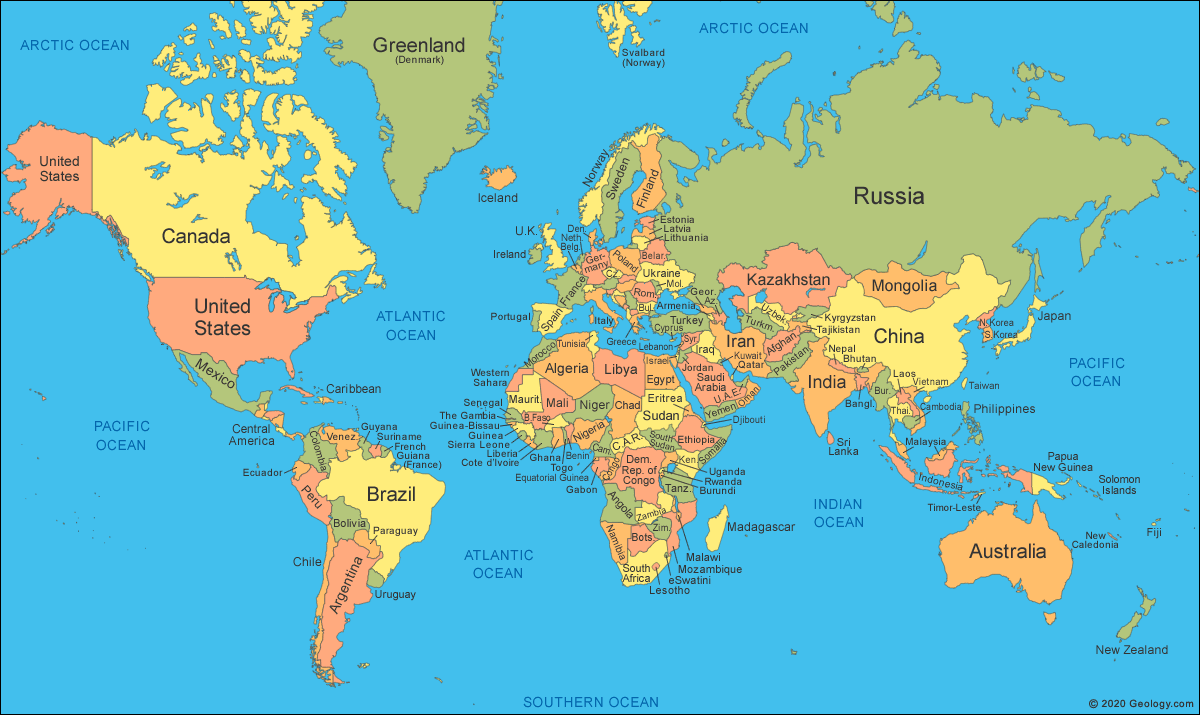
If you ask most Americans to close their eyes and envision a world map, the one that comes to mind will probably look a lot like this:
(click for a larger image)
Despite the popularity of this kind of world map, it's only one of many possible ways of depicting the earth, its lands, and its various people. More importantly, in terms of accuracy and sociopolitcal equity, it's also a bad way of depicting the earth, and of imagining it, because it reflects and encourages Eurocentric, "white" notions of superiority and centrality.
This popularly accepted image of the world is called a "Mercator projection," after Gerhardus Mercator, the Flemish mathematician and cartographer who invented it in 1569. In order to make it easier to navigate the globe, Mercator filled a rectangle with the surface of our spherical earth by shrinking some of its details and magnifying others. This distorted image comes to mind for most Americans as the way the world looks on a map because it's long appeared as the most common type of world map in textbooks, classrooms, and daily life.
In order to make the globe fill out a rectangle, Mercator enlarged land masses near the North and South Poles. A distortion commonly cited to illustrate this problem is the way the map portrays Greenland and Africa as about the same size. In the real world (or rather, on it), Africa is actually about fourteen times larger than Greenland. Also, since Europe and North America are distant from the equator, they too appear proportionally larger than they really are. A general problem with the Mercator projection's popularity occurs when many of us go on to confuse this distorted map for the territory.
Aside from fostering a distorted understanding of what the world really looks like, this map also reflects the location of its maker and users in Europe. It does so by placing this completely arbitrary geographical location directly in the center of the world (or almost directly--given Mercator's method, its location north of the Equator means that it has to be a bit north of dead center).
This manifestation of a European tendency to put themselves "at the center of things" brings to mind a famous New Yorker magazine cover, which depicts a map of America from a New Yorker's perspective:
(click for a larger image)
This cover became a popular poster in the late 1970s, primarily because it effectively satirizes the ironic provincialism of arrogantly "cosmopolitan" New Yorkers. By depicting New York as so much larger and more detailed than the rest of the U.S., and other parts of the world, the artist suggested that New Yorkers have a way of assuming that their city is the center of the earth.
I'm sure that few if any New Yorkers literally do imagine the world this way, and the map on this New Yorker cover probably also struck many of them as funny, and yet in a way, accurate. But in terms of actually trying to represent the world in the form of a map, many groups of people have literally put their land at the center, implying in the process their own heightened significance. Perhaps its natural to do that. Again, though, the problem with the Mercator projection, and especially with its popularity, is that it embeds in people's minds a false and arrogant notion of European (and thus by extension, "white American") significance.
In his book Colored White: Transcending the Racial Past, David Roediger analyzes a reworking of the Mercator projection that was published in 1929 by a group of Surrealists. Roediger points out how this map uses absurdist hyperbole to lampoon the Mercator projection's Eurocentric bias, in part by shrinking Europe and eliminating some of its countries. He also notes that other cultures have produced ethnocentric world maps, such as "an ambitious map drawn by members of Chief Powhatan's confederacy" during the period of British colonization:
The map placed the land which the Native Americans inhabited at the center of a flat world. Near the map's edge, a small pile of sticks represented England. In the early 1720s, remarkable Chickasaw and Catawban maps came into the possession of British officials in Charleston, South Carolina. One Chickasaw map placed the "Chickasaw Nation" in Northern Mississippi at its center, and one produced by a member of a Catawban group enlarged the Piedmont dramatically.
So seeing one's group at the center of things is probably a common human tendency, and indeed, there's a word for it--ethnocentricism. However, this tendency becomes a problem when one group enforces its own ethnocentric version of things onto other groups, washing away and often blasting away their ways of being, in favor of the dominant group's "naturally" more "civilized" ways.
The problem with the Mercator projection, and with other maps that place Europe at the center, is that they foster the common American perception that Europeans, and especially their American descendants, are also at the center--socially, culturally, politically, lingusitically, aesthetically, and in many other ways.
Americans learn in school that the colonial powers of England, France, and Germany are long gone, but most American teachers and other adults don't like to acknowledge that their own country has long engaged in what amounts to imperial abuse. The encouragement in our classrooms of a seemingly common-sense notion of "American exceptionalism" helps our corporate-funded leaders justify America's long tradition of racist resource- and labor-grabbing practices abroad. The continued use of Eurocentric maps like the Mercator projection is just one way of instilling this artificial form of "common sense."
Surprisingly enough (to me at least), the writers and producers of a corporate product, the defunct TV show The West Wing, addressed the role played in this indoctrination process by distorted world maps; they even went as far as having characters explain the arrogant and dismissive implications of the Mercator's projection to a presidential aid, in the hopes that the president would demand its widespread replacement. And, they even discuss an actual, viable replacement, the Peters Projection (of which I've included an example below).
I haven't seen the full episode--have any of you? Unfortunately, the following three-minute clip suggests that it deploys the usual corporate-media tactic: dismissing radical dissent by presenting its representatives as scruffy weirdos. Thus, I doubt that the show's fictional president eventually decides to recommend widespread adoption of more accurate world maps.
It's been a long time since I was in school--I wonder how many teachers have replaced Eurocentric world maps with something more like the Peters Projection (a.k.a., the Peters Equal Area World Map)?
This map was created by Arno Peters, who caused quite a stir in cartographic and scholarly circles when he presented it at a press conference in 1974. Peters argued that although his map also distorts some parts of the world, its depiction of the world's countries in more realistic proportions to each other could encourage a more equitable sense, and thus treatment, of all the world's people.
In case you didn't catch the Peters Projection in that West Wing clip, here it is again:
(click for more information)
Although Europe is still centralized on this map, its decreased size works against the Eurocentic bias of maps like the Mercator Projection. And "Eurocentrism" is the problem I'm basically writing against here.
The term "Eurocentrism" is sometimes used interchangeably with "whiteness," but I think their meanings differ. Both are grounded in a largely unexamined perspective that favors and calls upon European or "Western" "civilization," but "whiteness" has more to do with notions of race that are buttressed by Eurocentrism. And of course, European whiteness differs from American whiteness.
In their book Unthinking Eurocentrism, Ella Shohat and Robert Stam use the notion of "mapping" as a metaphor in their explanation of what Eurocentrism is, and why it's a problem. Their explanation makes this overly long blog entry even longer, but it's worth quoting at length, to flesh out the larger problem that Eurocentric maps are a part of:
Endemic in present-day thought and education, Eurocentrism is naturalized as "common sense." Philosophy and literature are assumed to be European philosophy and literature. The "best that is thought and written" is assumed to have been thought and written by Europeans. (By Europeans, we refer not only to Europe per se but also to the "neo-Europeans" of the Americas, Australia, and elsewhere.) History is assumed to be European history, everything else being reduced to what historian Hugh Trevor-Roper (in 1965!) patronizingly called the "unrewarding gyrations of barbarous tribes in picturesque but irrelevant corners of the globe."
Standard core courses in universities stress the history of "Western" civilization, with the more liberal universities insisting on token study of "other" civilizations. And even "Western" civilization is usually taught without reference to the central role of European colonialism within capitalist modernity. So embedded is Eurocentrism in everyday life, so pervasive, that it often goes unnoticed. The residual traces of centuries of axiomatic European domination inform the general culture, the everyday language, and the media, engendering a fictitious sense of the innate superiority of European-derived cultures and peoples. . . .
Europe is seen as the unique source of meaning, as the world's center of gravity, as ontological "reality" to the rest of the world's shadow. Eurocentric thinking attributes to the "West" an almost providential sense of historical destiny. Eurocentrism, like Renaissance perspectives in painting, envisions the world from a single privileged point. It maps the world in a cartography that centralizes and augments Europe while literally "belittling" Africa.
The "East" is divided into "Near," "Middle," and "Far," making Europe the arbiter of spatial evaluation, just as the establishment of Greenwich Mean Time produces England as the regulating center of temporal measurement. Eurocentrism bifurcates the world into the "West and the Rest" and organizes everyday language into binaristic hierarchies implicitly flattering to Europe: our "nations," their "tribes"; our "religions," their "superstitions"; our "culture," their "folklore"; our "art," their "artifacts"; our "demonstrations," their "riots"; our "defense," their "terrorism."
I'll end by emphasizing that the Eurocentric maps commonly used in American classrooms and textbooks are not the only ways our educational system instills and promotes Eurocentrism and/or white hegemony. In many fields, including history, literature, biology, psychology, sociology, anthropology and others, the basic, grounding fundamentals remain Eurocentric and white American.
These "European" fundamentals, which often remain unacknowledged and unexamined, include an academic area's presumptions and perspectives, its lauded figures and "heroes," its methods and practices, and in most cases, even the teachers themselves. Adding "mulitcultural" lessons, chapters, images, books and so on about and by non-white people can help broaden students' perspectives, but what does this add-on approach really do to identify and challenge the culturally and racially specific center?
If you have an American education, in what other ways was your schooling Eurocentric and/or white American?
Do you remember any teachers countering that central bias, perhaps by explaining the problems and effects of distorted maps like the Mercator projection, or in other ways?
And if you happen to be a teacher, are you doing anything in your classrooms to directly mark and challenge the whiteness buried at the heart and methods of your field?
[This post covers a lot of ground (so to speak), but in order to avoid losing readers, I've left a lot out. The differences between Eurocentrism and whiteness, for instance, call for further elaboration. I also wanted to cover the "North/South, Top/Bottom" problem--if that interests you, take a look at "The Upsidedown Map Page." Finally, I'm not a cartographer, so if I got something about maps wrong here, or anything else, please do correct me in a comment.]
Seven teenage friends had singled out a Hispanic man for a beating, but one among them - Jeffrey Conroy - was intent on killing when he stuck a knife into the man's chest, Suffolk prosecutors said after an indictment boosting his charges from manslaughter to murder was unsealed in Riverhead Thursday.
All seven Patchogue-Medford High School students charged in the attack on Marcelo Lucero, 37, now face new hate crime and conspiracy counts for what prosecutors said was an unsuccessful attempt to surround and pummel another Hispanic man earlier the night of Nov. 8. . . .
Outside court, Suffolk District Attorney Thomas Spota said the seven students charged in the attack admitted they regularly beat Hispanics for fun. He said one of the accused attackers, Anthony Hartford, 17, of Medford, told police "I don't go out doing this very often, maybe once a week."
"That statement provides a true window into the mindset of these defendants," Spota said. "To them, it was a sport."
Latino hate crime in NY: Teens in LI stabbing plead not guilty
Police have recorded a number of problems across the US which are being linked to the election of the first black President.
Mark Potok, director of the Intelligence Project at the Southern Poverty Law Center, which monitors hate crimes, said there had been hundreds of incidents
He said it was down to "a large subset of white people in this country who feel that they are losing everything they know, that the country their forefathers built has somehow been stolen from them".
The idea that white affluent western men are an oppressed minority is laughable. It is also a perspective that one encounters quite frequently in popular culture, and especially from so-called men's rights activists(MRAs).
They see rights, freedoms and opportunity as a zero-sum game, namely, if females are doing well, that means that males must be getting worse. This ties in to the problem with essentialist thinking. If one group is "naturally" better at something, but the other group is doing just as well as them in actuality, then the only way to maintain this false dichotomy, is to assume that something must be holding back the "naturally" better group.
For the White Person Who Wants to Know How to Be My Friend
The first thing you do is to forget that i'm Black. Second, you must never forget that i'm Black.
You should be able to dig Aretha, but don't play her every time i come over. And if you decide to play Beethoven--don't tell me his life story. They made us take music appreciation too.
Eat soul food if you like it, but don't expect me to locate your restaurants or cook it for you.
And if some Black person insults you, mugs you, rapes your sister, rapes you, rips your house, or is just being an ass-- please, do not apologize to me for wanting to do them bodily harm. It makes me wonder if you're foolish.
And even if you really believe Blacks are better lovers than whites--don't tell me. I start thinking of charging stud fees.
In other words, if you really want to be my friend--don't make a labor of it. I'm lazy. Remember.
What if every one of us bought a book by a black author and gave it to a white friend? So I'm naming December National Buy a Book by a Black Author and Give it to Somebody Not Black Month.
It might not be easy to actually get them to read it. Beverly mentioned that her friends were a little scared of the Ebonics they expected to find. But that's why your favorite African American authors really, really need your help. You, who they know and trust, can explain to white friends, neighbors, coworkers, classmates that there are books without Ebonics, and that books by black authors are much like any other book.
I know times are hard, but if you're doing any Secret Santa thing at work or planning to buy something for your kid's teacher, think about giving a book by a black author to a white (or Latino, Asian, Native American) reader. And, hell, if you really can't afford to buy a new book, regift one off of your shelf. I won't tell nobody!
AMY GOODMAN: Some of the crimes, Associated Press and a list of them, compiled over the last two weeks: crosses burned in the yards of Obama supporters in Hardwick, New Jersey and in Pennsylvania; in the Pittsburgh suburb of Forest Hills, a black man said he found a note with a racial slur on his car windshield, saying, “Now that you voted for Obama, just watch out for your house”; a black teenager in New York City said he was attacked with a bat on election night by four white men who shouted “Obama”; in Standish, Maine, a sign inside the Oak Hill General Store read, “Osama Obama Shotgun Pool”—customers could sign up to bet $1 on a date when Obama would be killed; at North Carolina State, four students admitted writing a sign on the campus that called for shooting Obama in the head; and in Idaho, second- and third-grade students on a school bus in Rexburg were heard chanting "assassinate Obama.” Do you think we’re just noticing this kind of thing more?
CORNEL WEST: No, I think this kind of thing has been around. We know all the different, you know, attacks, assaults and threats and so forth against dear Brother Barack. This is, you know, the undercurrent of the lower frequencies of the worst of America. We don’t want to lose sight of the best of America. But we’ve got to—I think we have to acknowledge any time you make a transition from one era to the next, you’re going to get this kind of bigotry manifest. Thank God it’s not as widespread, and thank God we have persons who are willing to bring critique to bear and to oppose it on all racial and cultural and political fronts.
Democracy Now!, with Amy Goodman November 19, 2008
whoa i wasn't aware that saying "colored" was a bad thing..
i honestly wasn't aware that "colored" was racist...
she said colored b/c he's technically not black, he's bi-racial. Also colored is an umbrella term for people of all colors black,brown,caramel,yellow,red ,etc and is another way of saying 1st non white president. She didn't mean it in the slave owner from the south sense of the word.
it don't make her racist...STUPID!...but not racist
It's such an old expression. Very weird. Is she hanging out with 85 year old people?
I when I am born, I'm black when I grow up, I'm black when I am sick, I'm black when I get sunburned, I'm black when I am cold, I'm black when I die, I'm black but YOU when you are born, you're pink when you grow up, you're white when you are sick, you're green when you get sunburned, you're red when you are cold you're blue when you die you're purple AND YOU HAVE THE FUCKING NERVE TO CALL ME COLOURED!
Today I spoke with Farai Chideya and L'Heureux Lewis on the National Public Radio program "News & Notes." The title of the 17-minute segment was "Inside The Thorny Landscape Of Racial Stereotypes." Topics included Obama Bucks, Obama Waffles, whether a stereotype can be positive, basketball, Dave Chappelle, the meaning of my email address, Peggy McIntosh, dinner parties, Gone with the Wind, and much more.
I can't find a way to embed the show in this post, but you can go and listen to the segment here on NPR's site. If you want to skip ahead, I joined the discussion at a little over four minutes.
This also seems like a good place to note that I woke up awhile ago at 3 a.m. to do an interview for an Australian Broadcasting Corporation program, "Sunday Night Safran." The hosts, John Safran and Father Bob, were curious about the whole idea of Columbus Day, and what it means for Italian Americans and whiteness.
Since the ABC provides mp3 versions of their shows, I embedded this one below. If you want to skip ahead, you can hear my interview at about 34 minutes.
How did the common American conception of Jesus Christ get so white?
from "Black Jesus," Episode 2 of the first season (1974) of Good Times YouTube has the entire episode, starting here
In the New York Times, Charles Grimes writes about the artist who produced America's most familiar image of a whitened Jesus:
With the race for best-known artist of the century nearly over, Pablo Picasso and Andy Warhol are running neck and neck, with Andrew Wyeth a respectable third. But when the official tally is made, all three are likely to be buried in a landslide vote for Warner E. Sallman.
Warner Sallman?
Sallman, who died in 1968, was a religious painter and illustrator whose most popular picture, "Head of Christ," achieved a mass popularity that makes Warhol's soup can seem positively obscure.
"Head of Christ," created in 1940, was reproduced more than 500 million times, appearing on church bulletins, calendars, posters, bookmarks, prayer cards, tracts, buttons, stickers and stationery. Tens of thousands of wallet-size copies were distributed to servicemen during World War II. In the mid-1950's, Sallman's soulful, back-lighted Jesus with flowing, shoulder-length hair gazed out from the Inspira-Clock and the Inspira-Lamp, tie-in products intended for the pious Protestant home.
"Head of Christ" (1940) Warner Sallman
At CrossLeft, where some bloggers are "balancing the Christian voice [and] organizing the Christian left," Landon writes:
Here's how the cycle goes: From our younger days when our critical thought process is non-existent or not fully formed, we are inundated with images featuring a Jesus that does not look like he actually would have. "This is the Son of God" we are told, "This is God incarnate." So, we guess, God must be white.
It never occurs to us that God is not white when we are growing up, and the dominant image that we get of Jesus is a white guy with flowy hair. As such, if God gets equated with white then "good" also get equated with white. (you see where I'm going?) If white is good, then that means (in the little ego- and ethno-centric mind) that "not white" is "not good."
Regarding what Jesus actually looked like, Mike Fillon writes,
In the absence of evidence, our images of Jesus have been left to the imagination of artists. The influences of the artists' cultures and traditions can be profound, observes Carlos F. Cardoza-Orlandi, associate professor of world Christianity at Columbia Theological Seminary in Atlanta. "While Western imagery is dominant, in other parts of the world he is often shown as black, Arab or Hispanic."
And so the fundamental question remains: What did Jesus look like?
An answer has emerged from an exciting new field of science: forensic anthropology. Using methods similar to those police have developed to solve crimes, British scientists, assisted by Israeli archeologists, have re-created what they believe is the most accurate image of the most famous face in human history.
This chapter addresses the "attitude" problem, also known as coming to work black. Since that sounds so negative, I have to explain it.
First of all, part of the problem with telling people that they have an attitude problem is that it is a subjective call. What you call attitude, I call righteous indignation. What you call attitude, I might call frustration. What you call attitude, I might call personality.
[Nonetheless,] every time your boss sticks that label on you, it's not necessarily wrong. Some people do have generally funky attitudes. You know them. So do I. They have a smart-ass answer for everything, or they are unnecessarily argumentative, or they have one relationship problem after another without appearing to learn any lessons.
When attitude becomes an issue for a black person in the workplace, however, is when a black employee does not feel that his employer is doing right by him and he suspects it is because he is black, or at least suspects that it is based on some reason that is not fair. Before that employee gets to the point of filing a complaint, he usually develops an "attitude" to carry him through this rough work environment.
A lot of the perceived attitude problem isn't about the black employee at all; it's about the person who is doing the perceiving. Truth is, whites are not always very good at reading the moods or facial expressions of black people. It never ceases to amaze me that the frame of reference many white Americans have for black comes from watching Good Times or The Jeffersons on television.
Blacks, on the other hand, can't afford to enter the work force with the same level of ignorance about white America that whites can have for every other minority group.
In the past year alone, I've had to explain to my white coworkers, at different times, who Lauren [sic] Hill, Luther Vandross, and P. Diddy were. Can you imagine me going to work and having to say that I had never heard of Gwyneth Paltrow, Garth Brooks, or Richard Simmons? They would look at me with disbelief, amazed at how I managed to make it to a professional career in such cultural ignorance. They would say Gwyneth and Richard were "mainstream," and how could I pick up a newspaper or magazine or watch television without hearing of them? Didn't I see Shakespeare in Love, or Garth's NBC Special, or Richard's Oldies but Goodies tape on the shopping network?
Yet, I've encountered white coworkers my age who have never heard of Jet magazine, don't know that Luther's Never Too Much is a classic, and don't remember P. Diddy from when he was sampling as Puff Daddy.
I once saw a grown woman on Who Wants to Be a Millionaire blank on the question, "Who is the 'Queen of Soul'?" I remember asking how any game show contestant over the age of 30 could not know that Aretha Franklin is the queen of soul. I'll admit, a lot of white folks probably scratched their head at that one, too.
The level of ignorance allowed by whites in the workplace is one of the reasons why a lot of black employees have an attitude problem. Not every black person believes that every white person is ignorant, but blacks can be resentful that this ignorance can be so open and blatant.
When the majority of the people you work with don't know the names of the top pop culture figures with your skin color (unless the person has gone completely mainstream), it takes its toll on you. For most blacks this is an example of how whites don't have any interest in knowing anything about blacks unless it directly benefits them.
Despite all our good reasons for indulging in a bad attitude in the workplace, we can never let that attitude crush us. . . . No matter how hard it is, no matter how many reasons you have not to, never go to work with a demeanor that expresses anything short of "I'm glad to be here and you should be damn glad to have me." With that attitude, you can roll through whatever comes up.
A grand jury indicted Cowart and Paul Schlesselman, 18, on Nov. 5, charging them with plotting to kill Obama, possessing a sawed-off shotgun, carrying guns across state lines to commit crimes and planning to rob a licensed firearms dealer.
Cowart and Schlesselman are awaiting trial without bond at a northwest Tennessee jail, on lock down in a two-man cell and separated from other inmates for their own safety.
In his petition, Cowart said the grand jury had two white members, while "21 were African-American or of another race or races." The jury, he said, could not "under the most modest constitutional scrutiny ... be considered fair, impartial and unprejudiced."
The Southern Poverty Law Center today won a crushing jury verdict against one of the nation's largest Klan groups for its role in the brutal beating of a teenager at a county fair in rural Kentucky. The $2.5 million verdict will likely cripple the Imperial Klans of America, which has 16 chapters in eight states.
"The people of Meade County, Kentucky, have spoken loudly and clearly. And what they've said is that ethnic violence has no place in our society, that those who promote hate and violence will be held accountable and made to pay a steep price," said SPLC founder and chief trial attorney Morris Dees, who tried the case. "We look forward to collecting every dime that we can for our client and to putting the Imperial Klans of America out of business."
The University of Illinois ended the use of the chief as a mascot due to cultural sensitivity issues two years ago. Unfortunately some of the students have decided that this distasteful tradition needed to be revived. The Students for Chief Illiniwek, funded the purchase of a new uniform and the chief is set to perform once again this Saturday at an Ohio vs Illinois football game. . . .
Many tribes have complained about how offensive this kind of behaviour is only to be told that it is all in good fun, or just good sportsmanship. It is exactly the same as telling a person of colour that they are too sensitive when they point out racism.
It is almost the end of 2008, the president is a man of colour and the state that he represented still engages in dress up like an Indian. Am I the only one that sees the cruel irony in this? Yeah, the US is so evolved that it can elect a black man, but not evolved enough to realize that having a man play Native, and dance around a stadium to loud cheers is offensive. WOW racism really did come to an end November 4th.
Understandably, much has been written about how historic President-elect Barack Obama’s election is for African-Americans in a country where they were brought in chains.
But Obama’s victory was also historic for white Americans who succeeded in breaking the shackles of racism. With African-Americans only 12% of the population, a whole lot of white folks had to vote for Obama, and it’s a triumph for them too.
Overall, according to exit polling, 55 percent of whites nationally voted for John McCain, while 43 percent supported Obama. That's very close to what Al Gore got in 2000 and what John Kerry got in 2004.
I know what some commenters are already thinking -- it was those stereotypically racist Southern whites who skewed the numbers, right? Wrong. True, Southern whites voted in far greater numbers for McCain over Obama -- 67-31, to be exact, but according to the Pew Research Center, in only one out of four regions of the country, the East, did whites break for the Democrat. And Southern whites' support for the Democratic nominee was actually up 2 percentage points (or roughly 7 percent) over what it was in 2004.
What really accounted for Obama's victory was an uptick in the African-American and Hispanic share of the electorate, and the tendency of voters from both of those demographic groups to break Democratic in larger numbers than in previous elections.
This Week in Blackness "Black, black, blackity black" (Profanity Alert)
She points out that President-elect Barack Obama is likely to be drafted for a new job that he never asked to hold.
Spokesman for the Entire Black Race. . . .
So, what should the HNIC do?
Here's my action plan. Obama aides need to aggressively attack reporters who attempt to make them discuss the actions of random black people across the country. Sure, there will be times when Obama has to take a stand, but most of the time he needs to have his aides question the motives of these reporters and their thinking. After all, did they ask George Bush to comment on every protest or issue involving white people? No they did not. They decided that certain things weren't Bush's concern and Obama aides need to make sure they get the press to install that same sort of filter when it comes to their guy. Of course, they need to make these attacks off the record and not for attribution.
John McCain professed to be deeply offended by Congressman John Lewis’ warning that the campaign of McCain and Palin was stoking fires that could not be put out. They spent months pounding away at supposed connections to terrorism that they knew were bogus. They spent months screaming that socialism was on the advance if they lost. Their campaign gave comfort and support to their fellow travelers of the hard right to scare and scare and scare people. And guess what, people are scared. And scared people do scary things.
As we celebrated the eve of November 4th, I was struck by a comment from New Mexico Governor Bill Richardson. He pointed out with pride the role of the Latino vote in Obama’s election. I wish I could say that about my fellow Filipinos. . . .
Filipinos can be quite forthcoming when talking about race. In news interviews in the Philippines and in Pinoy gatherings, many immigrant Pinoys have made it abundantly clear that their “discomfort” over Barack Obama is not due to the rumors that he’s an inexperienced, socialist, Muslim politician. Their discomfort is from Obama’s blackness.
Filipino Americans have long been proud of our ability to assimilate into American society. Decades of colonization helped ensure that Filipinos buy into the American Dream completely — minimal input from a goverment that back home is often corrupt, working hard to pull oneself up, and evidencing said hard work through conspicuous consumption.
But as writer Benjamin Pimentel points out, buying into the American Dream also includes embracing “the views of the dominant white society – including the prejudiced, distorted image of blacks.”
Last week's election of Barack Obama as the nation's first black president was like a booster shot for the six-month-old Marin initiative on race, class and educational disparities, organizers said.
"The recent election victory of president-elect Obama re-enforced, re-energized and emboldened our efforts and commitment to directly confront the educational inequities in Marin known as the achievement gap," said social worker Cesar Lagleva, a leader of Marin's education equity initiative on race and class.
It was great to receive a reminder from Dan Wolf a couple weeks ago about an exciting event, his stage version of Adam Mansbach's hilarious novel, Angry Black White Boy. Dan's play, which he also stars in, has been garnering rave reviews, as well as an extended run, through November 23 at San Francisco’s Intersection for the Arts. Mansbach’s novel (which I wrote about awhile back, here) is a primary inspiration for me, and its flawed protagonist, Macon Detornay, is the source of my nom de blog, “Macon D.” I suggested the interview below about Dan’s new play, and what led him to it.
Dan Wolf is an actor, playwright, educator, and MC, as well as a rapper with the live hip-hop group Felonious. His co-authored play Beatbox: A Raparetta was produced in San Francisco, Oakland, Germany, and at the New York Hip Hop Theater Festival. Dan is currently developing The Stateless Project, a hip-hop and beatbox infused theatrical collaboration that combines German and Jewish history with the problems of racism and the Jewish African American Experience, and he’s also working on a documentary film entitled return of the tuedelband, a multi-media lecture, and a museum installation.
In Angry Black White Boy, Macon, a white student at Columbia who also drives a cab, decides to avenge the unearned privileges of white people and their ongoing oppression of black people. He begins by robbing businessmen that he picks up on Wall Street; when these crimes gain media attention, Macon and his friends, Nique and Dre, decide to go national, including a National Day of Apology, which involves apologies delivered personally and individually by whites to blacks.
Wolf’s stage production of this farcical, biting satire includes storytelling, poetry, rap, beatboxing, ballet and hip-hop dance; you can read recent reviews here, here, and here.
MD: So what grabbed you about Mansbach's novel? And what did it take to finally get it up on the stage?
DW: I heard Adam on the KPFA show “Hard Knock Radio” talking about the book. It was at a time that I was seriously pondering why a white dude like myself had a right to go into schools and juvenile halls and teach kids about hip hop. That was basically my day job for about ten years, and I was able to really engage folks in an artistic approach to hip hop, but always nagging at me was the political side of it. The “right” and “ownership” I was exercising in a culture that was obviously not born on the streets I grew up on. I guess it was part of my maturation process as a person and an artist.
A lot of my work is about looking back so we can move forward, and this question fit right into that process. I also work as a producer at the Jewish Community Center in San Francisco, and when Adam was looking for places to promote his next book The End of the Jews, he contacted me. At the end of our first meeting I let him know that after reading Angry Black White Boy I felt that it had so much dramatic possibility, and that I wanted to use it as the source material for a new theater play, and he was down. That's how it started.
MD: Could you give us a quick history of your hip-hop group, Felonious? And has the group done much racially aware work?
DW: Felonious started in 1994 as a three man a capella hip hop group. Just MCs and Beatboxers, and we'd perform in coffee shops and at house parties. We moved out to Santa Fe (I went to school there for a year) and started to get all experimental with jazz musicians and drummers. When we landed back SF we found the guys to make Felonious a live band and started to build there. Felonious is mixed racially, but since we all came from a theater background that never really played into the art of it all. I keep saying “art” ‘cause I do believe there is an artistic side to hip hop, and then a political side and, until our work on ABWB, most of what we did was in the artistic side of things. Really pushing what you think hip hop is and breaking down stereotypes not by what we said, but purely who we were.
MD: How much input did Adam Mansbach have in transforming his novel into your play?
DW: He wrote the book and the book is the source. He is so good at dialogue and, at least in my initial adaptation, I kept very true to his words. I think he is one of the most intellectual dudes I have ever met in the hip hop world. He is smart and biting and really true to his game. He gave us notes on the script but he wasn't that involved in the whole process of getting it up. He has a screenplay adaptation of the book that he’s been shopping around and that proved challenging, because I think in his mind it's the definitive adaptation. He got the entire book into a 2 hour film which is amazing considering how much ground is covered in that 300 + page book.
My adaptation was initially about 130 pages and that was condensing the entire book into a five-character piece. As we moved into rehearsal we only used 4 actors, so we condensed that 130 page script into about 57 pages. Early on we read a version of “Book One – Race” (ABWB has three “books” in it) and the reading took over 90 minutes. The director and I knew we had a lot to cut to make this a play that was performed in 90 minutes with no intermission. We couldn't cut enough to have no intermission, and so the first act is now 90 minutes and the second act is 40 minutes. And even at that length we only do Books One and Two.
MD: So you yourself play the novel's protagonist, Macon Detornay. Did you have any trouble turning him into a plausible stage presence?
DW: Macon is a hard character to play. On one side I totally connect to the white Jewish suburban dude raised on hip hop. I always say I learned about hip hop on mixtapes via satellite, meaning I was listening to these songs in my room and deciphering the codes and learning about the characters in the same way I learned to break down a Shakespeare character or a Mamet character. The Beastie Boys were the first to really make me own my love of hip hop (Paul's Boutique not License to Ill). I loved the collage of the Dust Brothers' music and the energy of these dudes making music with their friends.
Then I heard NWA and the message grabbed me by the balls and made me realize that this is a music about fighting a real power of oppression, a power that still to this day doesn't mean the same for me as it does folks from other communities. (I could insert some BS about Jews and holocaust and my family and that's why I connected to hip hop, but it’s bigger than that, so I won’t). Then I found the Pharcyde and the creativity of hip hop. They broke it open for me. The underdog as intellectual. The nerd getting the girl. The comedy and limitless rhythmic possibilities. I was a bboy waaaaaaay before I thought about rapping, and that led me to soulsonic force and herbie and all the other west coast breaking musicians, but really all that was coming to me through movies and TV not the streets, so I'm second generation with all that.
Macon is a hard dude not to judge. He is the thing he hates and as the novel and play progresses, it becomes clear that his privilege reigns supreme. I tried not to judge him as I read the book and wrote it, but that's who he is. I have to play him fully on stage. We have one other white dude playing all the obnoxious characters, as well as Red in the Fleet scenes [these are characters from a subplot that involves old-time baseball players, including Macon’s racist ancestor]. You think Macon will be the righteous one and this other guy is the asshole, but it’s really the opposite. Macon bitches out in the end and becomes like “all these other white folks out here,” while Red sacrifices his life for the cause. That's a real hero.
MD: I haven't seen the play yet, but I assume there's some music in it? Does Macon perform at all, and is there enough music to actually call it a "musical"? If not, did you ever consider going that route?
DW: The play is not a musical but everything in the play responds to music, ‘cause that's what Macon is responding to and that's the world of hip hop. Tommy Shepherd plays Nique (among others) and he’s also the Musical Director. He’s also the BADDEST beatboxer and is basically a human jukebox. He brings in live beatboxing and uses a Boss Loop Station to build layered soundscapes that illuminate the moment and the movement. The whole beginning of the show is a soundscape of songs like Jungle Brothers’ “Black is Black,” Pharcyde's “Running,” PE's “Public Enemy #1,” and Cube's “Amerikkka's Most Wanted,” all performed live with stomping beatboxing vocals and melodic singing. We come from a live aesthetic and that's what we like to incorporate into all our work. We also use samples from other pre-recorded hip hop songs.
MD: AWBW’s Macon displays pretty openly his hip hip influences and borrowings, as well as a wide and well-understood range of other elements of African American culture, history, style, and so on. Is it fair to say that Macon is "blacker than a lot of black people"?
DW: I’m not playing him as blacker than black. I am playing him as a white dude who is caught up in his own mind, his own guilt, and the race against history. He is certainly well versed and can hold his own or Nique would beat his ass from the jump. But he's not trying to disappear into the culture. In fact he wants to stand out as white.
We talked a lot about what his hair should look like. Shaved head or white-boy style. In the end we kept his hair long and his face shaved clean because Macon needs to stick out to get his point across. He needs people to be able to challenge him and have his victory be “you’re pretty cool for a white dude.” I guess if being blacker comes from knowledge versus action then yes, he's blacker. But as Nique says, “I’m gonna die black with or without you,” so no, he doesn't fully disappear into it, even if folks let him into the club.
MD: Do you have any favorite lines from the novel that made it into the play?
DW: I like the line "You gonna eat that pickle? I demand that pickle as reparations, wasssup!" that made it. One line that didn't make it was the line about the cooks at Justin’s restaurant. Something like, "What does he do, hire chefs that were hot in the 80's to remix their dishes?” The director didn't like it but I wanted it in there.
MD: How have audiences been reacting so far?
DW: Great. Sold out every night since we opened and we have extended it till November 23 (possibly all the way until December 7). With the election it’s been interesting. I’ve started to say at the curtain speech that this play should be the beginning of a conversation and since Obama won, don't get it twisted, racism is not dead in America, it’s just wearing a new layer.
MD: Can you tell us what you think white people should do?
DW: Stop being such self-centered assholes and actually realize that there are other people in the world.
MD: Any possibilities yet for taking Angry Black White Boy to other cities?
DW: I hope. We'll see.
MD: I hope so too, so I can see it! Thanks so much for your time, Dan.
 Maurice Berger,