According to the CNN and ABC exit polls, white Americans overwhelmingly wanted John McCain to be the next US president. The white vote was lopsided for McCain at 55-43 percent. If the 2008 electorate had the same demographic character as any before about 1980 (that is being nearly 90 percent white), Senator John McCain would currently be the president-elect.But as we know that did not happen, because the electorate this time was only 74 percent white, and those voters who were not white voted very heavily for Senator Obama.
If you are incapable of mustering pride in this moment, and if you cannot appreciate how meaningful this day is for millions of black folks who stood in lines for up to seven hours to vote, then your cynicism has become such an encumbrance as to render you all but useless to the liberation movement. Indeed, those who cannot appreciate what has just transpired are so eaten up with nihilistic rage and hopelessness that I cannot but think that they are a waste of carbon, and actively thieving oxygen that could be put to better use by others.
This election does indeed matter. No, it is not the same as victory against the forces of injustice, and yes, Obama is a heavily compromised candidate, and yes, we will have to work hard to hold him accountable. But it matters nonetheless that he, and not the bloodthirsty bomber McCain, or the Christo-fascist, Palin, managed to emerge victorious.
For more than three decades Eugene Allen worked in the White House, a black man unknown to the headlines. During some of those years, harsh segregation laws lay upon the land. . . .
The issue of race bedeviled this White House, even amid good intentions. In February 1963, Kennedy invited 800 blacks to the White House to commemorate the 100th anniversary of the Emancipation Proclamation. Louis Martin, a Democratic operative who helped plan the function, had placed the names of entertainer Sammy Davis Jr. and his wife, May Britt, on the guest list. The White House scratched it off and Martin would put it back on. According to Martin, Kennedy was aghast when he saw the black and white couple stroll into the White House. His face reddened and he instructed photographers that no pictures of the interracial couple would be taken.
I would further advise you not to take on other people's enemies. Most damage that others do to us is out of fear, humiliation and pain. Those feelings occur in all of us, not just in those of us who profess a certain religious or racial devotion. We must learn actually not to have enemies, but only confused adversaries who are ourselves in disguise. It is understood by all that you are commander in chief of the United States and are sworn to protect our beloved country; this we understand, completely. However, as my mother used to say, quoting a Bible with which I often fought, "hate the sin, but love the sinner." There must be no more crushing of whole communities, no more torture, no more dehumanizing as a means of ruling a people's spirit. This has already happened to people of color, poor people, women, children. We see where this leads, where it has led.
What does this promise land look like? This Obamerica? Shortly after Obama is sworn in, the police, instead of subjecting blacks and Hispanics to capricious traffic stops, will only stop them to offer free tickets to the policeman’s ball. Throughout the country, they will address blacks and Hispanics as sir and ma'm. The overcrowding prison problem will end, because all of the blacks and Hispanics who’ve been sent there as a result of prosecutorial and police misconduct, -probably half- will be set free. And all of those police who have murdered unarmed blacks only to be acquitted by all-white juries will be retried. Blacks will have the freedom to shop in department stores without being watched.
Jesse Jackson will be appointed lead editorial writer for The Wall Street Journal. and Al Sharpton will assume duties at The National Review. Rush Limbaugh will inaugurate a series called “Great African American Inventors.” Spike Lee will be invited to run Columbia Pictures and Amy Goodman will take over at NBC. The Newspaper Society of America will apologize for the lynchings and civil disturbances caused by an inflammatory media over the last one hundred or so years. A choked up Rupert Murdoch will read the statement on behalf of his colleagues.
Let me tell you--when I talk with my parents about this issue, they get pretty vehement. Not about the immorality of alternate lifestyles--neither of them really cares about that--but about the arrogance and gall of LGBTs for “riding on the coattails” of the black civil rights struggle. Keep in mind that people of my parents’ generation have witnessed other groups do the same thing and benefit from it: c.f. white women, who were the primary beneficiaries of Affirmative Action, and Asian immigrants who arrived after the 1965 Immigration Act, many of whom were praised as a “model minority” and thus used in an attempt to bludgeon other PoC (including unsuccessful/activist Asian Americans) into silence on issues of racism. In my parents’ lifetimes and in their respective cities--Mom lives in the Deep South, Dad’s in NYC--black and Latina/o neighborhoods have deteriorated or gentrified since the Civil Rights movement, while gay neighborhoods now thrive. And of course, they’ve seen people like Jacobs equate “gay” with “white” for years. So is it any wonder that now they shake their heads at yet another group of white people (e.g., poor whites, white women) who seem to forget that white privilege still benefits them, however much their other identities suffer oppression?
White folks who cannot fully recapture a lost cultural heritage, like myself, often experience a real sense of loss. Sure, there might be subcultures of whites who feel attached to what they see as a particularly American culture, like those who would claim a "Southern" culture.
However, many of us find ourselves looking at other groups and longing for the connection we imagine they feel with their roots, their homeland, their culture. Many white folks can be heard saying, "We don't have culture. They have culture."
Even if African Americans do not choose to reconnect with their African ancestral culture, many white folks generally imagine that Black culture in the United States is rich with meaning.
Many of us then travel and bring other group's cultural artifacts home with us. In my familial home, for example, we have puppets from Indonesia, figurines and baskets from Africa, a rug and bedspread from Guatemala, and carvings from Mexico. For a long time, I saw my inclinations toward tourism as evidence of my openness and respect for other cultures, having no idea how much it also betrayed my inner sense of loss.
In the mid-1990s, I attended a performance put on by the UCLA Drama Department. In one main hall, individual artists each had a roped-off section of space. Each enacted a cultural way of being. There was someone representing Santeria, another enacting a Middle-Eastern culture I cannot remember.
And then I saw her, the white woman.
I stood transfixed in front of the white female artist. She sat on a chair on a square stage four feet above the crowd in a glass case. She wore a delicate white dress and was holding a bag from Pier 1 Imports. She admired the exotic artifacts from lands abroad one after the other. I stood transfixed for several minutes, trying to sort out the emotion rising in me.
There was something very discomforting about seeing her that way. I recognized that woman. She was me. Or at least, she had been me. She was my mother. She was my grandmother, perhaps to some lesser degree. I felt that, that blandness, that plainness, that whiteness. I felt her whiteness as a lack, a loss. I felt this loss in my bones. I could barely move as I was reminded of how I loved what other cultures have precisely because I know the emptiness that results when tradition is traded in for whiteness.
I know that I am not alone. I hear the same sentiments too much from other white people. If anything, this is one of the truest hallmarks of whiteness that I have yet encountered. There is a hole within many of us, created when our families gave up our culture in order to be successful in the United States.
Of course, there are plenty of people from other groups and cultures who also travel, collect artifacts, and shop at Pier 1 Imports. However, the collection of objects is not the important point. What struck me most was the deep, underlying pain that I hear emerge from many white people as they discuss what it means for them to feel connected to another culture.
At this time, with what I now see, there is nothing about that setting that feels coincidental: the glass separating the woman from the audience, the stage that put her on a pedestal, the center, privileged position within the room, and the way her presence commanded attention. Even given that secure foundation, she exuded a sense of loss, of being lost, adrift in the larger world . . . captured by the glass case.
Shelly Tochluk is an educator with a background in psychology. She spent ten years as a researcher, counselor, and teacher in California's public schools and now trains educators to work with the diverse Los Angeles school population as an assistant professor of education at Mount St. Mary's College, Los Angeles, California.
When I woke up this morning, I was feeling pretty good about the momentous choice America made last night. After breakfast I found some time to enjoy other people's reactions on the Internet.
Then I felt like a glass of cold water had been thrown in my face, when I read about the passage of California's bigoted Proposition 8. When I was in college, California was referred to as the bellwether state, so maybe on this issue, it's a good thing that Missouri has taken its place.
Then I heard what former Secretary of Education William Bennett said on TV last night, and it felt like I'd been splashed again. Bennett's assessment of the significance of an Obama win, which you can watch in the clip below, reminded me that with the reality of a black president, a lot of white people are going to continue holding, and enacting, some messed-up attitudes about race.
Right. Meet the new truth, same as the old truth. In terms of racism, Obama's presence in the White House isn't going to improve things overnight, and maybe not all that much at all.
One thing we're going to be hearing white people say more openly is something that many of them have long thought. As Bill Bennett demonstrated on CNN last night, this attitude will basically go like this: "Thank God we have a black president! Now black people can't complain anymore about being held back by racism. Thank you Barack Obama, for proving that race doesn't matter anymore."
Bennett's comment begins about 45 seconds into this clip; he and the other people in it didn't know at this point whether Obama would win (in case the video loads slowly, I've included a transcript below):
Anderson Cooper: I mean, if he does become president, and it still is an if, does anyone know what this means in terms of change of race relations in the United States, or perception of?
Bennett: Well, I'll tell you one thing it means, as a former Secretary of Education: You don't take any excuses anymore from anybody who says, 'The deck is stacked, I can't do anything, there's so much in-built this and that.' There are always problems in a big society. But we have just -- if this turns out to be the case, President Obama -- we have just achieved an incredible milestone. For which the world needs to have more respect for the United States than it sometimes does.
Bennett isn't merely rebuking people here who use racism as an excuse for failure. He's claiming that institutionalized racism is no longer a barrier to achievement. This claim fails to match the realities lived by many non-white people, and those who make it overlook, just for starters, the persistence of job discrimination against black people.
In his obstinate way, Bennett dramatizes something that Tim Wise described this morning, in his post-election reaction piece, as "racism 2.0." Wise describes an up-and-coming form of racism, which "allows whites to still view most folks of color negatively but carve out exceptions for those few who make us feel comfortable and who we see as 'different.'”
Clearly, Bennett feels some amount of admiration and respect for Obama. But that's mostly because he thinks that Obama's achievement can be held up as a counterexample to other black people, most of whom he seems to lump together as pathetic whiners about non-existent institutional racism.
Like a lot of white folks, Bennett is a habitual player of the "race doesn't matter anymore" card (he says other nasty things too--why the hell is he still a respected pundit?). And one effect of Obama's victory on a lot of white folks will be an increased use of this white race card, as people point to Obama's achievement in order to claim that "anyone can do it, so why do any black people still think they have something to complain about?" Who knows, they might even just wear the damn thing out. Come to think of it--would that be a way of getting rid of this particular card?
It's obvious to me, and I'm sure to most of my readers, that race and racism in their many, many forms aren't going anywhere any time soon. Race will continue to matter. A lot. No matter how much white folks want to wish it away.
I'll end with one more way of showing that on the day after Obama won, race does still matter, because it's on a lot of people's minds right now.
I've written before about how I can view the statistics for this blog, including terms entered into search engines that brought readers here.
Just today, people went in search of answers on the Net by typing in the following phrases and questions. It's a small sampling, but I think it's clear that these searchers don't believe that race doesn't matter anymore.
Do you see any trends below, or anything that connects with how you're hearing people talk about race?
How do you think race is going to matter in the Era of Obama?
>> people say that barack obama will make white people slaves >> what is the white race going to do? >> are the white people angry? >> what does post election mean for white americans? >> Do white people still harbor thoughts that people of color deserve to be treated differently? >> white people's reaction to the election >> why white kids mass murder >> where are some obama racist jokes? >> 88 and 14 as it relates to white supremecy >> why would white people vote for obama? >> what do white people say to black people regarding the election? >> are white people upset over Obama? >> are black people finally happy now? >> white people mad that obama won election >> white people are a problem >> people oppose diversity in the workplace >> overcoming unconscious racial prejudice >> DO WHITE PEOPLE STAND A CHANCE UNDER OBAMA? >> do white people know lift every voice and sing? >> crazy ass shit white people do >> common beliefs among white people >> black people blaming white people >> blacks blame whites for problems >> apollo theater white supremacists
A lot of people find Elisabeth Hasselbeck's presence on "The View" incredibly annoying, and I gotta say, I do too. She's like a feminine Bill O'Reilly--loud, domineering, condescending, obstinate, and most of the time, just plain stupid.
Nevertheless, for the purposes of this blog, I'm glad that Elisabeth is on television. By arguing her (talking) points so tenaciously, she often dramatizes common white tendencies.
I've written before about Hasselbeck's continual demonstration of the common white insistence, especially in mixed-race discussions, on occupying center-stage. In the clip below, from this morning's edition of "The View," she launches a vigorous, last-ditch volley of attacks, which largely consist of guilt-by-association claims about Barack Obama.
We're probably all tired of such crap, especially today, but a tone of something approaching desperation in Hasselbeck's attack here does provide a sense of something like schadenfreude. More to the point, she also demonstrates a common white tendency in such discussions -- refusing to see or consider how something looks from another, non-white point of view, and then judging that thing from a limited white perspective.
In this discussion, Joy Behar serves as a foil to Hasselbeck; Behar highlights Hasselbeck's performance of this common form of white solipsism by performing the opposite, an openness to experience that differs from her own.
Joy Behar thus provides some hope here; she shows that some white people can step back and admit that because they're coming from a different place in terms of race, they just don't know enough about something to judge whether it's right or wrong.
So what do you think? Just how "white" is Elisabeth Hasselbeck?
Also, is "The View" going to change after this election?
In the midst of some fine fancydancing, Sherman Alexie and Stephen Colbert raise a common question about proper terminology. But . . . do they ever provide a proper answer?
If recent polls are to be believed, white voters favor John McCain over Barack Obama by nearly ten percentage points, but the McCain and Obama camps probably haven’t factored in the following fact: In an informal Esquire survey, three out of four white supremacists prefer Obama, while McCain is the clear favorite among black nationalists. (Sure, our methodology suffered from an extraordinarily low sample size--limited to four white supremacists and one black nationalist--but just because it wouldn’t fly with Gallup doesn’t mean there ain't a kernel of truth in there.) This is just one of many surprising views that emerged after we talked to extremists about this historic electoral showdown between a 46-year-old black man and a 71-year-old white man.
Daniel Cowart and Paul Schlesselman, the two Tennessee neo-Nazis arrested for plotting to kill 102 African-American schoolchildren and then assassinate Barack Obama, clearly drew inspiration from a violent white nationalist group called the Order. In the 1980s, members of the Order carried out a crime spree that included several high-profile murders.
The connection to the Order is evident in the numbers the two men scrawled on their car on Saturday shortly before they were arrested: 14 and 88. The so-called Fourteen Words is a slogan - "We must secure the existence of our people and a future for white children" - coined by Order member David Lane, who also wrote an essay called 88 Precepts. In white supremacist circles, 14-88 is a shorthand expression of allegiance to the beliefs put forth by Lane and the Order, who wanted to found a white homeland where they could preserve the "Aryan race" from being polluted by non-whites and enslaved by the "Zionist-occupied government" of the US. Lane also advocated polygamy and a kind of European paganism he called Wotanism.
Decades after killing an unknown number of Vietnamese, he still calls them racist names. “I hate the gooks,” he said in 2000. “I will hate them as long as I live.”
These are only a few examples of McCain’s outbursts. He also insults members of his staff and complete strangers.
But does all this unpleasantness really matter in an election? Perhaps it means a great deal in a presidential election. Early in 2008, Senator Thad Cochran of Mississippi said, “The thought of his being president sends a cold chill down my spine. He is erratic. He is hotheaded. He loses his temper and he worries me.” (Boston Globe, 1/27/2008)
McCain has another problem that relates to all this. He’s a compulsive gambler, and he loses thousands of dollars every year. He shoots craps, which any professional gambler will tell you is a sucker’s game. It’s all a matter of luck, unlike five-card stud, for example, where you can see and remember some of the cards dealt. And you can calculate the odds of what cards will appear next.
Do we really want an angry, racist president, one who makes decisions by rolling dice? Think about it. If you’re still not sure, take a nice cold bath.
Maron v Seder McCain Campaign's Most Racist Ad Yet (Warning: NSFW Word Ahead) [h/t: redcatbiker]
Racial disparities have long been documented in health care, but a University of Washington study on doctors' possible biases is validating the feelings of many African-American patients. . . .
Released Tuesday, the study found that most doctors unconsciously prefer white people to black people. The exception was black doctors, who exhibited no preference for either race.
David Fleming, health officer and director for Public Health -- Seattle & King County, called the study "reasonable" and said it was a step in educating doctors on bias and patient care.
He, too, stopped short of calling the biases prejudice.
"Using words like racism or prejudice gets people's attention," said Fleming, who is also the board chairman for the Puget Sound Health Alliance, which is studying racial disparities in health care.
"But I think it conveys an intentional act, as opposed to something that people do in an unconscious way."
There, I said it, "I am racist!" But more importantly, I am anti-racist. . . . We see racists as nasty people who march around with white hoods burning crosses. But this actually reinforces racism. We need to shift from using "racist" as a noun, to an adjective. The reality is that white folks are racist; how can we grow up in this culture and not internalize racism?
The task that faces us is not to try and identify who is or is not a racist, but to examine the many invisible ways in which racism and white privilege pervade our lives, our views, our assumptions, and our opportunities. The question is not are we racist, but are we anti-racist? What are we doing to recognize and undermine racism and privilege as it shapes our life, day in and day out? We need to strive to make racism more visible, more conscious. Only once it is conscious can we work to undermine it.
Who's the more believably ordinary white guy-- Joe the Plumber or Dave the Fisherman?
Here's an article from yesterday's Guardian on the uninformed voting habits of white people. The reader comments at the Guardian's site are interesting too--a lot of them accuse the author of being a racist. What do you think of this modest proposal? [h/t to Carmen Van Kerckhove]
Why Whitey Shouldn't Vote
Over-emotional and unready, white people in America have shown that they cannot be trusted with the right to vote
As a lifelong Caucasian, I am beginning to think the time has finally come to take the right to vote away from white people in America, at least until we come to our senses. Seriously, I just don't think we can be trusted to exercise it responsibly anymore.
I give you Exhibit A: The last eight years.
In 2000, George Bush and Dick Cheney stole the election, got us attacked and then got us into two no-exit wars. Four years later, white people re-elected them. Is not the repetition of the same behaviour over and over again with the expectation of a different outcome the very definition of insanity? (It is, I looked it up.)
Exhibit C would be Pennsylvania governor Ed Rendell and congressman John Murtha, who in separate moments of on-the-record candour they would come to regret, pointed out that there are plenty of people in Pennsylvania who just cannot bring themselves to pull the lever for a black man--no matter what they tell pollsters.
These people are ruining things for the rest of us white people who are ready to move on. Sure, they have their reasons, chimerical though they may be: He's a Muslim. He's a terrorist. He's a Muslim terrorist. He's going to fire all the white people and give their jobs to blacks.
But those are just the little white lies these people allow themselves to be told, a self-induced cognitive dissonance that lets them avoid saying the un-sayable: "I cannot pull the lever for a black man."
Hey, some people just aren't ready yet, even the governor said so. Just like some people aren't ready yet for computers or setting the clock on the VCR.
Or, to hear Murtha tell it, some people--specifically some people in western Pennsylvania--will never be ready. But the fact is, if you did a state-wide head count of racists, you'd find just as many in eastern Pennsylvania as you would in the western part of the state.
That's why this ban on white people voting has got to be national. And I'm sorry to say, it's going to have to include all white people, even those who would vote for Obama, because you can't just let some white people vote. That would be unfair.
By this point, you either think I am joking or are calling me an elitist. I assure you I am neither. OK, maybe I'm a little of both. But it wasn't always like this. I come from the coal belt, from that Alabamian hinterland between Pittsburgh and Philadelphia, as per James Carville's famous formulation.
I am, in fact, just two generations out of the coal mines that blackened the lungs of my grandfather, leaving him disabled, despondent and, finally, dead at the ripe old age of 54.
So, understand that I am saying all this for the good of the country and, in fact, for the good of those hard-working white people that Hillary Clinton used to pander to.
I know those people, I come from them. They are not some shameful abstract demographic to be brushed under the rug of euphemism by Wolf Blitzer and his ilk on CNN.
I have broken kielbasa with those people. I have gone to Sunday Mass with a deer-hunter hangover with those people. I went to school with their children. They are bitter with good reason, and they are armed because they are scared. They mean well, but they are easily spooked.
I fear for what is to become of them after the campaigns leave town for the last time, and Scranton and Allentown and Carlisle go back to being the long dark chicken dance of the national soul they were before the media showed up.
* * * * *
If you didn't go to the original version at the Guardian to check out the reader responses to this article--mostly by British readers, I'd say--here's a sampling:
Your post is a brilliant confirmation of the Republican argument that Dems are elitist - your post positively reeks of patrician elitism...it has a 'how dare the little people like Palin...the very thought of it gives me the vapors...' tone.
I'm beginning to think white people shouldn't be allowed to write columns for the guardian.
This is a truly shocking article. Really depressing that racist dross like this ever got posted.
I fully endorse this article's proposal. Actually, what would actually be a good idea would be to only let poor people vote - say the bottom 70% of any country. That would even things up a little bit given that all the rest of all forms of every kind of power rests in the hands of the other 30%.
In any case, i think this cause could be the new suffragette movement. No votes for whitey.
If Obama loses and there are full scale riots, white writers and commentators like this will have a lot to answer for. The paranoia and false expectations they are whipping up will be hard to contain.
Hey guys, chill out. He's white. He's entitled to denigrate his own kind. What's the white equivalent of an Uncle Tom?
Do any of the following four images strike you as a racist way for a white person to celebrate Halloween?
Each of these images includes white people celebrating Halloween by connecting with other races. Or rather, with ideas of other races. Of course, the photo with the Obama pumpkin would seem entirely non-racist to most Americans (unless, perhaps, they're Republicans). That's because it's the only one where white people aren't dressed up as people of other races.
So among the other three photos above of various white folks in racial drag, is any one of them more racist than the other two (assuming you think that any of them are racist)?
I would bet that for most white Americans, the image of the three blackened white boys seems the most wrong. And for some, the only one that's wrong. That one is pretty widely recognizable as an example of the old-fashioned, denigrated entertainment practice of "blackface." That thing that got Ted Danson in trouble back in the day, during . . . what was it?
If the other two get-ups depicted above--the "Indian Brave" and the "Geisha"--don't seem as racist to a lot of white people as the one depicting blackface "wiggers," why is that? Why is it that blackface is more clearly wrong, while redface or yellowface are okay, or else, not as wrong?
What about Halloween parties that have racial themes? Do you think those are wrong? Like the "ghetto fabulous" or "tacos and tequila" parties that occur on college campuses? And in people's living rooms?
It's been my experience that when white folks are questioned about such Halloween choices, they usually brush off any allegations of racism with the claim that it's all just good, harmless fun. The implication is that they don't intend to be racist, and therefore, they're not. Never mind any actual effects of their actions.
But if those are "all in good fun," then how about a houseful of white folks throwing something called a "lynching party"? Would that be any different, or worse?
Actually, I wonder if that's what these young good ol' boys at Auburn University called this Halloween party:
So what do you think? Where do you draw the line on these things?
If you see anyone dressed up like a stereotype this Halloween, do you plan to say anything to them?
On that last point, how would the following idea work for you?
If you meet a white friend or acquaintance who's dressed up like a member of some other race or ethnic group, you could say this to them: "Wow, what a concept! Where'd you get the idea of dressing up like a racist dipshit?"
David Roediger is the Kendrick C. Babcock Professor of History at the University of Illinois at Urbana-Champaign. He is more widely known as the "the leading US historian of racism" (as Joe Feagin puts it), as well as the most productive and influential figure in "critical whiteness studies." Roediger defines this area of analysis this way:
The critical examination of whiteness, academic and not, simply involves the effort to break through the illusion that whiteness is natural, biological, normal, and not crying out for explanation. Instead of accepting what James Baldwin called the "lie of whiteness," many people in lots of different fields and movement activities have tried to productively make it into a problem. When did (some) people come to define themselves as white? In what conditions? How does the lie of whiteness get reproduced? What are its costs politically, morally and culturally?
macon: Your new book seemed very rich in detail and information—I learned a great deal from it—but at 240 pages, it’s also pretty short. Did you sometimes feel as you were writing that you were leaving too much out?
david: I began with the idea of writing a very short introductory book on race in the U.S.—perhaps 125 pages—and an editor who maintained that there was a much bigger audience willing to spend three hours reading such a short book on race than one willing to spend six hours on a longer book. In the end it proved impossible to keep to that very brief length, though the book still tries for an easy accessibility, and it’s without footnotes.
One reason it had to be a “six-hour” book is that I very much wanted it to treat more than the African American/white color line and to include the history of settler colonialism and American Indians, of anti-immigrant racism, of empire and race, and of the deep connections between race and gender in the U.S. past. With so much on the table, it did feel at times that there was also more to say. In particular the book speaks more to the roots of race thinking in unequal social relation—in what white people do, to use your terrific blog’s language—than to the intellectual history of race.
macon: This book takes an approach to race and history that I don’t think I’ve seen before. Like many other recent historians, you do explain how the artificial concept of race gained such salience and power, and then how it’s privileged white people and harmed non-white people in many ways throughout U.S. history. But you’re more focused here on how the concept of race has “survived” a series of apparent threats to its existence. The book also focuses less centrally than much of your previous work has on whiteness in U.S. history. Can you explain what led you to this different approach?
david: Popularly, and the book is meant for a popular audience, I think that a major prop of white supremacy has become the sense that race is over, or almost over. I wanted to look at the evidence of deep inequality suggesting that it isn’t, and also to show how much of U.S. history has featured dynamics—a revolutionary tradition, emancipation of slaves, mass immigration, the need for multiracial labor, civil rights legislation—that seemed to challenge and potentially undermine, race. The ways in which race mutated and persisted therefore command our attention and they suggest that premature obituaries for race have long been written.
macon: Okay, I’d like to ask, In a more or less chronological way, about some of the book’s moments that stood out for me, and then later about how you see race still surviving today, and into the future, especially in light of “the Obama phenomenon.”
You point out that in the 1600s, Christianity played a big part in the establishment of racial difference, and especially of white supremacy. You even write at one point, “The term ‘Christian’ increasingly meant ‘white.’” Could you summarize how that happened, and how Christianity and race were sort of tied together?
david: Taking the labor and land of colonized and enslaved peoples could be justified either by the sense that victims were “heathens” (not Christian) or “savages” (not using land for farming and especially for commercial agriculture). While separate, these rationales overlapped. In the colonial period few attempts were made to converts slaves to Christianity, again making for a symmetry between white and Christian.
macon: I thought your focus on “contagious liberty” was very revealing. Could you explain how freedom, which is still so fundamental to how America thinks of itself, was thought of at the time as “contagious”?
david: Many revolutionaries reported, either with alarm or joy, that the idea of freedom spread into the minds of slaves, women, sailors, and the poor generally as the nation was founded. However those groups were often repressed by powerful forces and kept apart and powerless. Some liberatory contagion did occur, with the Northern states mostly moving at least gradually to abolish slavery for example, but the contagion of expansion onto Indian land, increasingly justified by a sense of revolutionary mission, was the more tragic result.
macon: Many different factors influenced the establishment of what you write of later in the book as the ongoing fact of white supremacy today. Aside from Christianity, two other factors that seem central to your argument about how race took on such significance are gender and labor. How did these elements play a part before America was even a country?
david: Though brutal from the outset, New World slavery, as the great historian C.L. R. James long ago remarked, was not originally based on notions of African inferiority. Slaveowners acknowledged the abilities of African workers—and the skills of specific ethnic groups in Africa—and acted on a desire for African labor, even at great expense. Nor did the white poor in say, 1650, think that they were so different from Africans they labored beside as to preclude socializing, sleeping, marrying, fleeing and rebelling together.
To control rebellious labor of both races, authorities in the key colony of Virginia turned to greater use of African slave labor and greater elaboration in laws of the relative privileges of white labor, creating a new racial divide, before and after Bacon’s Rebellion of 1676. To define the intersections of race and gender was a central part of the process. Interracial relationships were criminalized harshly and the fact that children’s status followed that of their mothers was made clear. African women typically could give birth only to slaves and “white” women would give birth only to free people.
macon: I found your analysis of different drafts of the Declaration of Independence revealing about how race was already helping to frame political thought at the time, especially about the identity of the U.S. itself, about what kind of country its elite makers wanted it to become. What did you find about the significance of race at the time by looking at different drafts of this foundational document?
david: A few textbooks mention that Jefferson’s draft Declaration culminated in antislavery language, albeit displacing blame onto England and away from American slaveholders. But the ease with which even such self-interested language was jettisoned in the interest of placating slaveholders is seldom examined, and the anti-Native American language of the Declaration almost always goes unremarked.
macon: As your book moves on into the industrial revolution, you focus on the connections and parallels between two spheres of sorts that are normally thought of as separate—the agricultural, slave-owning economy of the South, and the industrial, worker-driven economy of the North. In particular, you point out the North’s admiration for slave management practices, and the idea of “management” and race becomes a central focus of this chapter. Why does the management of workers play such a big part here?
david: The chapter on race, capitalism and management argues against the idea that because capital cares mostly about rational matters like efficiency, productivity and profit, it is therefore somehow an enemy to the irrationality of race-thinking and to color bars keeping people of color out of some jobs. From slavery and the fur trade forward, managers thought of the working bodies that they attempted to control as raced, not as abstract units of labor. They often pitted workers of one race or ethnicity against others in managing labor. This pattern increased in later periods of expanding immigration, empire and industry.
macon: The end of slavery would obviously seem like an event that really challenged white America’s ideas about race, as well as changing the fate and circumstances of black people. Yet again, though, race “survived” this historical moment, and in many ways things didn’t get better at all—they just changed. Which of the aspects or events of the Reconstruction era that caused that to happen especially caught your attention?
david: For me the extent and effectiveness of white supremacist terror, particularly targeting political activists and successful figures in the Black community, remains the untold story of Reconstruction. Because the early Republican Party so featured people who were on fire about profit, this terror (and the promise to turn it off) became a way to convince enough Republicans that a stable, governable and profitable South had to involve a return to white supremacy.
macon: I noticed that you didn’t go so far as Douglas Blackmon does in his recent book, Slavery by Another Name, in directly stating and illustrating ways in which slavery didn’t really end with the Emancipation Proclamation. If you’re familiar with Blackmon’s work, do you think he overstates his case? Or do you agree, but maybe just put what happened in different terms?
david: I think the emancipation, even with the tragic backward motion of the 1870s. 80s and 90s, actually mattered greatly. It was the force of freedom—largely won through slaves’ own efforts-- and its long-lasting possibilities that made the turn to new regimes of racial terror, incarceration and segregation necessary to maintain elite white rule. Even the horrors of sharecropping differed much from slavery, in that workers were no longer routinely whipped in the fields, and freed people often elected to withdraw the field labor of women workers.
macon: The subtitle of your chapter that moves into the twentieth century is, “How Race Survived Mass Immigration.” How did the waves of immigration, especially the ones that we in this so-called “nation of immigrants” hear so much about from Europe, threaten the idea of race? And also, how did they instead solidify it?
david: What a great pair of questions! The fact that elites, and sometimes working people themselves, made invidious racial distinctions among Europeans potentially fractured whiteness. All such immigrants, including those especially suspect ones from Ireland and later from eastern and southern Europe, were “white” according to naturalization law, but in accessing jobs, good schooling and neighborhoods, they were often treated as much “less white” than the native-born. Getting firmly on the more favorable side of the color line often became a conscious effort among immigrant communities as they learned the racial hierarchies of the U.S.
macon: You write that the “Irish became white—twice.” How did that happen, and why do you find that significant?
david: Sharply under suspicion of being racially inferior in the eyes of their British colonizers, the Irish coming to the early U.S. were considered, Catholic or Protestant, to be white under naturalization law of their new country. But by the 1840s and 50s, with the mass migration of mostly Catholic Irish, often under dire, desperate conditions, the question of whether the Irish were fully white reemerged in the U.S., only to be solved over a period of decades as the Irish took advantage of voting rights to build alliances and political power in U.S. cities to establish their whiteness a second time. The case of the Irish suggests that being from Europe did not wholly prevent “racial” slights, but that it did confer political privileges vital to leaving such slights behind.
macon: In your overview of the mid-twentieth century, you discuss the connections between “liberalism,” “colorblindness,” and white supremacy. I think those two terms, liberal and especially colorblind, have a much more recent, contemporary feel for a lot of Americans, but you show that they already had a lot of currency back then. Could you explain these earlier uses of these terms, especially colorblindness, and what they said about race back then?
david: In the 1800s “liberal” referred to a supporter of a society based on contracts and self-interest more nakedly than “republicans,” who valued the possibility of a post-Revolution U.S. built on community and sacrifice, did. The modern usages of “liberal” and implications of colorblindness get interesting in the 1930s though. New Deal reformers, in need of the votes of white segregationist Democrats, capitulated to leaving the contours of Southern, and much of Northern, racism intact. What modern racial liberalism offered then was inclusion in some welfare programs, and some industrial unions, but on unequal bases. Indeed when the logic of colorblindness was invoked it did not imply equal treatment but rather a denial of any need or possibility of taking specific matters to more fully include people of color.
macon: Late in your book, you see a lot of historical resonance in John McCain’s defense, all the way up until 2000, of the term “gook.” What can an understanding of history teach us about that term, and more generally perhaps, about recent political deployments of Asian American stereotypes?
david: I wrote a short history of “gook” some years ago in Monthly Review, emphasizing that its long history, probably dating from the U.S. occupation of the Philippines, featured the dehumanizing racial slur following imperial adventures around, sometimes being applied in Central America as well as in Asia. McCain’s long-time insistence on using the term to refer to the people whom he bombed seems never to have hurt his political prospects. Among the many dangers of new anti-Asian attitudes is that they coincide with massive U.S. debt to China and great potential for conflict when that debt is collected.
macon: You’ve written before about Rush Limbaugh’s racist handlings of black politicians, and African Americans more generally. He’s extreme, but I think his methods are pretty typical of right-wing pundits and talk-show hosts—people like Bill O’Reilly, Sean Hannity, Michelle Malkin, Michael Savage, and so on (it’s interesting how impossible it is to come up with anything like a similar list of well-known left-wing pundits) . If Obama wins the election, do you think it will cause such people to skulk off in defeat in terms of race, or will they instead change their tactics? Or might they just continue with the same ones?
david: There has been a ratcheting-up of racist and xenophobic appeals during the campaign. Obama, as Pedro Caban argues, is subject not only to anti-Black racism from the right but also to an association with closeness to immigration and to being “not one of us”--the flag pin, Limbaugh’s conflations of his name with Osama, the falsities circulating over his religion. The economic crisis is already now and will be increasingly the focus of scapegoating of people of color, as in the recent attempts to lay the subprime crisis at the doorstep of people of color, characterized as “undeserving” of the loans they got.
macon: An Obama presidency will obviously be a “game-changer” in terms of race in America—another of the kind of potential watershed historical moments that structure your book. Do you think he’s shown promise so far as a leader who can really make a difference in how race survives, and in the ongoing prevalence of white supremacy?
david: This is an election of great symbolic import and the possibilities it shows, for example, in Black-Latino unity defeating the white right-wing will inspire struggles at all levels. The extent that the Republican coalition of investors and the religiously saved, of the money-changers and the born-again, is rapidly unraveling in the face of connected crises of empire and economy will become clear.
On the other hand, Obama has so far shown little ability to separate himself from the politics of corporate bailouts and imperial investments. More specifically, he has apparently felt constrained not to dwell on the tremendous gaps between white wealth and that of people of color in campaigning, and has proposed very little that is concrete in policy terms to close such gaps. Presidential two-party politics may be the absolute worst place to build a movement meaningfully, and one that would specifically address the plight of the African American and immigrant poor. If Obama is to be “forced into glory” of articulating reforms improving the lives of those at the bottom of society, lots of organizing from below will be needed.
macon: Towards the end of your book, you refer at one point to “affirmative action’s ghost.” Do you think this strategy toward equity still has any life in it that could be resuscitated? Or do you think newer or different strategies should be pushed for?
david: Affirmative action seems likely to survive in some corporations and in the armed forces, but it is greatly hamstrung in public institutions, including educational ones, by court decisions and the lack of any vigorous defense of the policy by political leaders. The recent split Supreme Court decisions on affirmative action in higher education defined permissible continuation of the policy not mainly in terms of racial justice, but rather of temporarily providing diverse educational experiences for majority students. Agitation, it seems to me, should increasingly turn to going on the offensive regarding issues like reparations for slavery, Jim Crow, federally engineered housing discrimination, and color bars in employment, than on staying on the defensive regarding affirmative action.
macon: As a historian, you’re obviously used to taking the long view, and I’d like to ask about your long view of the future. In your book’s afterword, you cite some recent prognostications by Orlando Patterson in the New Republic and the New York Times. In the course of pointing out several contradictions in his logic, you summarize the main points of his two articles this way: “Race will vanish—but whiteness will persist.”
How did he end up making such contradictory points? And is this kind of paradoxical thinking about race widespread now? If so, where else do you see it happening?
david: I think Patterson, often an acute writer, sometimes loses track of the fact that whiteness is itself a racial position. He writes, for example, of people of color in some utopian/dystopian future being able to alter their appearances to not be recognizable as nonwhite. To me this signifies a continuation of race, not its disappearance.
The confusions and contradictions regarding race abound. Take, for example, the writing by pundits on the presidential campaign. On the one hand, since Obama’s early triumphs in Iowa, there’s been much talk of his popularity heralding an “end of race.” At the same time, voting behavior by people of color has been reduced to ridiculous, unexamined stereotypes. When polls showed majority Black support for Clinton over Obama early in the campaign, we were told that his mixed race status made him “not Black enough” in African American voters’ eyes. When he did get the huge majority of Black votes, the equally oversimplified story became that Blacks vote on racial lines for other African Americans. In the primaries, Clinton’s edge over Obama was said to reflect an insurmountable Black-Latino divide. Now that Obama seems poised to win the huge majority of Latino votes, we don’t hear so much about that.
macon: Finally, your book’s ending implies that despite the Obama phenomenon, race is going to survive for a long time to come. Is there any hope for at least ameliorating some of its more pernicious effects? If so, do you have hope for any concrete forms of resistance and/or change?
david: As much as the economic crisis—and the huge outlays already made to corporations and banks—promise to create a logic that says little social spending can occur, we must make an alternative case that the austerity absolutely requires bringing troops home from Iraq and Afghanistan, cutting military/imperial spending dramatically, and ending the scandalous expenditures for prison expansion. To link these demands with spending to rebuild urban communities and to provide relief for people of color hit disproportionately hard by the subprime mortgage crisis would bring together social forces promisingly. The wonderful New Orleans slogan MAKE LEVEES NOT WAR, is, in the context of white supremacy’s role in the neglect and the selective rebuilding of that city, something of a model of connecting issues and people simply and practically.
macon: Thank you so much for your time, Professor Roediger.
Dan Wolf wrote in with a reminder about an exciting event, his stage version of Adam Mansbach's novel, Angry Black White Boy (a primary source of inspiration for me that I wrote about awhile back, here). The play runs from tonight until November 16 at The Intersection for the Arts, in San Francisco.
According to the S. F. Theater Examiner, "Wolf is an extraordinary actor, playwright, MC and rapper behind the live hip-hop group Felonious":
In one of those life-altering moments, Wolf heard San Francisco author Adam Mansbach on the radio talking about his 2005 novel “Angry Black White Boy or The Miscegenation of Macon Detornay.”
“It was just the right moment for me because I had all these questions about the future of Felonious and what it meant for a white kid from the suburbs teaching hip-hop to white kids,” Wolf says. “I ran out and bought the book, and it just cracked open all these questions in my mind, and passages just jumped off the page.”
Being a man of the theater, Wolf immediately began thinking about adapting the book in some way, but he quickly learned the book had already been optioned as a movie. In his work with the Jewish Community Center, Wolf actually crossed paths with Mansbach, the two talked about some sort of stage adaptation, and Wolf was off and running. . . .
Part theatrical storytelling, part poetry, rap, beatboxing, ballet and hip-hop dance, “Angry Black White Boy” previews this weekend and opens Monday, Oct. 27 at Intersection and continues through Nov. 16.
A must-see if you're in the area, and here's hoping this show goes on the road.
Break a leg, Dan! (Or should I say, "Bust a move!" No, wait . . . )
If any readers of this blog manage to provoke my extreme jealousy by making it to Dan Wolf's Angry Black White Boy, please tell us what you thought of it in a comment.
Here's a feature article about Dan and the new play from the San Francisco Chronicle.
"Stay of Execution for Troy Davis" (email sent by Amnesty International to its supporters)
I am delighted to share some good news with you! Troy Davis received a stay of execution based on a new last-minute appeal filed this past Wednesday to the federal appeals court in Atlanta. As a result, he will not be executed on Monday, October 27th, as originally scheduled.
Your action has succeeded in putting a spotlight on Troy's case worldwide and bringing about this victory. At least 300,000 individuals have written letters in support of Troy. Additionally, prominent leaders such as former President Jimmy Carter, the Pope, and Archbishop Desmond Tutu have all called for justice in this case. . . .
While we pause to celebrate this good news, we cannot forget that Troy still faces the very real possibility of execution—despite the fact that no physical evidence tied him to the 1989 murder of a police officer in Savannah, GA, and that 7 of the 9 eyewitnesses have since recanted their testimony. . . .
We now await the decision of the federal appeals court, which will determine whether Troy's case warrants a new hearing. We believe their ruling could happen at any time during the next month. . . .
To stay informed about Troy Davis' case and to find out how to take additional actions, please visit: www.amnestyusa.org/troydavis
Barack Obama, the first black major-party nominee, is positioned to win the largest share of white voters of any Democrat in more than three decades, according to an exclusive Politico analysis of recent Gallup and Pew Research Center polling.
The most recent two weeks of Gallup polling, which includes roughly 13,000 interviews, show 44 percent of non-Hispanic white voters presently support Obama — the highest number for a Democrat since 47 percent of whites backed Jimmy Carter in 1976.
Frozen River is an unflinching brutal portrait of the desperation and struggles of the lower class in America, and Melissa Leo pulls out all the stops to show that brutality for every wrinkle, stain, cigarette, nickel and dime that encompasses it. Unlike the movies of David Gordon Green which attempt to touch upon the American white underclass but always leave everything with a tinge of music video fetishism, Frozen River allows no room for the stamp of MTV prettiness or indie pop culture fetishism of the working class. Nothing about the characters in this movie is hip and cool. Nothing about them will sell blue jeans or pop music. This is a brutally real portrait of the struggles of those who are invisible living under the hammer of capitalism and its economic cannibalism in America, and I suggest you get out there and see it.
“Right now,” said Mr. White, the head of the American National Socialist Workers Party, “we’re facing the potential of a half-black candidate financed by Jewish money going up against a white candidate financed by Jewish money, who are both advocating the same policy. So you’ve got two terrible choices.” . . .
“What we really haven’t seen is white supremacists really rallying over an Obama presidency,” said Mark Potok, the director of intelligence at the Southern Poverty Law Center, which tracks hate groups. “Hate groups are in a more or less stunned position right now; they haven’t been able to figure out how to proceed just yet.” . . .
“There’s a real problem,” Mr. White said in the interview last month, “in what’s called the ‘white movement.’ One, there’s a lot of people who are just mentally ill, and we deal with those a lot. No. 2, there are people who have serious sexual problems.”
These cases are among hundreds examined by The Plain Dealer in an effort to gauge whether white defendants get different treatment than black defendants in the criminal justice system. The newspaper focused specifically on drug cases, which not only dominate local court dockets but also are characterized far more than most violent or property crimes by judgment calls and policy decisions at virtually every level of the system.
The analysis was done against a national backdrop of questions about the racial justice of America's decades-long reliance on law enforcement to stamp out drug abuse.
Two reform-minded organizations -- The Sentencing Project and Human Rights Watch -- made essentially the same case in separate studies earlier this year.
Despite data consistently showing that far more white people use crack cocaine, powder cocaine and other illegal drugs than black people, both groups noted, it is black people who overwhelmingly dominate the ranks of those who are arrested, prosecuted, convicted and imprisoned for drugs.
Cleveland -- where records show a black person is nearly four times more likely to be arrested on felony drug charges than a white person -- is no exception.
And since 2000, a black person has been 12.7 times more likely than a white person to be sent to a state prison from Cuyahoga County on drug charges.
Colin and Sarah, black and white, smart and dumb, etc.
Regular SWPD reader Phoebe Caulfield recently wrote in a comment, “I've noticed a lot of white ire over Colin Powell's endorsement. Claims that it's ‘obvious’ why he endorsed Obama. I'd love to hear your thoughts on that.”
Thank you Phoebe, I’ve been wondering about that white ire too, and especially about where such thoughts and comments about Powell’s endorsement come from.
Powell made his endorsement four days ago, but with so much else going on these days, including the rising tides of racist swill currently threatening to swamp all other issues in this election, Powell’s endorsement already seems like a historical footnote.
Nevertheless, this blog’s primary mission is to tease out, and then spell out, common white tendencies, and one that’s been appearing again and again lately, especially in “white ire” over Powell’s endorsement, is this one: the common white belief--really more of a suspicion at times--that blacks and other groups of non-whites are “birds of a feather,” who just sort of naturally stick together, and who watch out for each other with a reflexive, impulsive, irrational loyalty. The flip-side is a common white belief, despite a lot of evidence to the contrary, that most white people are free-floating, independent-minded individuals, who are never brought together by their racial whiteness.
It's no surprise to me that when Powell offered his measured, detailed, and convincing endorsement of Barack Obama on Sunday, conservative pundits quickly dismissed it as nothing but a Black Thing--“yet another” case of a black person reflexively, irrationally standing by another black person. Predictable simpletons like Rush Limbaugh, Kathryn Jean Lopez, George Will, Michael Savage, and Pat Buchanan are often quick to resort to that kind of reductive, relatively open racism.
There’s probably another white tendency at work in such reactions as well. That is, I think it’s difficult for some white people to really listen to a black person discuss issues that have, or in the case of Powell's endorsement, seem to have, something to do with race. I’ve been in professional meetings, for instance, where a solitary black person will make a suggestion, the whites will nod their heads and move on, and then a few minutes later a white person makes the same suggestion, and suddenly everyone thinks it’s just a great idea!
But the common white tendency that I want to bring into focus here is the assumption that blacks and other non-whites just naturally, and rather irrationally, stick together. Immediately after Powell's endorsement, Rush Limbaugh fired off a sarcastic email to his dittoheads that said this: "Secretary Powell says his endorsement is not about race. OK, fine. I am now researching his past endorsements to see if I can find all the inexperienced, very liberal, white candidates he has endorsed. I'll let you know what I come up with."
Never mind all of the endorsements by notable conservative white people for white candidates, or for that matter, for Obama--it would never occur to Rush, nor to most other white people, to wonder whether a famous white person's backing of a white candidate has anything at all to do with racial solidarity, nor whether a famous white person endorsing Obama would do so for racial reasons.
The issue here is not so much whether Powell and other black people, or other non-white people, or white people for that matter, do stick together and watch each other’s backs. Instead, the common white tendency I want to spell out here is a double standard commonly deployed from a white perspective—that of supposed non-white (and “irrational”) togetherness, versus supposed white (and “commonsensical”) individualism. This assumption can be summed up as, “birds of a darker feather naturally stick together, but birds of a white feather don’t.”
Soon after Powell's endorsement, white-solidarity enthusiast Pat Buchanan gave truculent voice to this assumption during a panel discussion on "Hardball," where he engaged in "analysis" of Powell's endorsement with Joan Walsh and Chris Matthews:
Buchanan: All right, we gotta ask a question. Look, would Colin Powell be endorsing Barack Obama if he were a white liberal Democrat?
Walsh: Oh, Pat, I'm really sorry you went there.
Buchanan: Look, General Powell started off by saying it would be electrifying if we elected an African American, and it is naive, Joan, to suggest it had nothing at all to do with his decision.
Matthews: What about . . . Just to finish this point, and it is very tricky. He said that if that were his driving motive, he would have done it weeks ago because the guy looked African American weeks and months ago.
Walsh: And Obama's been courting him. He's been courting him for months.
Buchanan: Chris, this explains why--this is why he threw in the whole kitchen sink! A lot of things that are silly and ridiculous. Economics and Supreme courts justices--
Walsh: That's not silly. . .
Buchanan: It's that, we've got all the motives, except for the one everyone is wondering about!
Matthews (who’s been doing a much better job lately) at the end of the segment: You oughta--you and I can agree on one thing, the hardest thing in American life is to figure out someone else's motives. Because it's very hard to figure out your own motives sometimes, let alone somebody else's. Look, I think that's about as profound as I can get on a Sunday night.
Buchanan: [derisive, smirking chuckles]
Notice that aside from assuming that Powell’s endorsement must be a “black thing,” Buchanan dismisses Powell’s extended and detailed reasoning as merely “silly”—it’s like he can hardly even hear the content of Powell’s words.
In terms of race, Buchanan has long been a notorious fear-monger, which is something that I think lurks behind the common white perception of “irrational” non-white solidarity, especially that being flung at us from the low road by the McCain/Palin ticket: white fear that Obama is a Manchurian candidate” who's going to tear off his mask if he wins and “paint the White House black,” by instituting unprecedented levels of support and “handouts” for black people. And white fear as well that masses of embittered black people will rise up and finally seek revenge for what the collective white psyche paradoxically knows is true, which is that white supremacist America has yet to account for centuries of ongoing racial exploitation and abuse.
So the common white tendency here, which makes conservative interpretations of Powell’s endorsement resonate with a lot of white people, is the common belief or suspicion that black people compulsively stick together and watch each other’s backs; that other groups of non-white people, like those Arab Muslims, do that too; and that they're doing it with anti-white intentions.
Like a lot of conservatives before them, the McCain/Palin camp knows how this sort of submerged racism works. Making any sort of negative association between Obama and someone else is much more effective with a lot of white voters if that someone else is not white.
As blogger blackgirlinmaine concisely observes, they can’t use the “n-word” for Obama, so they use the racially coded word “terrorist” instead--“terrorist is the new n-word.” So it's sad indeed for Republicans that sixties-radical-turned-respected-professor Bill Ayers is white!
And in a rather bizarre racial twist, “Muslim” is another new n-word, which again wouldn’t work nearly so well for McCain’s efforts to tar Obama as a Muslim if the Democratic nominee were instead a white person with childhood Islamic connections. (And on this subject, Colin Powell made a great point during his endorsement by basically asking, why in the world it would be a problem if Obama were a Muslim?)
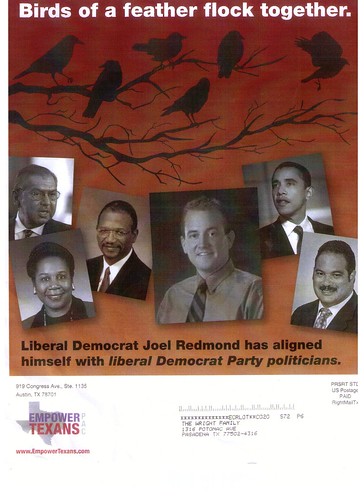
The submerged, racist tendency at play here--the assumption that “darker” people stick with “birds of a feather” for irrational or sinister purposes--is perfectly crystallized in the following image. This is a recent campaign advertisement for a state-level race in Texas, sent through the mail by “Empower Texas,” a group of Republican swiftboaters.
The white guy among the black “crows” is Joel Redmond, the Democratic candidate being attacked in the ad, presumably for sympathizing somehow with black leaders and causes.
As Glenn Smith writes at Open Left, “Anyone with any racial sensitivity gets the meaning of the mailer: Redmond has betrayed whites by befriending people of color. He can't be trusted.” I would add that white recipients are also supposed to sneer at Redmond because he’s a “race traitor,” and that his traitorous crime’s include that of betraying his whitened individuality, by joining a darkly sinister flock of like-minded, irrational (and thus animalistic) . . . sorry, but there’s no other word that fits here—“niggers.”
Those crows are, you know, "black" crows. Pretty much like these, from the 1941 Disney "children's classic," Dumbo:
Oddly enough, and despite a lot of evidence to the contrary, white Americans rarely think that white people naturally flock together and watch each other’s backs. When white folks cluster together into lily-white towns, or into white-bread suburbs like the one I grew up in, or into all-white churches and nearly all-white schools, or into boardrooms and "Fortune 500" lists, and then work in assorted covert ways to keep out people of color, that’s supposedly just a sort of coincidence, and surely not evidence of white racial solidarity.
On the other hand, as Chris Matthews pointed out above, the general issue of racial solidarity is "tricky." For a variety of reasons, various groups of non-white people sometimes do stick together, and they sometimes do watch each other’s backs. But when they do so, there are good reasons, and they usually do so in very different ways from the unacknowledged forms of white solidarity.
“American” culture and society--which are actually “white” or “white-framed,” instead of just “American”--have encouraged a bleaching away of non-white traditions and ways of being that a lot of people would just as soon hang onto. So, non-white people often get together or stay together so they can do just that. At the same time, whitened American society has also pushed non-white people together in many ways, and it continues to oppress and exploit them, making it a good, realistic idea for them to watch each other’s backs.
All of which is not to say, however, that all African Americans, for instance, naturally or irrationally stick together. And it’s especially not to say that if a lot of them support a black politician, they’re doing so thoughtlessly and impulsively, merely because they’re black too.
The main problem I see with this ironically reflexive and irrational white perception of black solidarity is that it ignores and discredits the kind of individual thought and careful consideration displayed so thoroughly in Powell’s endorsement. That kind of informed consideration was also on display early in the Democratic primary, when a majority of black voters supported Hillary Clinton instead of Obama.
Many of those supporters clearly saw in Clinton a candidate whose beliefs and favored policies fit well with their own, and as I understand it, a major turning point came when Clinton and her husband Bill started engaging in some of the same “birds of a feather” race-baiting against Obama that McCain and Palin have been using recently.
So yes, the topic of racial solidarity is a tricky, complicated issue, and it's resulted in a really long blog post. I’ll conclude by referring to a useful characterization of Rush Limbaugh’s most recent racist remarks by David Neiwart, who writes for Crooks and Liars:
Limbaugh is the guy at the sports bar who carefully tabulates the racial composition of every team on the screen and roots accordingly. If a team has a black quarterback, he predicts they're going to lose. Heaven forfend that any black player demonstrate too much enthusiasm over a touchdown or a dunk or a home run, or that any black linebacker should level a white quarterback, because then the "thug" and "jungle" references come out. He hates Tiger Woods with an inexplicable venom (mostly because he's too uppity "full of himself").
We all know that guy. (Some of them are in our families.) And anyone who's even moderately serious about sports, and moderately knowledgeable about them, knows that that guy is completely and hopelessly full of shit.
Neiwart sets up a pretty large target here, and he does proceed to land a bull's-eye, but I think he misses the larger target. That’s the proverbial white elephant in that bar, and in our living rooms, and in America at large.
Digging a little deeper beneath the white skin of Limbaugh/Joe Sports-Bar reveals that his thought processes are not all that different from those of most other white folks. Like Limbaugh and his cawing, conservative white crows, most white folks think that blacks or other non-whites flock together, and that they do so naturally, impulsively, and irrationally.
Many white folks would pat themselves on the back for being different from Limbaugh and those white racists represented by Neiwart’s Sports Bar Guy.
How different are we, though, in those moments when we don’t really listen to what black people have to say? Or when we assume that blacks and other non-white groups just naturally stick together, and even belong together, and that they belong together over there? And how different are we when we also assume that nearly all-white gatherings and settings have nothing at all to do with racial solidarity?