Sunday, May 18, 2008

overlook hillary clinton's whiteness


As I've pointed out before, it's odd how white Americans were generally upset over the remarks of an African American candidate's African American minister, but they tended to overlook the racism of Hillary Clinton's own remarks on race. In a radio interview, Clinton made an overt call to white solidarity, proclaiming herself a more viable candidate than Barack Obama because she supposedly has broader support among white voters. The public reaction was mild, at best, and Clinton was not pushed into making a major speech about race in America, as Obama eventually was because of someone else's remarks.

White Americans tend to overlook the racism of Hillary's playing, in this instance and others, of the white race card, as well as those by her husband Bill, and by other supporters of her campaign, such as Geraldine Ferraro. White Americans commonly overlook such racism because they've been trained into ignoring the more general white supremacist context of contemporary American society.

Democrats are making history this year because for the first time, their nominee will be a person who is either a woman or an African American. While Obama continually downplays his racial status, nearly everyone else foregrounds it. Clinton usually downplays her gender status, and with the exception of many white feminists, who receive little attention in the corporate media, nearly everyone else downplays her gender too. These disparate treatments of Obama and Clinton have more to do with the significance of race, which in this election seems to be trumping the significance of gender.

In an exceptional analysis of these issues posted yesterday on the progressive-opinion web site CommonDreams.org, political scientist Zillah Eisenstein explains why these different perceptions of the two Democratic candidates occur. The very title of Eisenstein's article is a blunt declaration of the significance of what most white Americans tend to overlook: "Hillary Is White."

Eisenstein writes in part,

Hillary Clinton presents herself to the electorate as a woman. She argues that she wants to break the glass ceiling of/for gender. But the truth is that she is not simply a woman but both a woman and also white. The very fact that she ignores her own race, in a way that Obama cannot, is proof of the normalized privileging of whiteness.

In this instance white is not a color, but the color, the standard, by which others are judged. So she silently, inadvertently but knowingly, uses her color to write her meanings of gender and mobilize older white women and angry white men by doing so. She presents herself as a woman but her real power here is as white. . . .

Most often the term white is not spoken alongside the term woman; there is no need. One only specifies color when it is not white. Women are assumed to be white if not specified otherwise, especially if you are speaking about gender or women’s rights, or feminism. Forget the fact that it was a group of black women that initially challenged the Supreme Court in the first sex discrimination case in this country years ago.

Hillary speaks of herself as a woman, and then speaks separately about race, as though she does not embody both at the same time. She has as much ‘race’ as Barack, but her race is not a problem for her. It is for him, even though it may not be as much as a problem as she is trying to make it. As such, Hillary, as a (white) woman pits herself against Barack (as black) with a race so to speak. So Hillary (as a woman) is falsely, wrongly, pitted against Barack (as black). Her whiteness privileges and pits gender against race. She encodes her whiteness as though it is central to her gender, and to her kind of feminism without saying a word.


In America's past, whiteness was a highly marked, highly sought status,* but most forms of whiteness today go unnoticed as such in the minds of white people. While most white Americans immediately see and react to the blackness of black people (and to lesser degrees, the racial status of other non-white people), they tend to think of other white Americans as mere individuals. Accordingly, in contrast to anything that might have to do with Obama's blackness, such as the controversial remarks of his minister, Clinton's calls for white solidarity are not widely considered in terms of her own racial status.

Another oddity here is that while Clinton's whiteness means she is not pressured to address her own racial status after making her own racist remarks (again, it was instead Obama who was pressured into delivering a major speech on race, because of someone else's remarks), her minority status in the political arena in terms of gender is also not something she feels pressured to address.

Although gender disparities still exist in America, Clinton has not been pushed into making a major speech about them. She has felt pressured to compensate in less direct ways for her gendered minority status in the political arena. Her occasional response has been to project a paradoxically "manly gender," as Eisenstein puts it, which she does by embracing the stereotypically white working-class behaviors and attitudes associated with militaristic posturing, hunting, and alcohol consumption.

As Eisenstein points out,

She has never spoken on behalf of women or as a candidate with a woman’s agenda, let alone as a feminist when she was in the White House. Many of us who are her contemporaries were active in the Civil Rights Movement and Women’s Movements and Anti-Vietnam War movement — while she chose not to be. Her one speech addressing the exploitation of women was delivered in Beijing, China, as though it is women outside, but not inside the U.S. who face untold discrimination. Now she runs for president and has become a gun-toting, war mongering white woman who asks for your vote if you are an angry white Reagan Democrat. Maybe she thinks manly gender is the answer for breaking glass ceilings for women. . . . Instead of challenging the gender divide Hillary simply slides over to the other side of it.

Clinton's various performative contortions have demonstrated that race, class, and gender are all significant factors in this election season. Religion is too, in the persistent efforts to associate Obama with Islam; alternative sexualities are less at play, since, unlike George Bush, all of the candidates project unquestionable heterosexuality.

In terms of race, Clinton carries her whiteness wherever she goes, but white people tend to overlook its significance, even when she makes racist pleas for white solidarity by suddenly pretending to care about white working-class people.

(Hat-tip: season of the bitch)

*"By 1850 American expansion was viewed in the United States less as a victory for principles of free democratic republicanism than as evidence of the innate superiority of the American Anglo-Saxon branch of the Caucasian race. . . . a sense of racial destiny permeated discussions of American progress and of future American world destiny. This was a superior race, and inferior races were doomed to subordinate status or extinction." (Reginald Horsman, Race and Manifest Destiny)

Update: The New York Times has a good discussion of the overall uselessness of Clinton's effort to appeal to limited sectors of the white voting population. In "White on White," Timothy Egan writes in part, "In Kentucky, over 25 percent of Clinton supporters said race was a factor in their vote – about five times the national average for such a question. Clinton, if she really wanted to do something lasting, could ask her supporters why the color of a fellow Democrat’s skin is so important to their vote."

Saturday, May 17, 2008

travel on the road to nowhere

Whiteness describes, from Little Big Horn to Simi Valley, not a culture but precisely the absence of culture. It is the empty and therefore terrifying attempt to build an identity based on what one isn't and on whom one can hold back.

--David Roediger


To be white is to have expunged all dirt, fecal or otherwise, from oneself; to look white is to look clean. . . .Whiteness as an ideal can never be attained, not only because white skin can never be of the hue white, but because ideally white is absence: to be really, absolutely white is to be nothing.

--Richard Dyer


You stop and crawl inside your head with a flashlight to look for the lost lesson. The light jumps out into the darkness like a shout and bounces off freshly painted walls. There is an almost blinding whiteness, an emptiness with your name on it.

--George Roberts


Friday, May 16, 2008

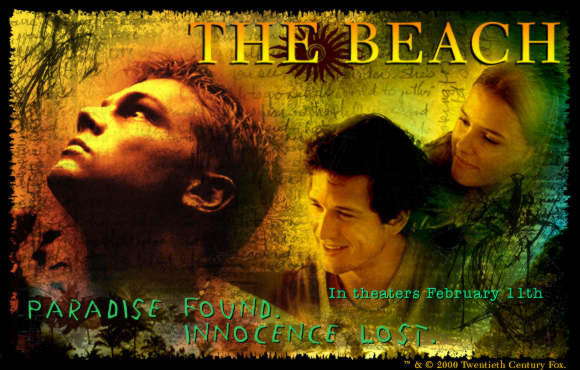
white movie friday : the beach


I watched this film last night, hoping to write an admiring review of its handling of white characters in foreign lands, but The Beach left me disheartened. I thought it had promise because its makers, director Danny Boyle and producer Andrew MacDonald, put together the much better films Shallow Grave and Trainspotting. They seem intent here on getting a message across about young Americans abroad, but the message ends up garbled at best, lost amidst the apparent need to earn back the megastar salary of Leonardo di Caprio by offering a lot of titillation, and very little cerebration.

In my review of Wes Anderson’s The Darjeeling Limited, I examined how such whites-in-foreign-lands movies tend to operate, which is basically by keeping culturally blinkered, self-involved white characters on center stage throughout, and by reducing non-white characters to one-dimensional stereotypes, and the lands they live in to exotic, variably beautiful or disturbing backdrops. These adventure films are “white movies” because they’re made by white people, about white people, in order to appeal to a white audience.

Again, I had hopes that this film would have more substance threaded into its entertainment efforts than Darjeeling does, but alas. An extensive review would thus entail repeating much of what I said about that film. All-American-boy Leo plays Richard, who goes to Thailand, drinks snake blood, gets laid, finds a bitchin’ beach, gets laid again, stabs a shark, sees some people die and almost dies himself, then escapes it all with a wry smile, a little older and a little wiser. Richard also wrangles occasionally with sweaty, scowling dark people, none of whom get more than two or three lines of character-building dialogue.

So The Beach portrays a very white, male American brand of adventurism, but it does demonstrate more effort than many other such movies to critique its obstinately white travelers, whose stubbornness resides mainly in their apparent inability to dislodge themselves from their own blithely selfish, destructive perspectives.

The beach Richard finds is inhabited by a group of people like himself, Americans and Europeans who want to live “off the map.”
These people repeatedly proclaim their joy at having found paradise, and Richard soon joins them. He’s made the mistake though of inviting others, who soon follow, resulting in the emergence all sorts of repressed ugliness, not unlike that portrayed more insightfully in another island-life story, Lord of the Flies.


Like Richard, the people in the ad hoc family he joins take relational pride in being unlike other Western travelers, or “tourists,” those who flash by in the city scenes, gaudily and obviously chugging beers, groping Thai women, dancing on fire-lit beaches, and vomiting in the street. The filmmakers know, though, that “paradise” is just a Western state of mind, and they make some effort to expose the imperialistic underpinnings of this supposedly egalitarian community.

Dean MacCannell, who made a scholarly reputation by analyzing Western approaches to the rest of the supposedly uncivilized world, has explained part of what’s wrong with this urge to get away from the crowd, and often from oneself, by pursuing some unspoiled Eden. Any paradise found is almost always a paradise constructed, and it almost always remains tethered in a specific relation to the supposedly civilized society one came from, and to the darker, supposedly messier society it actually belongs to: "A paradise is a traditional type of tourist community, a kind of last resort, which has as its defining characteristic its location not merely outside the physical boundaries of urban industrial society, but just beyond the border of peasant and plantation society as well."

Aside from the irony of there being little original about this community’s off-the-map (but really on-the-map) portrayal of what amounts to “tourism,” rather than “travel,” it resides on an island owned by a Thai marijuana farmer. He and the hired, armed men who guard his crop have little to say or project beyond menacing threats, but they do deliver a comeuppance to the community that unveils its careless disregard for local people.

The community's claim to being a sustainable, valid alternative to "normal" life is also exposed as a sham when some of its members suffer a shark attack. As one attackee lies groaning for days on end with a leg that's turning green, the community dispatches him to a tent, unable to put up with his complaints. As the party that is their life resumes, Richard registers disgust for us with their basic immorality.

Despite such brief displays of its own morality, the film itself is notorious in another, racially charged way. Just prior to its 2000 release, news began emerging about the actual Thai beach where it was being made. The filmmakers wanted their white traveler’s goal to be an especially unspoiled, paradisaical beach, so they found a nice one in Thailand. It wasn't unspoiled enough, though, so coconut trees were imported, unsightly sand dunes were bulldozed, and other landscape adjustments were made. Local environmentalists objected, but Fox Studios found the right government officials to bribe, and the actual beach’s ecosystem is still struggling to recover. (The extent of the damage caused by the film crew and its aftermath were tracked by a group of Thai students, who logged their results on a web site called “Footsteps on the Beach.”)

At one point, Richard descends into a deranged state, running half-naked through the jungle, eating insects, and setting vicious booby traps for the farmer's armed guards. His internal frame of reference is suddenly highlighted by the image of him as a character in a video game, fighting animated tigers and dispatching paper-thin villains. This scene connects with earlier ones showing him playing an actual video game, and with another character's attribution of the thickness of his thumbs to excessive video-gaming. The implication is that Richard suffers a detachment from reality because a socially induced filter alters his perception of the world, and of his role in it. Also, we can see that the lingering effects of his American upbringing inform his performance of a Tarzan/Rambo fantasy in ways that would only fit a white male. What seems to snap him out of this fantasy, if only briefly, is the reality of having a woman's blood splatter in his face as she dies.

Had the filmmakers further explored Richard's young, white, male American perspective, and the tendencies while traveling abroad that are often induced by such a social status, this movie could have been much more interesting. As it is, The Beach mostly just participates in the kind of hedonistic, exploitative tourism that it pretends to critique and rise above.


Here's the film's trailer:

work for the benefit of non-white people

The ways of white folks, I mean some white folks . . .


When I write on this blog about "stuff white people do," I hope it's clear that I'm always writing about stuff SOME white people do. Rather than making blanket statements about all white people, what I'm usually trying to point out is what I've come to understand as common white
tendencies.

As a white person, most of my own white ways were not evident to me until I had them pointed out by others. Those others have usually been non-white people, who often understand the ways of white folks better than white folks themselves do. When I recognize a common white tendency in myself now, I usually try to counteract it.

These days, white folks were all told as children that they should avoid broad generalizations about groups of other, non-white people. However, being categorized into any racial group does induce tendencies, and I think those can be addressed without constant qualifications about how one is not talking about
all members of the group.

Over at one of my favorite blogs, Too Sense, One Drop wrote a very helpful post on this topic, explaining in part:

There are times when I speak in broad generalities, when it seems as if I am accusing all American white people of being guilty of the acts that I am discussing. I'm not doing that. I know full well that there are an awful lot of white people who want no part of racism, and who are working to overcome racism within themselves and within our community. I try to be one of those people every day. But it's difficult to talk about large societal issues, and group behavior, without treating people who fall into a certain category as if they are part of some monolithic group. I don't always communicate in my writing what I am thinking subjectively, which is that of course not all of us in the white community do the harmful things I'm writing about.

Since I'm also writing this blog in an effort to promote understanding of the ways of (some--most?) white folks, I've been thinking lately about what
certain white people do. White anti-racist activists, that is. One thing that some white people do is work for the benefit of non-white people. I think of this blog itself as a form of anti-racist activism, but of course, white folks have many other options for fighting racism.

A friend of mine, for instance, seems to put her entire self into that fight, in part by working with children on an Indian/Native American reservation. I asked her recently how she thinks of her own whiteness while she does that work, and she sent me a letter in response.

I think my friend's letter does answer my question about her whiteness, and after asking her permission, I'm posting it here. It strikes me as an admirable expression of white self-awareness, and both of us invite any sort of response. (If you're so inclined, you could leave a comment, or write to me at unmakingmacon@gmail.com ).

One other possible way to think about this letter--Resist Racism recently offered a provocatively entitled post, "Why I Hate White 'Anti-racists.'" I'm wondering if the author of that post would also hate my friend.

(In the interests of legibility, I'm posting this letter without the usual italics that I use for longer quotations.)

____

I am what some people call a “do-gooder.” I like to help people, to encourage them in some way to make the world around us a little better. My desire to help others is often expressed by volunteering with non-profit organizations that provide services for low-income, at-risk children, youth, and families. In my desire for social justice, I have volunteered and worked with faith-based organizations in the Philadelphia area, Chicago and northern Illinois, Mississippi, and most recently on an Indian Reservation in the upper Midwest. I am white, and most of the people I have worked with have been POC, primarily African-American and Native American.

When I first stared volunteering, almost twenty years ago, I admit I was condescending and patronizing, desiring to alleviate the “plight” of those poor people – a pretty typical white do-gooder. I began to realize that I was “white.” and that I had a lot to learn about being white. I began to see things from another perspective, to see myself as a white person.

Perhaps it was the sudden realization that the roles were reversed, and I was often the only white person – wondering what “they” thought of me: was I was welcome? what did they say about me after I left? I remember driving through my inner-city, predominately non-white neighborhood
the day after the Rodney King verdict, and going into a neighborhood store to get a bottle of iced tea to drink. I suddenly felt very aware of my whiteness and the privileges that go along with that whiteness.

I saw in myself the condescension, the paternalism, the assumptions that white was normal and right. It was not pretty to see the arrogance and ethnocentrism in the white world around me, and in myself. My motives were sincere and genuine, but I was blind to my attitudes of racial superiority and white privilege. I began to see myself as a learner and a receiver, instead of a teacher or the one with the solutions. This has been a long and often humbling journey of realizing that I have been and still am being trained to be white.

Recently, I was visiting friends and volunteering on the “rez” at a small Lakota-led parochial school. While I was there, I kept thinking about your post about white people being trained to be white. I observed two situations that illustrated this concept of white training.

As I was working in the office, a white retired real estate agent was visiting the school to help with acquiring some property for expansion. He commented, “I don’t sense that these people [meaning the Lakota residents] want any help. Do-gooders come here to help, yet it doesn’t seem that the people take advantage of it. What are do-gooders supposed to do when they don’t want help? What about you, why are you here? You’re a do-gooder.”

This man’s motive was sincere in that he truly wanted to help, but he could not see his own white assumptions and impositions. He seemed to assume, like many white people, that POC are incompetent, that poverty, alcoholism or drug abuse are their own fault – in other words, blaming the victims. White people often do not recognize or want to admit that white privilege and influence like their own created the systemic issues that continue to exacerbate the problems of low socioeconomic status and the accompanying isolation and exclusion.

In addition to helping with some office work, I also volunteered in the classroom, by helping Native American students with their schoolwork. The teacher there, a white woman in her mid-twenties, a para-educator, has no patience with the children, and can’t wait for school to be over. She is clueless that the actual source of her frustration is her expectation that the children act like white suburban children. Clearly, though, that’s an unfair expectation because these kids come to school weighed down with problems that would break many adults.

Over half of the kids have parents in jail and live with other family members. One 11-year old boy hasn’t seen his mom since he was three. He often says that it really doesn’t matter if he comes to school because he is just going to end up a drunk Indian anyway. A nine-year old girl is afraid when she goes home because her mom and uncles are always drunk.

This woman has lived here for over a year and a half, and she still looks at the children as an outsider, as a white outsider. She cannot put herself into their world – she cannot accept them as they are nor give them hope for the future. It’s heartbreaking to listen to her and watch her interact with the children. I wonder if this is what the old boarding schools were like – trying to make “white Indians”!

So – am I any different from these two white do-gooders? I hope so. My response to the white retired real estate agent’s question is that I try not to come as an outsider imposing my solutions to what I perceive as problems. I come as a learner, seeking to learn about the Lakota people and the challenges they face, hoping to better understand their world. When I come to the rez, I ask them what they want me to do to help them accomplish the vision they have for their own reservation. The poverty and alcoholism are overwhelming – I admit that I want to “fix” the problems of the rez. But, I also realize that as an outsider, a white outsider, I really do not understand and I really cannot just jump in and fix whatever is wrong.

The problems are the result of hundreds of years of injustice that cannot be quickly or easily solved. I do not have the solution, but I want to do something to help those on the inside who have more understanding and influence than outsiders do. I want to come along beside and be a partner, not the “great white hope” with all the answers. I do not volunteer out of guilt or shame for the centuries of past white injustice and their continuation into the present, but I do acknowledge and admit that it is wrong, very wrong, and that I have benefited from it. I volunteer not only to help, and to balance the scales of justice, but because I want to learn, to understand a little bit better, and become more culturally sensitive.

However, volunteering is only one small part of my process of growing in cultural awareness. The most important and most effective way for me to become more aware has been through relationships, through genuine friendships that are strong enough to talk honestly and openly about racial and ethnic issues. I appreciate my friends who are honest with me and can confront my whiteness, friends who I’m there to help but who are also my peers. I hope these are friendships based on mutual respect and appreciation.

I also hope I will continue to grow in recognizing my own whiteness and ethnocentrism. I hope I am growing in understanding. Although I began this process of recognizing my whiteness and how it affects my worldview some years ago, I realize that I have a long way to go, that it takes work and intentionality to become more aware and sensitive.


Thursday, May 15, 2008

forget the names of non-white people


Asian Americans often claim to be good at distinguishing their groups from each other--Japanese Americans from Korean Americans, Chinese Americans from Filipino Americans, and so on. It's hard to blame non-Asian Americans for lacking that ability (unless we're talking about distinguishing, say, Japanese Americans from Asian Indian Americans).

However, the common failure to distinguish individual members of a group from each other is a problem, and it's an area where non-Asian Americans should simply try harder. And when it comes to African Americans, non-African Americans should try harder too.

As you may have heard, People magazine recently screwed up royally in this respect. They did a feature on a Korean actor and singer named Rain (or Bi, in Korean). He's the Asian sensation who's been having a feud/dance contest with Stephen Colbert lately, and also the Asian sensation who's also currently starring in the new Wachowski brothers film, Speed Racer:


Problem is, that photo on the upper-left of the original page isn't Rain--it's Karl Yune, a Korean American actor (and the younger brother of a more famous actor, Rick Yune). That's the real Rain in the inset photo that's superimposed on the lower-right of the magazine page.

Rain and Karl Yune don't really look alike, do they? Alike enough to mix up their photos in such a prominent, publicity-generating magazine?

These things have happened before, so you'd think the people at People would know better by now. In 1988, Rolling Stone magazine committed a similar gaffe when it sent P. J. O'Rourke, the reactionary, white, psuedo-gonzo journalist, to South Korea. O'Rourke's ostensible topic was elections and political protests, but his real interest was pursuing and depicting what struck him as the bizarre, alienating elements of a foreign place.

For O'Rourke, none of the individual Koreans emerged as distinct human beings--they're more like an undifferentiated, "tea-stained" horde. At one point, scanning the Korean faces at a major demonstration, O'Rourke wrote with something approaching terror:

I was looking at this multitude, and I was thinking, "Oh no, they really do all look alike--the same Blackgama hair, the same high-boned pie-plate face, the same tea-stain complexion, the same sharp-focused look in one million anthracite eyes."

But it's not just white folks who lump members of other groups together (and who knows what sort of person slipped up at People). Over at Ask a Korean, a blogger named "the Korean" has a confession to make about what he sees as a natural human tendency:

This process happens to any race of people who are considered "exotic."

Here's a confession: the Korean himself, for some years after he moved to the U.S., had the hardest time distinguishing Danny Glover and Morgan Freeman. They are both slim, distinguished looking black men who have some gray hair -- at least, those were the only things that stuck in the Korean's head whenever he saw Mr. Glover or Mr. Freeman. So even though they look nothing like each other, the Korean's mind just jumped the gun, until he consciously tried to remember every single facial feature of the two men.

So depending on the context, failing to distinguish between the members of a group can happen to anyone--it's not something that only white folks do.

When it becomes a problem, though, is when you have regular contact with people outside your group. When you're working with them, or attending school with them. Then it's definitely worth the effort to try to remember "every single facial feature," so that you can remember that very important thing, their names.

Since this blog is about Stuff White People Do, I'll point out the most common, annoying, and at worst, demeaning way that white folks tend to confuse non-white people for each other--they call people of color they know by each other's names.

Usually if there's one non-white person around, all the white folks know that person's name, just because he or she is such an anomaly. But if they know, for instance, two black women, or two Asian men, white folks often use their names interchangeably.

New York Times veteran Lena Williams discusses this problem in her book, It's the Little Things: Everyday Interactions that Anger, Annoy, and Divide the Races. As Williams points out, what white name-confusion boils down to is a lack of respect:

We've all done it: called an acquaintance, colleague, or classmate by someone else's name. Yet black Americans are more likely to become agitated when whites call them by another's name, because they are convinced the mistake stems from the racial stereotype that "all blacks look alike." It's another form of invisibility.

"We all have gradations in skin color and hair texture, but white people don't seem to make those distinctions," said Cassandra Woods, a thin, dark brown-skinned woman in her forties. A former bank teller, Ms. Woods recalled countless times when regular customers mistook her for another black teller, who was lighter in complexion, heavier in build, and ten years her junior.

"It was bad enough when regular customers did it," she said, "but even some of my longtime colleagues would make the same mistake."

Williams (who is also black) also recalls incidents in which she and other black people are mistaken for celebrities, and for other black individuals that white folks know.

But these were strangers, and their mistake was understandable. It's a far more grievous injury when the mistaken identity is made by whites who, by now, should know better. You know, people you work with, go to school with, live in the same apartment complex with.

"We feel as though we're interchangeable parts," said my brother, known as Doc to friends and family. "That whites don't take the time to look at us or get to know us as individuals with our own unique qualities and habits and hobbies."

Williams admits that this can happen in reverse too. Black people often mistake white people for each other too. However, "there is a difference":

Blacks have been stereotyped for so long, the perception, in most cases, has become a kind of cold, harsh reality. Deep down, many whites truly feel that most blacks look alike. . . . [Also,] blacks sometimes bark at whites and say things that are rude, stereotypical, and ignorant, but we don't, in a systematic way, deprive them of their livelihood or anything that has an ongoing effect on their life or lifestyles."

So what can sincere, goodhearted white folks do about the problems that arise from their tendency to think that non-white people all look alike?

Open your eyes. Look more closely for distinguishing features. Have conversations with the non-white folks around you so that their distinctive qualities emerge past the veil of their color.

In other words, get to know the non-white people around in the same way that you've been led to know the white people around you--as individuals.

Wednesday, May 14, 2008

find it odd to label whiteness "white"

(wearing 1 cup of white self-raising flour)

In Locomotion, a novel for young readers by Jacqueline Woodson, a young black child named Lonnie Collins Motion tells his story. The novel’s format is unique—a series of sixty poems written by eleven-year-old Locomotion (that’s Lonnie’s nickname), who writes them at the prompting of Ms. Marcus, his white teacher.

Throughout his poems, Locomotion gradually reveals that his parents have died in a fire a few years earlier, that he’s separated from his sister, and that he’s staying with a woman he knows as Miss Edna.

In one of his verse-style poems, Locomotion reveals his ability to see the significance of something that his teacher seems unable to see as at all significant—her own whiteness:

Last night this commercial came on TV. It was this white lady making a nice dinner for her husband. She made him some baked chicken with potatoes and gravy and some kind of greens—not collards, but they still looked real good. Everything looked so delicious, I just wanted to reach into that television and snatch a plate for myself. He gave her a kiss and then a voice came on saying He’ll love you for it and then the commercial went off.

I sat on Miss Edna’s scratchy couch wondering if that man and woman really ate that food or just threw it all away.

Now Ms. Marcus wants to know why I wrote that the lady is white and I say because it’s true. And Ms. Marcus says Lonnie, what does race have to do with it, forgetting that she asked us to use lots of details when we wrote. Forgetting that whole long talk she gave yesterday about the importance of description!

I don’t say anything back to her, just look down at my arm. It’s dark brown and there’s a scab by my wrist that I don’t pick at if I remember not to. I look at my knuckles. They’re real dark too.

Outside it’s starting to rain and the way the rain comes down—tap, tapping against the window—gets me to thinking. Ms. Marcus don’t understand some things even though she’s my favorite teacher in the world.

Things like my brown, brown arm. And the white lady and man with all that good food to throw away. How if you turn on your TV, that’s what you see—people with lots and lots of stuff not having to sit on scratchy couches in Miss Edna’s house.

And the true fact is alotta those people are white. Maybe it’s that if you’re white you can’t see all the whiteness around you.


Locomotion ends his poem with a profound understanding about a fundamental difference between white and non-white self-awareness. While non-whites carry around a conscious sense of their own racial makeup wherever they go, most whites are blithely oblivious to their own.

This white oblivion to a significant part of one’s social identity has an array of consequences. One of the worst is the common white belief that non-white people pretty much see the world the way they do. A result of that belief is that when non-white people say that race still matters, white people often ask in return, “What in the world are you talking about?”

Another consequence of the common white inability to see the whiteness all around themselves is the discomfort they tend to feel when that whiteness, and their own racial status, are pointed out to them.

In her luminous book Learning to Be White, the theologian Thandeka describes the results of a revealing experiment that she likes to conduct with white people. She calls this experiment “the Race Game.”

My luncheon partner, a fifth-generation Smith College graduate with a New England genealogy older than the state and a portfolio perhaps as wealthy, wanting to get to know me, asked what it felt like to be black.

I was not offended by her query. Her face was open; her eyes were friendly and engaged. She simply believed that nothing from her own background or experience could help her understand me. I knew better. I had been assigned a race by America’s pervasive socialization process, and so had she. I thus believed that if she drew upon her own experience of being “raced,” she might then be able to see what we had in common.

But how could I make her conscious of the racialization process to which her own Euro-American community had subjected her? Searching for an answer to this question, I invented the Race Game and invited her to play it for a week.

The Race Game, my luncheon partner very quickly discovered, had only one rule. For the next seven days, she must use the ascriptive term white whenever she mentioned the name of one of her Euro-American cohorts. She must say, for instance, “my white husband, Phil,” or “my white friend Julie,” or “my lovely white child Jackie.” I guaranteed her that if she did this for a week and then met me for lunch, I could answer her question using terms she would understand.

We never had lunch together again. Apparently my suggestion had made her uncomfortable.

African Americans have learned to use a racial language to describe themselves and others. Euro-Americans have also learned a pervasive racial language. But in their racial lexicon, their own racial group becomes the great unsaid.

I wanted my luncheon partner to give voice to her whiteness as the racial unsaid in her life. By consciously referring to this unvoiced color, she would become aware of what it feels like to take and maintain a racial identity in America.

Or so I thought. . . .

Why was the very prospect of playing the Race Game so daunting?


As both of these examples point out, the labeling of whiteness with the word “white” is daunting to most white Americans. Because they’re just not accustomed to doing that, being pushed to do so makes them uncomfortable.

But is that all there is to that discomfort?

Are there more feelings, or thoughts, or suspicions that arise when the great unsaid gets said?


Monday, May 12, 2008

prefer hillary clinton because she's white?

[Update: I recently analyzed Hillary Clinton and her whiteness in a broader context over at Talking Points Memo, in a piece entitled "Is Hillary Clinton a White Supremacist?" It made its way up to their list of "Recommended Reader Posts," and a heated discussion took place in the "comments" section below the article. -- Macon D]


The Democratic race now moves to West Virginia. Today, Hillary Clinton claimed she always wanted to be a coal miner. But those dreams were dashed when she was forced to attend Wellesley and Yale.


After last week's primary election results, it looks more than ever like Barack Obama has a lock on the Democratic nomination. Thus, whatever remains to be said about Hillary Clinton's latest playing of the white race card is sort of moot by this point.

Also, almost everyone else is blogging hard and well about this. So, I'll keep my comments short.

First, for the record, here are Clinton's 43-second comments about white solidarity, which she made during a radio interview:


Despite their brevity, Clinton's comments are generating a lot of bloggage because they display several severe errors in judgment. Perhaps the worst is her inaccurate implication that Obama cannot win because he's black, and that white Americans are finally waking up to his blackness as a problem.

What I'm wondering is, why are Clinton's efforts to rally white people together not being called out by the corporate media for what they are--a desperate, remarkably racist effort to solidify what amounts to a White Power Movement?

Just imagine how many talking heads would explode if Obama were to ever say such a thing about his appeal to black voters (most of whom, by the way, shifted their early support from Clinton to Obama precisely because of the repeated race-baiting of both Hillary and Bill Clinton).

As I've said before, the main reason Clinton doesn't get nearly as much blame as Obama would for trying to rally race-based support is that white people are not seen by other white people as white people. They're seen instead as individuals. Non-white people, though, are seen as members of a group, and as a result, they're considered unfairly biased.

From a white perspective, Hillary may come across as a racist fool, but if so, it's Clinton herself who's acting the fool--she doesn't represent white people in general. But again, if Obama were to say such things, white suspicions and fears about black solidarity, black bias, black claims to victimhood, and even black revenge would come to the fore.

So, since the producers and actors of corporate news outlets are overwhelmingly white, and since the media's audience and the voting population also remain largely white, Clinton more or less gets a pass for the kind of race-baiting calls to racial solidarity that would destroy Obama's campaign. Obama, on the other hand, has to demonstrate, constantly, that even though he's black, the common interests of black people are not a priority for him.*

As many statistical analysts have shown, Hillary Clinton does not actually have a broad base of support among white voters. Clinton is right about one thing, though--she does still have strong support among certain sectors of the white voting population, especially working-class/blue collar people (which is why, despite Obama's lock on the nomination, she will soon win in West Virginia and Kentucky), and older white women.

Now if she could just somehow combine those two voting blocks . . .


*By the way, I do think that such things as Obama's early work as a community activist and his recent speech on race demonstrate that he understands, and will work to change, the race-based disparities caused by the ongoing fact of American white supremacy. Again, though, I don't think he can openly say such things, since he does want to get elected.

Saturday, May 10, 2008

make books into movies

I recently reviewed Adam Mansbach's excellent novel Angry Black White Boy, the story of Macon Detornay, the downest white boy evuh.

Now I hear Mansbach's book is being made into a movie!

Here's the trailer (they changed the title. And a couple other things):


Just kidding--I know of no plans to film Mansbach's book.

In case you didn't catch it, that slice of sad cinema is called The Breaks, which was released in 1999.

Nice to see George Clinton again.

(Hat-tip: Wigger Lover)

saturday book rec : the bluest eye


Toni Morrison is widely recognized as one of America’s greatest literary authors. However, because of her race, she is most often labeled a great “African American” author. When was the last time you heard John Updike, or Jane Smiley, or any other pale-faced writer, described as a great “European American” author? Or even as a “white author”?

Racial labels are rarely applied to white American authors, or to other kinds of artists who are white, unless their work is being compared to that of non-white artists. The latter, however, have to drag around their group identities, representing and supposedly speaking for their race wherever they go.

Toni Morrison’s writing has always demonstrated her willingness to take on this burden, which she does by addressing the manifold realities of “her (black) people.” However, categorizing her this way limits recognition of the insightful artistry with which she depicts and examines other subjects. In her first novel, The Bluest Eye, which was published in 1971, the title itself suggests that this story, about African American characters living in Ohio during the 1940s, is really about something else.

Although this novel is one of several that routinely earn Morrison praise for producing “masterpieces of African American literature,” The Bluest Eye really focuses on three other topics: Love and Beauty, and a social force that still determines who most deserves both, American White Supremacy.

The novel’s main characters are a trio of girls—Claudia and Frieda McTeer, part of a relatively secure, middle-class family, and Pecola Breedlove, whose family mostly does the very opposite of what their name implies. As the novel opens, Pecola is staying with the McTeers because her own family unit has been destroyed. That happened when her father, Cholly Breedlove, raped and impregnated her. As she drinks way too much milk from a Shirley Temple cup, Pecola gradually becomes obsessed with acquiring that which the world most evidently loves, blue eyes.

Claudia narrates alternating sections of the novel from an adult perspective, sorting through her childhood memories in an effort to understand how Pecola’s life was ruined. She retells and reveals much else along the way, especially the forces that bore down on the lives of everyone she knew back then. The novel’s other sections, told by an unknown narrator, relate the life stories of various members of the Breedlove family, and also towards the end of the novel, that of a peculiarly clean “dirty old man,” a fraudulent spiritual adviser named Soaphead Church.

Throughout the novel, as in real life, black people are continually faced with the assumptions and demands of a white world. Some of these involve encounters with actual people, as when white furniture movers refuse to take back the Breedlove’s torn couch, or when a white candy store owner displays his contemptuous indifference towards Pecola because she’s black. But like the great Modernist writers she has studied and emulated (she wrote a Masters thesis on Virginia Woolf and William Faulkner), Morrison is more interested in interior landscapes. In The Bluest Eye, she burrows deep into her characters, exploring the insidious ability of white supremacy to ambush the black psyche, ultimately crippling what we now identify as “self-esteem.”

The novel’s primary object of critique is the “thing” that makes some children automatically more valuable than others, more loved because they are considered more beautiful. This “thing” finds its way into the novel’s girls via their parents and the other black adults around them, who coo over white babies on the street but not black ones, and who give their black children white dolls, Shirley Temple drinking cups, and affectionate nicknames based on white movie stars.

One of many painful scenes in the novel describes the failed efforts of Claudia and her sister to befriend a favored, light-skinned classmate, Maureen Peal. All the girls can eventually manage is hatred for each other, and the adult Claudia explains that the cause was something external to them all, something that caused adults to love Maureen more than Claudia and Frieda. Compared to the fair Maureen, Claudia says,

We were lesser. Nicer, brighter, but still lesser . . . . What was the secret? What did we lack? Why was it important? And so what? Guileless and without vanity, we were still in love with ourselves then. We felt comfortable in our skins, enjoyed the news that our senses released to us, admired our dirt, cultivated our scars, and could not comprehend this unworthiness.

And all the time we knew that Maureen Peal was not the Enemy and not worthy of such intense hatred. The Thing to fear was the Thing that made her beautiful, and not us.

In Rock My Soul: Black People and Self-esteem, bell hooks discusses this same “thing,” which is actually a set of standards for beauty and worth. hooks encapsulates these standards with the term “white supremacist aesthethics,” and she explains well the vexed relationship that Morrison’s novel is all about, that between white standards and black females:

The black female body is the site where white supremacist thinking about beauty and blackness is reinscribed again and again. Dark-skinned black males, thought often portrayed stereotypically, play a number of roles in mass media. They are not always and only villains. They are not always and only depicted as ugly, or less than desirable.

Yet whether the images are those of black girls or black women, the color caste is in place and dictates the standards. The contemporary movie Soul Food depicts images of three black sisters, all of whom are fair skinned with straight hair, all of whom are portrayed as desirable. Their black male partners are different colors—one is dark, one is light, one is brown skinned—but they are all depicted as desirable. The only darker-skinned black female character is the obese brown-skinned mama; she is not portrayed as desirable.

These racist, sexist stereotypes are all-pervasive. They set the standards in all mass media. Yet scholars and writers have not created a progressive body of work that examines fully the connection between shaming about the black body and low self-esteem. It continues to be the case that the most brutal stigma of color affects females more than males.

“Internalized racism” has become the standard term for describing the effects of white supremacy on non-white self-esteem, and Morrison’s novel may well be the most effective, moving description of how such standards hold back and even destroy non-white people. The Breedloves feel continuously “ugly” and act accordingly, and the primary reason is little more than their disfavored black skin. Pecola’s mother, Pauline, gradually gathers a sense of herself as despicable, especially by going to the movies and comparing herself to the parade of white beauties; one consequence is her subsequent inability to love her children well.

The broken personality of Pecola’s father, Cholly, is also traced back to encounters with white power. Like hooks, Morrison demonstrates through Cholly’s story that white supremacy affects black men differently, because men are valued more for what they do than for what they are. As hooks puts this difference, “sexism leads men to be judged more by how they perform than by how they appear.” Being interrupted and laughed at by white men while performing one of his foundational acts—his first sexual encounter—becomes for Cholly a literally defining moment for understanding himself, and as a result, for the inability of another Breedlove parent to love effectively.

Pecola’s repeatedly crushing encounters with the many guises of white supremacy bring her to Soaphead Church, a man who says he can give her those blue eyes, if she will consent to giving him something in return. By novel’s end, Claudia’s realizations include the fact that “Love is never any better than the lover,” and that black beauty fails to gain self-affirming recognition because it’s defined so strongly as the opposite, by a blind, omnipresent white eye.

The Bluest Eye was published in 1971, at the height of that particular coalescence of the Civil Rights era known as the black power movement. Although Morrison had her reservations about that movement, her first novel demonstrates her alignment with its aggressive assertion of black self-esteem.

Like Morrison herself, though, The Bluest Eye also deserves credit for artfully depicting the awesome power and reach of white supremacy.

Finally, for a profound and highly influential analysis by this “African American author” of some more specific white behavior and tendencies, I also recommend her brief non-fiction work, Playing in the Dark: Whiteness and the American Literary Imagination.

Now that James Baldwin is no longer with us, white America has no better, more insightful and loving critic of itself than Toni Morrison.

____

PS--For more on white beauty standards, see this earlier post

Friday, May 9, 2008

white movie friday : watermelon man

The very first thing we must do is reconquer our own minds. The biggest obstacle to the Black revolution in America is our conditional susceptibility to the white man’s program. In short, the fact is that the white man has colonized our minds. We’ve been violated, confused and drained by this colonization and from this brutal, calculated genocide. The most effective and vicious racism has grown, and it is with this starting point in mind and the intention to reverse the process that I went into cinema in the first fucking place.


In 1971, Melvin Van Peebles launched himself into the pantheon of black history and culture with his groundbreaking film, Sweet Sweetback’s Baadasssss Song. In that movie, which Peebles wrote, produced, directed, scored, and even acted in as the central character, insurgent black pride suddenly found cinematic expression. Van Peebles made that film outside of the Hollywood system, which never would have allowed a black protagonist’s heroic actions to consist of beating up cops, inciting race riots, and generally “sticking it to the man.”

Sweet Sweetback has been hailed as the first Blaxploitation film, but others say that it doesn’t fit that genre, since it works explicitly against white power, and also against black stereotypes, instead of exploiting such stereotypes for profit. Released just a year before Sweet Sweetback, Watermelon Man also addresses white power, but Van Peebles made it for Columbia Pictures, and apparently as a result, its satiric bite is somewhat muted.

Watermelon Man
does still manage to break genre limitations, by moving from broad comedy to satire to serious social drama. When the studio suggested several well-known white actors for the main character, Van Peebles held out for a black actor instead. He finally got Godfrey Cambridge, who plays white insurance salesman Jeff Gerber, a cheerfully racist and misogynist suburbanite, who wakes up one night to discover that he’s turned black.

When the studio requested a happy ending, in which the protagonist wakes up and realizes that his entire conversion experience has been nothing but a dream, Van Peebles insisted instead on a more serious and socially conscious ending. By doing so, he made his movie resonate sympathetically with broader efforts to fight racial oppression, and the film is now hailed as a milestone in African American cinema for doing so.

What the film still does not get enough credit for, though, is its additional analysis of the era’s common enactments of whiteness.

The movie opens in a lightly comic mode, with a whitefaced Cambridge playing Jeff Gerber, a suburban husband frantically working out and tanning himself in his basement, while his wife Althea (played by Estelle Parsons) and their two pubescent children, Janice and Burton, eat breakfast upstairs. After crediting his imaginary boxing partner, Muhammad Ali, with being “a credit to [his] race,” and then stretching out his naked white body under an elaborate sun lamp, Gerber joins his family in the kitchen. Not in their TV viewing, though, since he doesn’t like what’s pouring out of the television—news coverage of race riots.

When Althea says that white people should show “greater interest and understanding” in black struggle, Gerber won’t hear of it. Soon he’s out the door and performing his morning ritual, a footrace with a bus. He runs alongside it while the passengers shout for its black driver to hurry, hoping the bus will beat him to a later stop. Gerber arrives first, apparently as usual, and as he boards the bus, pays his cheaper fare, and demands a round of applause, we realize that he’s a loudmouthed dickhead.

As is usually the case with whiteness, whatever it is that’s white about this guy becomes more apparent in the presence of non-whiteness. Before going to work, he stops at a diner, where he jokes with the black man behind the counter by flinging racist comments at him. As he then boards a skyscraper’s elevator with other white passengers, he puts his cocked hand to the black operator’s head, announces a hijacking, and demands to be taken to Harlem. Gerber’s racism seems to bounce off these black targets, and the white folks around him shrink back in alarm.

His ultra-sexist masculinity also becomes more apparent in the presence of its opposite. As he strolls through the insurance office where he works as a salesman, he declares the women working there “sluts! Sluts! All of you are sluts!”

Oddly enough, in this satiric portrait of white masculinity, Van Peebles has Gerber project characteristics that normally register as black—athletic physicality, brash self-confidence, and hypersexuality. The difference from Hollywood's innumerable depictions of such qualities in black men is that when Gerber arrives home after a long day, these characteristics dissipate like air from a balloon.

When Gerber’s bored, pent-up wife asks for sex, he expresses no interest, then retreats for more exercise to the basement. Tellingly, a mirror there has the word “pretty” written across it. In all of his encounters, Gerber has shown himself to be totally self-absorbed, seeking out ego-boosting reflections of himself wherever he goes. As opposed to the stereotypical notion of inherent black masculinity, Gerber’s sexualized physicality does not spring from biological needs or urges, but rather as a needy response to the outside world.

This narcissism, and the persistent need to bolster it, have been widely identified as characteristics that are encouraged by whiteness; they’re also characteristics that are exacerbated by masculinity.

That night, after again refusing his wife’s pleas for sex, Gerber awakens in the middle of the night and heads for the toilet. When he turns on the light, he screams at the sight of his suddenly blackened self in the mirror. Van Peebles uses a series of colored filters to add a joke to Gerber’s horror (he’s become “colored”), and then Gerber speaks directly to the camera, as if he’s speaking to himself in the bathroom mirror.

The real horror here for Gerber, the white male narcissist, aside from a fulfillment of what is for him a racist nightmare, is that his constructed, performed, and rigorously maintained sense of himself is shattered. He cannot simply continue to see himself as Jeff Gerber, a man who happens to have a strange skin problem, because his identity is based so much on how he sees himself reflected in others. If they're going to see a black man instead of white one, the former Jeff Gerber will no long exist.

After pleading with his God for help, Gerber slips back into bed, hoping it’s all been a nightmare. Alas, the next morning finds him desperately scrubbing himself in the shower, and Althea bursting in and shouting, “Jeff, there’s a Negro in the bathroom!” Gerber then calls in sick and takes a taxi to his town’s “colored section,” where he empties some drugstore shelves of hair relaxers and bleaching creams.

Van Peebles’ interest in whiteness, or rather in specific and varied enactments of whiteness, extends beyond Jeff to the other Gerbers. When Jeff seeks sexual attention from Althea as a form of reassurance that someone still values him, she's no longer interested, and in fact, clearly repelled. As Gerber points out, her white “liberal” sympathy for blackness is thus exposed, as the sort that prefers to keep actual black people at arm’s length.

The Gerber children are soon highlighted as well, in a remarkable, and equally revealing moment. In this broad, often slapstick satire, viewers might expect Van Peebles to depict these white kids as nasty, spoiled brats. Instead, they are consistently good-natured and curious. This choice of characterization allows for another point about whiteness to emerge.

As the parents discuss how they’re ever going to tell the kids about their father’s monstrous conversion, Janice and Burton suddenly appear in a doorway. Faced with telling them the hard truth, Gerber wrings his hands and painfully mutters, “Hi. I’m your father.”

Instead of being shocked, or failing to recognize their father immediately, the children come to him while saying, “Sure, hi dad.”

“Don’t you have anything to say to me?” Gerber asks.

“Your face is dirty,” Erin says.

“Sure is a heck of a tan you got, dad,” Burton adds matter of factly. “You look like a colored man.”

As Gerber looks somewhat chastened by their utter lack of reaction in racial terms, a point gets made about whiteness--that it consists of a set of learned, performed responses to the world. The children are not yet old enough to have absorbed and learned to enact their era’s white adult fear and repulsion when confronted with blackness.

Gerber seeks medical help, suspecting that his condition is the result of too much tanning, and too much soy sauce in a homemade lotion recipe. His doctor eventually reveals, though, that it can only be the result of black ancestors. Gradually, the tone of the movie shifts, as Althea sends the kids away and then leaves herself, their white neighbors insist on buying their house, and Gerber loses his job and sets up his own insurance office.

I won’t give away the end of the movie, but I will say that Van Peebles’ insistence on his own ending, rather than the studio’s, aligns his film with the black power agenda of its day. Like some of his other films, particularly Sweet Sweetback, Watermelon Man contributes to Van Peebles’ reputation as a bold, rebellious fighter for black justice.

As I’ve been saying, though, he also deserves credit for turning the racial lens around, analyzing and exposing some of the ways of white folks, and of some white men in particular--as a self-involved, narcissistic, life-denying performance.


(The trailer for Watermelon Man doesn't seem to be available online, so here's one for a documentary about the film's maker, Melvin Van Peebles.)

How to Eat Your Watermelon in White Company (and Enjoy It)


From this documentary's promotional site:

“My politics is to win,” Van Peebles declares at the beginning of How to Eat Your Watermelon in White Company (and Enjoy It), a documentary that explores the life and work of this maverick, modern-day Renaissance man. Whether making guerrilla-style films, flying Air Force sorties over the Pacific (ferrying the atom bomb, no less), studying astronomy in Amsterdam, writing novels in self-taught French, composing music (by means of a self-devised notation system), writing musical stage plays (for which he received nine Tony nominations), recording seminal rap albums or trading options on Wall Street, Van Peebles has blazed his own path, making a mark in each endeavor he’s pursued.


Finally, if you're wondering what Blaxploitation cinema is, here's a taste. This is a compilation of trailers for four Blaxploitation films: Black Belt Jones (1974), Cleopatra Jones (1973), Ebony, Ivory, and Jade (1979), and (the unfortunately titled) Monkey Hu$tle (1976). Again, the two Van Peebles films above do not fit seem to fit this genre, because they address white supremacy and they avoid pandering to common white fantasies about blackness.


Thursday, May 8, 2008

teach their children to act white


Martin Mull
"Actress" (2002)


In 1949, Lillian Smith published Killers of the Dream, a memoir about growing up as a white Southerner during the early 20th century. Given the setting of her childhood, it’s no surprise that her memories include a lot of abusive acts against black people at the hands of white people.

What makes her memoir especially insightful, and far ahead of its time, is her understanding that race is an act, and that performing one’s appointed racial role means following a script. Also, by concentrating on her childhood with intensity and passion through a different act, that of writing, Smith came to see that the racial roles people are expected to follow distort the humanity of both white and non-white people:

I began to understand, slowly at first but more clearly as the years passed, that the warped, distorted frame we have put around every Negro child from birth is around every white child also. Each is on a different side of the frame but each is pinioned there. And I knew that what cruelly shapes and cripples the personality of one is as cruelly shaping and crippling the personality of the other.

I began to see that though we may, as we acquire new knowledge, live through new experiences, examine old memories, gain the strength to tear that frame from us, yet we are stunted and warped and in our lifetime cannot grow straight again any more than can a tree, put in a steel-like twisting frame when young, grow tall and straight when the frame is taken away at maturity.

Although Smith had recently published Strange Fruit, an extremely popular novel, her memoir generated little interest. One likely reason is that it says things about white people that they, as a group, were not ready to hear. Things that are still by and large true, but that white people as a group are probably still not ready to hear.

One of her most insightful points about white identity is a rather simple one, which still applies today:

White people aren’t born white. They’re raised to be white.

Times have changed since the days of American Apartheid, when Smith was writing. And yet, children born into white families still receive an array of directives regarding who they supposedly are in terms of race.

Racial lessons for children are less direct now, but they still learn that there are correct and incorrect forms of white behavior. As they mature, most of these children gradually gather what amounts to a list of rules and understandings for suitably white thoughts, feelings, and behavior.

Having undergone this racial training myself, and having since worked to perceive and understand it, I can see that the world around most budding white citizens continues to instill in them the following rules and understandings:

1. You are different from other children. Even though your initial impressions in pre-school, at the park, or on the playground behind your apartment building, tell you that other kids are just kids like you, some of them are not just like you.

2. You go to a school populated mostly by other white kids. If you don’t attend such a school, you’re an unusual white kid. There’s nothing wrong with going to a school that’s mostly white—it’s normal.

3. You are not to ask why you’re surrounded mostly by other white kids, nor why your neighborhood or town is so very white. You are also not to ask how things got that way. Adults do not have answers to these questions, and they quickly change the subject if you ask them.

4. You are an individual who is responsible for your own actions and accomplishments; your own racial membership is not a factor in your life. Nobody tells you that your race has anything to do with who and what you are, nor with what you achieve (nevertheless, as you might learn later in life, it does). The rules for white conduct are not explicitly stated as such, and you instead learn what you supposedly are as a white person by learning what other people supposedly are. The characteristics displayed by people who are presented to you as “black,” “Indian,” “Mexican,” and so on, define what you are by defining what you are not.

5. At the same time, your race does matter, and you should be proud of it. It was people like you who “revolted” against England and then “settled” the land, people like you who “built this country” into “a nation of immigrants.” And it’s people like you whose faces almost always occupy the various center stages placed in front of you, where lights shine on them as the makers of history, the captains of industry, the writers of books, the doctors of medicine, the inventors of inventions, the scientists of science, the psychologists of psychology, the movie stars of movies, the TV stars of TV shows. These are brilliant individuals, not “white people.” On the other hand, when a non-white person makes a rare appearance on these stages, he or she is carefully described as a black inventor, a Mexican labor organizer, a Japanese internment camp resident, a Chinese railroad builder, and so on.

6. The race of your parents does not matter. Never mind the fact that they’re both white, and that all or most of their friends and acquaintances are too. Do not wonder, nor ask, what their being white has to do with the ways they think, act, talk, or feel. They’re just individuals—“mom” and “dad.”

6. You will not venture into mostly non-white areas. If anyone explains why you should not do this, they will not explain that it’s because non-white people live there. Instead, they will explain in a caring way that such places are “dangerous.”

7. When you have feelings or thoughts about racial issues that counter what you’ve been told, you will keep them to yourself. As a result, you will feel things like shame and guilt for having such inappropriate, yet persistent, feelings. You will learn to split yourself inside, with one side that feels such things, and another side that has learned that you shouldn’t feel such things.

8. Because people like you are the normal, smart, safe, and celebrated people, you will feel that much more confident in yourself. You will also feel superior to other people. Later in life, if you have taken advantage of both your own abilties and the extra wind at your back that is your whiteness, and have thus attained a level of “success” in life, you will question the success of your non-white peers. One reason will be your learned sense of superiority towards them.


These rules and understandings about proper ways of acting white reach young citizens through many channels—teachers, parents, textbooks, movies, TV shows, music, friends, and so on. The white citizen’s internalization of these rules and standards results in ritualized, habitual, and more or less automatic responses to the world.

If white parents do not want to raise their children to perform such a racially appropriate role in life, they have to work hard at preventing such messages from landing inside them and taking root. And if white people who are raised this way want to overcome their white actor's training, they have to make a conscious, daily effort to deprogram themselves.

Wednesday, May 7, 2008

dance at whites only parties


"whites only party"
by the dears


we ain't here to steal your women
well, at least that wasn't the plan
there's that closet smell
makes you think you've
been inside there too long
you're almost mystical
and i'm impossible
we need a miracle
a miracle

don't say i'm paranoid
it's more like just annoyed
maybe a bit destroyed
a bit destroyed
and there's nowhere else for us to run
and our time has sure as hell become
and life has just begun
it's just begun


The Dears seem to be singing here about the days of segregation.

Back in the day, that is, when whites forcefully cordoned off or outright excluded non-whites from such things as parties, dances, graduation ceremonies, drinking fountains, swimming pools, country clubs, movie theaters, restaurants, schools, weddings, funerals, sporting events, restrooms, neighborhoods, jails, front-door entrances and exits, cemeteries, political offices, bus seats, train seats and train cars, gas stations, houses, apartments,
barbershops, churches, locker rooms, hotels, motels, parks, stores, child-adoption rights, military units, bowling alleys, pool halls, bars, mental hospitals and other health-care facilities, interracial relationships, liquor stores, sidewalks, land ownership, workplaces, sports teams, reparations, musical groups, libraries, postal services, orphanages and other child-care facilities, textbooks, government services, and public telephones,

and also from such activities as

voting, accusing white people of lying, using white people's first names, offering to shake hands with a white person, kissing or hugging each other in public, staying in any of thousands of entire towns after dark (and often during the daytime too), commenting upon the appearance of a white female, cursing or laughing derisively at a white person, being in white neighborhoods without a specific reason, recreating with white people (including such activities as boating and playing checkers or dominoes), claiming or demonstrating superior knowledge or intelligence to those of any white person, suggesting that a white person is inferior in any way (even to other white persons), and defending oneself or one's friends or family members from an array of white forms of
physical, mental, emotional, and sexual attack.

Between the end of the Civil War and the end of the Civil Rights Movement, white people really, really did not want to be around non-white people, especially black ones.
In the Land of the Free and the Home of the Brave, they also severely restricted the activities of non-white people.

But white folks aren't like that anymore.

Right?


[I compiled the above lists from several printed and online sources--if you think of more examples, please let me know in the comments, or by email ( unmakingmacon@gmail.com ) and I will add yours to this post. Among the more useful sites for details on what the era of American Apartheid was like is Ferris State University's online Jim Crow Museum.]
hit counter code