Saturday, August 22, 2009

wonder where to start when they join the fight against racism


This is a guest post by Robin F, who lives in Toronto. She writes at Dragon Life, and offers the following in the hopes of helping white anti-racist newbies, and of relieving PoC from the burden of said newbies.
Since Robin chooses to write about what she knows and the only countries she's lived in are the United States and Canada, this is written from a North American point of view, but in general, the principles also apply to other countries such as the U.K., Australia, etc. As this guide is a work in progress, she asks that you please offer any suggestions and thoughts you may have. The original post is here and that's the version that will be updated on an ongoing basis.


Racism 101 for Clueless White People, Written by a Slightly Less Clueless White Person

People of Color (PoC) encounter the following on a regular basis: they're online or in real life and suddenly a white person, who barely understands privilege or racism, is demanding that they educate them regarding the topic. The white person says, in essence, "Hi! What can I do to help fix racism?" or "Hi! Can you explain racism to me?" or "Hi! What's this 'privilege' stuff?"

Understandably, the PoC says, "Google. You know how to use it." They say this because they're real people, who have real lives and commitments and other things they need to do, and they weren't born to go around educating white people who want to sit on their ass and have an education handed to them on a silver platter.

And then the white person gets butt-hurt because all they want to do is learn and they're trying to educate themselves and that PoC is being so mean to them! And then they sulk about it and often post about how they're trying to learn and become better people but damn it, PoC are so hostile, all that does is teach whites to shut up and sit down! And the white person fails to understand that the PoC wasn't saying, "You're a moron, shut up and sit down," they were saying, "Look, I don't have time to teach you. It's not my responsibility to give you Racism 101. Go educate yourself, the resources are out there."

(Of course even if a PoC says the latter, the white person often will respond with, "But it's such a big subject! I don't even know where to begin looking!" PoC just can't win in these discussions.)

Anyway, I'm familiar with this scenario because I was once That White Person myself, and I've since come across it repeated over and over and over. So, I have decided to make a Guide to Racism 101 for Clueless White People, written by a Slightly Less Clueless White Person.


1. Put some cream on your butt and get over the hurt. The PoC weren't angry at *you* per se; they're frustrated because you're the thousandth person who has made the same demand on their time. They're tired of being seen as objects that exist for the edification of whites, and even if you didn't realize that's how your question came across, the fact is that that's how your question came across.


2. If you're a LiveJournal user, go join [info]racism_101. Read the articles and posts linked to from within the userinfo and then start reading through the entries. It's an excellent starter-level community. Even if you don't have a LiveJournal account, you can still view all the public entries on the community.


3. Make sure you understand the definitions of the terms that are going to be used. The first thing you really need to understand is that the definition of racism that you probably have (which is the colloquial definition: "racism is prejudice against someone based on their skin color or ethnicity") is NOT the definition that's commonly used in anti-racist circles.

The definition used in anti-racist circles is the accepted sociological definition (which is commonly used in academic research, and has been used for more than a decade now): "racism is prejudice plus power". What this means, in easy language:

A. Anyone can hold "racial prejudice" -- that is, they can carry positive or negative stereotypes of others based on racial characteristics. For example, a white person thinking all Asians are smart, or all black people are criminals; or a Chinese person thinking Japanese people are untrustworthy; or what-have-you. ANYONE, of any race, can have racial prejudices.

B. People of any race can commit acts of violence, mistreatment, ostracizing, etc., based on their racial prejudices. A black kid can beat up a white kid because he doesn't like white kids. An Indian person can refuse to associate with Asians. Whatever, you get the idea.

C. However, to be racist (rather than simply prejudiced) requires having institutional power. In North America, white people have the institutional power. In large part we head the corporations; we make up the largest proportion of lawmakers and judges; we have the money; we make the decisions. In short, we control the systems that matter. "White" is presented as normal, the default. Because we have institutional power, when we think differently about people based on their race or act on our racial prejudices, we are being racist. Only white people can be racist, because only white people have institutional power.

D. People of color can be prejudiced, but they cannot be racist, because they don't have the institutional power. (However, some people refer to intra-PoC prejudice as "lateral racism". You may also hear the term "colorism", which refers to lighter-skinned PoC being prejudiced toward darker-skinned PoC.) However, that situation can be different in other countries; for example, a Japanese person in Japan can be racist against others, because the Japanese have the institutional power there. But in North America, Japanese people can't be racist because they don't hold the institutional power.

E. If you're in an area of your city/state/province that is predominantly populated by PoC and, as a white person, you get harassed because of your skin color, it's still not racism, even though you're in a PoC-dominated area. The fact is, even though they're the majority population in that area, they still lack the institutional power. They don't have their own special PoC-dominated police force for that area. They don't have their own special PoC-dominated courts in that area. The state/province and national media are still not dominated by PoC. Even though they have a large population in that particular area, they still lack the institutional power overall.

F. So that's the definition of racism that you're likely to encounter. If you start talking about "reverse racism" you're going to either get insulted or laughed at, because it isn't possible under that definition; PoC don't have the power in North America, so by definition, they can't be racist. Crying "reverse racism!" is like waving a Clueless White Person Badge around.

G. If you go into an anti-racist discussion and start trying to claim the colloquial definition that "racism is simply viewing or treating others differently based on race", you're going to get a negative reaction. Stick to "racism = prejudice + power". Anti-racists aren't going to take it well if you wander in halfway through the debate and start trying to make them abide by your definition rather than the commonly accepted "prejudice + power". Imagine if everyone in a classroom was chatting about a particular subject and then someone walked in and said, "No! You're all doing it wrong! The REAL definition is ABC and I don't care that all the rest of you think it's XYZ!" -- do you think that would go over well? Of course it wouldn't; the newcomer would be considered rude. (Also, making an appeal to Dictionary.com is not going to work. Pointing out that the colloquial definition is how Webster's Dictionary defines racism is not going to make anti-racists suddenly say, "Wow, you know what? You're right! I never realized it, but now that Webster's has backed you up, I see that you're totally right and racism really is just judging people based on their skin color!" Actually, they may say that, but they'd be saying it sarcastically.)

H. I'm under the impression there are a number of different reasons why anti-racists use the sociological definition as versus the colloquial one, but the major reason I'm aware of is that anti-racists aren't just focusing on individual acts of racism; they're looking at racism as an entrenched system that pervades every layer of our society. The colloquial definition reduces racism to an individual level; the sociological definition focuses on the systemic level. The systemic level is actually more important, because even as individual/obvious acts of racism become less socially acceptable, the systemic effects of institutionalized racism continue to work quietly, efficiently, and powerfully. Think of it like a body; it's easy to find a cancerous lesion on the skin and remove it, and then you'd look like you were cancer-free. But even as you looked fine on the surface, the real cancer would be inside your body, spreading from lymph node to lymph node, and invading your bones and organs. Individual and overt acts of racism are the lesions on the surface; the invisible cancer is the systemic racism. Unless you're addressing the underlying disease, eradicating surface symptoms isn't going to accomplish much. But that's enough about the definition of racism for now; let's continue.


4. Start learning about privilege. You need to understand what it is, and how it works. Read Peggy McIntosh's essay, Unpacking the Invisible Knapsack. (If that link is no longer good at some point, just Google it.) Acknowledge that you have privilege, through no fault or worth of your own; it was accorded to you at birth, and there's no way to get rid of it. It just is, under the current system of institutionalized racism.

If you feel like doing so, spend a little time coming up with your own list of the ways that privilege works in your life; this will give you a greater understanding of the disadvantages that PoC face. Understanding your privilege will help you learn how to:

A) use it for good when possible (for example, when I write this I am taking advantage of part of my white privilege, which is that whites tend to listen to other whites and afford them more credibility than they extend to PoC), and

B) not use it to hurt PoC inadvertently (for example, by going into a PoC "safe space" and taking over the conversation).


5. Put down that strawman! Nobody's asking you to feel guilty over having privilege. Guilt doesn't get us anywhere. We just want you to be aware of it. Just acknowledge it and be aware of it and move on, for now.


6. Next, learn about derailing. "Derailing" refers to the many ways that white people take a conversation about racism and privilege and, well, derail it -- make it all about them, rather than the PoC. This is almost always an unconscious act. Learning about how derailing works will help you learn how to avoid making the common derailing mistakes. Derailing for Dummies is a great resource. (Notice that the first two entries in Derailing for Dummies actually address the whole "educate me, PoC!" concept. It's THAT prevalent.) Then go read this post: The Art of Defending Racism. (You will also notice both the article and the post are written with a heavy dose of sarcasm. Sometimes it feels like you have to laugh so you don't cry, and sarcasm is a defense mechanism. Some people find sarcasm to be upsetting, but even if it bothers you, don't allow the tone to keep you from absorbing what's being said. It's important stuff.)


7. Do not make the mistake of believing that because you have a lack of privilege in one or more ways (examples: "I was/am poor", "I'm gay", "I'm female", etc), this means you understand what PoC go through.

A. We're all privileged in some ways and have lack of privilege in other ways. A straight black man has straight privilege and male privilege, but lacks white privilege. A gay white woman has white privilege, and lacks straight privilege and male privilege. (A straight white cisgendered male with no handicaps, born to wealthy parents, has all sorts of privilege.)

B. By saying that "you have white privilege", they're not saying "you don't know what it's like to be oppressed" -- they're saying "you don't know what it's like to experience racial oppression". You will not win points by saying, "But I'm gay/female/handicapped/etc, so I totally know where you're coming from!" Nor will it win you points to say, "But I live in an area of town dominated by [insert PoC group here] and people are always threatening me because I'm white, so I know what it's like to experience racism!" You don't. If that's your situation then you know what it's like to be on the brunt end of racial-based acts of prejudice, but you still don't know what it's like to live in a racist system day in and day out. (If you haven't yet read Unpacking the Invisible Knapsack as linked above, go do it now.)

C. To use an example of how racial privilege and class privilege are different: If you (as a white person) were obviously poor and at a country club, people would assume you’re a server. But if you were obviously rich and at a country club, nobody’s going to assume you’re a server. But if you’re a person of color and you’re at a country club, even if you’re obviously rich and dressed just as well as all the white people there, there’s still going to be some patrons assuming you’re a server and asking where their drinks are. Even if a PoC has ‘class privilege’ -- which means they’re rich or at least upper-middle-class -- that still never erases their lack of white privilege. They will always be seen first and foremost as a PoC. You, on the other hand, get to bypass that; people may judge you on your clothes or other visible markers of wealth, but they’re not going to judge you on the color of your skin en masse. That’s part of your white privilege.

D. To use another class/race example, if you were driving a really nice car, it's highly unlikely you'd get randomly pulled over (unless you were breaking the law, speeding, whatever), even if you're young. On the other hand, if you were black and driving a really nice car, you may well get pulled over just so the cop can check that it's really your car (and not just something you presumably stole).

E. You're going to come across the term "intersectionality". The definition is "intersectionality holds that the classical models of oppression within society, such as those based on race/ethnicity, gender, religion, nationality, sexual orientation, class, species or disability do not act independently of one another; instead, these forms of oppression interrelate, creating a system of oppression that reflects the 'intersection' of multiple forms of discrimination." In easier terms, this means that often different types of discrimination reinforce each other. Trying to tackle one system of oppression without dealing with other systems as well is going to leave some people in the cold. (This is a criticism often leveled at the current feminist movement; it's primarily working on issues that pertain to white women.)

F. For another way of thinking about how privilege works, here's an analogy. Imagine a racetrack with all those little divided aisles for people to run. Have a rich, white, cisgendered, straight male on the farthest aisle, and he has an aisle that only has a few hurdles. Have a rich, white, cisgendered, straight female on the next aisle, and she has a couple more hurdles. Have a rich, cisgendered, straight female of color on the next aisle, and she has a few more hurdles than the rich, cisgendered, straight white female. Keep going down the line, adding more and more hurdles as you add each form of lack of privilege. And if you've got a situation where intersectionality is often at work -- for example, a PoC who lives in poverty -- throw an additional few hurdles into their aisle beyond what they already had.

Now, let everyone run the race. It's likely that straight rich white guy is going to finish first. And as for everyone else -- well, many of them will still make it over their hurdles and get there too, but it's going to take some people a lot more effort than others. And some people have so many hurdles that they're going to be psychologically beaten from the get-go. No, being white didn't get you where you are now -- nobody showed up in a car and drove you to the end of the race simply because you're white. But being white made it easier to finish that race, even though you will have had additional hurdles from the other ways you may lack privilege (being gay, poor, etc). No matter how many hurdles you had, at least you didn't have the additional hurdles that the PoC faced.

Also, what's even more unfair is when that white guy finishes and says, "Well, I got here on my own two feet, so I don't know what you all are whining about! If I can do it, so can you!" That's the nature of privilege, both to discount the ways it helps us and to refuse to see the ways a lack of privilege makes it harder for others.


8. Read. Read read read read read. I suggest starting with these blogs: Angry Black Woman (http://www.theangryblackwoman.com), stuff white people do (http://stuffwhitepeopledo.blogspot.com/), and Resist Racism (http://resistracism.wordpress.com/). There's a lot of other amazing anti-racist journals too; try checking the blogrolls on those sites for links to other blogs. (If you're a LiveJournal user, there's syndicated feeds for the blogs I recommended: [info]abwoman_feed and [info]whitesdostuff and [info]resist_racism .) Also, go read the public posts on the LiveJournal community [info]debunkingwhite. (If anyone else has good resources to suggest, please do so.)


9. Accept that you will make mistakes and you will show your privileged ass and people will get upset at you about it. It doesn't feel good to have people upset at us; we're social animals and we don't like it when we hurt people and people get angry. But don't get defensive; relax, take a deep breath, and know that however upset you're feeling about being jumped on, the people on the other side of the exchange are probably even more upset about what you said. (If you're feeling very defensive and angry, the best option is not to respond right away; give yourself a little time to cool down and think things through. It's a natural reaction to want to dig our heels in and defend ourselves, but it's not the most productive path to take.) What you need to do now is accept that you screwed up, make a sincere apology, and figure out what you did wrong so you don't do it again. Making mistakes is part of the learning process and it won't kill you, so don't get butt-hurt about it. Just make a sincere apology, figure out your mistake, and keep learning. (If you don't know how to make a sincere apology, it goes like this: "I'm sorry I hurt you by saying XYZ." Statements like "I'm sorry I did XYZ, but [offer excuse here]" or "I'm sorry if I upset you" or "I'm sorry you found my statements offensive" are not sincere apologies and they won't help the situation.)


10. Once you reach a place where you are somewhat less clueless, start reaching out to other white people and trying to educate them about these issues. The weight of educating white people does not and should not rest on the shoulders of PoC; as a white person, you're in a good position to educate other whites. White people generally listen to other white people (who are seen as being "more rational" about the topic of race, but that's a whole other topic), and it's less frustrating/upsetting for us because we're choosing to educate others, rather than it being demanded/expected of us.


11. No, you can't erase your privilege, or dismantle racism. But you can do as much as you can. That's all any of us can do.


So there! Now you know how to start educating yourself on this topic, and the more education you get, the easier it will become for you to find ways to apply it. :)

Friday, August 21, 2009

miss "their" america

These days, a lot of people in the United States are decrying the loss of "their" America. So far, every person that I've seen crying like that is a white person.

I mean, seriously -- how many non-white Americans go around shouting, "I want my America back!"

In other words, just what kind of America is it that these white Americans -- most of whom would never, ever consider themselves capable of a "racist" act -- just what kind of America is it, in racial terms, that they want back?

Jon Stewart and Larry Wilmore
"The Daily Show"


For a more sober analysis of the racism that's been bubbling up during the great health care debate, I highly recommend two recent pieces by Tim Wise, who identifies this racist resurgence as symptomatic of a conservative "movement."

This movement, Wise writes, "is trying desperately to create a groundswell of support behind the notion that white people are the new victims of massive discrimination, the new victims of the Obama era: the ones who don’t get picked first for the Supreme Court, and who can no longer take for granted their hegemonic power."

Wise explains how and why conservatives are reframing socialism as the "new black bogeyman" here, and the bizarre connections they're making between health care, Obama, and Hitler here.

The good old days are gone for good. Of course, they never really were all that good, were they. Why is it so hard for some folks to keep in mind that "Leave It to Beaver" was just a TV show?


"Leave It to Beaver"
(the "Magical Beatnik-jazz Hairdo" episode)

Wednesday, August 19, 2009

display racist memorabilia in their homes

I had an interesting encounter with racism when I stayed at a "bed & breakfast" recently. It became one of those moments in which I now wish that I'd said more than I did at the time.

I've never stayed at a B & B before, and one thing I liked about this one was that the sole owner, a middle-aged white woman, was friendly and talkative. She lets her guests wander freely about the house, including the kitchen, where she prepares the breakfasts that are part of the lodging deal.

One morning I was in there with her, chatting about what to do in and around her small town, when I noticed a small statue of a woman, about eight inches tall, standing at the base of a door. I saw that it was shaped to look like Aunt Jemima, that old racist stereotype of sturdy, domestic, maternal black comfort. Comfort for whites, that is. Some whites, and less and less of them, I hope.

As I bent over to pick it up, I asked the B & B owner -- I'll call her Jenny -- if it was an antique. She said she wasn't actually sure if it was or not, and then I wondered what else to say about it. It certainly wasn't something I would display anywhere in my own home.

As I've been writing this post, I Googled Aunt Jemima, and I quickly found the exact same item (I guess I'd rather not identify with a link just where it's available for sale online . . .).


"Wow, this thing is heavy!" I said, surprised at its weight.

"Yes," said Jenny. "Makes a perfect doorstop."

"Um, perfect?" I said.

Jenny paused in mid egg-scramble to raise an eyebrow at me.

"Have you had any black guests stay here?" I asked.

"Yes, one. Once. He was a man. Why do you ask?"

"Well, I wonder what a black person would think of such a thing. In a white person's house."

"I don't know," Jenny said. "That one didn't say anything. But then, I'm not sure he saw it."

As I weighed Aunt Jemima back and forth in my hands, Jenny went back to her eggs as she added, "And you know, I hear black people actually collect those things. If they can afford to."

I had noticed before a lot of antique-y things in Jenny's place; I figured she was trying to match that decor with this old-timey item. Even if it wasn't an antique (and I now know that it wasn't), it certainly looked like a relic from another time. A more racist time. A time when many white people who couldn't afford the extensive, daily assistance of a black maid envied those who could. A time when few white people thought or cared about the costs to the lives, and to the family lives, of those countless black maids, who usually exhausted themselves with running the houses of very demanding white people. People who often paid such women a pittance.

All of which is why, I think, that for a white person to display such an item in her home, as if it's just another part of the pleasant, intriguing decor, is itself a racist act. No matter who ends up seeing it.

But something held me back from saying that to Jenny. Everything else about her, and about her B & B/home, had been perfectly accommodating and charming. Still, as I placed Aunt Jemima back on the floor, although I'd already said something, I felt I had to say something more.

"It's kind of appropriate," I said, "that you've got her holding open the back door, isn't it?"

By this point, Jenny was frowning a bit. I think she'd begun to wonder just why I found that simple doorstop thing that interesting.

"Why?" she asked. "Because black servants and such used to have to come to the back door instead of the front?"

"Yes, exactly."

"Hmm. Yeah, I guess that is appropriate, in a way. Anyway. These eggs are done. Are you ready?"

"Sure," I said, and turned toward the dining room, where other guests were already eating, drinking coffee, chatting and laughing. "But, you know . . . "

This had all become awkward.

"I really do wonder what a black guest of yours would think if they saw that thing. Don't you?"

"Well," Jenny said, looking down at her Aunt Jemima. "I don't know what they'd think. Maybe something bad, eh? Who knows!"

I smiled, because she was smiling.

"Yes," I said, "who really knows?"

And I for one did not really know.

But I did have at least some doubt now that Aunt Jemima would be holding back that door much longer.


CODA (8/25/09)

KatinPhilly wrote in with a description of her own amplified experience:

I had your experience magnified by literally 1000 times.

The B&B I stayed at in 1991 outside of Richmond was lovely. The owner invited me and the ex into the kitchen where we were surrounded by over 1000 racist salt and pepper shakers, cookie jars, "dolls", etc. I had never seen such a collection in my life. And they were antiques and museum quality pieces. The only thing missing was a loop of "Oh, Susannah" on the stereo.

We were absolutely speechless, our mouths agape in horror. And we found ourselves staring at two unsmiling, silent black employees sitting amongst this lovingly assembled paean to White Virginia's idealized racist past. They immediately read our reaction; one put their finger up to their lips to shush us before we said anything and maybe cause trouble for them. I kid you not.

It was almost midnight, and we decided to stay (I wish we didn't, but the ex pointed out that could have caused problems for the workers too). We cut our visit short and left the next morning, without breakfast.


See the comments to this post for other stories involving these objects, from both sides of the color line.

Tuesday, August 18, 2009

contrast white individuality with non-white homogeneity


"White Australia:
Australia for the Australians"

(badge, circa 1906)


Jeanswest, a clothing outlet in Australia, is currently offering jeans made of "Japanese denim." Here's part of their ad campaign.


As Gwen notes at Sociological Images, the white people here "are foregrounded and depicted as specific, individual human beings."

On the other hand, the apparently Japanese people are used as mere props -- an undifferentiated group told to look away from the camera and at the ground, as if in submission to the white wearers of "Japanese denim."

What we see here is an extreme example of a tendency in Western culture that appeals to and reflects a demographic white majority. Another Australian, Ross Chambers, explained this tendency over ten years ago, in his essay "The Unexamined":

In contrast to minorities, whose identity is defined by their classificatory status as members of a given group, whites are perceived as individual historical agents whose unclassifiable difference from one another is their most prominent trait. Whiteness itself is thus atomized into invisibility through the individualization of white subjects.

Whereas nonwhites are perceived first and foremost as a function of their group belongingness, that is, as black or Latino or Asian (and then as individuals), whites are perceived first as individual people (and only secondarily, if at all, as whites). Their essential identity is thus their individual identity, to which whiteness as such is a secondary, and so a negligible factor.


This form of Western culture -- centered, white individuals contrasted with undifferentiated, typecast minorities -- is pervasive. This recent Palm Pre ad is another example, as are cinematic and literary "magical negroes." Older instances include racial and ethnic sidekicks, such as Jack Benny's Rochester and the Lone Ranger's Tonto. I think the common white use of non-white backup singers often serves this purpose, as did Gwen Stefani's "Harajuku Girls."

It seems to me that in most cases, when stereotypical minorities appear alongside white characters, their primary purpose is to define and individualize the white characters. And yet, it's a paradoxical dynamic, because while white people are depicted at the center of such stagings, they're usually not depicted as white. Rather, as in the ads above, the non-whiteness of the homogenized others helps to emphasize their individuality. At least for white producers and consumers -- I don't imagine their whiteness is as secondary, negligible, and invisible to non-white viewers as it is to them.

Aside from how such usages of nonwhites de-individualize and dehumanize them, another problem here is another paradox -- privileged white people who, instead of recognizing their privileged state in relation to nonwhite people, feel instead that those people have something that they themselves lack. Something specifically "cultural."

The Jeanswest ad campaign appeals to this white sense of lack by describing these jeans as "a little bit exotic." It also explains that their material, Japanese denim, "is made by the top denim mill in Japan that has been manufacturing denim for over 110 years." In an odd twist, this very Western item of clothing -- jeans -- is being sold as authentically Japanese. And "you," the targeted non-Japanese/white consumer, can become "a little bit exotic" by purchasing and wearing them.

The exotic quality of these jeans is further enhanced in other ways:

* Each style has been finished with unique trims echoing the Japanese origins, including the red button at the button fly, hand painted buttons and Japanese printed pocket bags.

* The rivets have been engraved with the Japanese characters that mean 'Genuine and Authentic', ensuring even the smallest of details has our Japanese denim hallmark.


So here we have an Asianized product aimed at white people in a white majority country, a country that, like the U.S., used to have exclusionary immigration laws that explicitly targeted Asians. One such law in the U.S. was the Chinese Exclusion Act. Australia's parallel was the White Australia Policy.


According to Wikipedia,

The White Australia policy comprises various historical policies that intentionally restricted non-white immigration to Australia from 1901 to 1973.

The chief architect of the policy, Michael Pilcher, believed that the Japanese and Chinese (Asians) might be a threat to the newly formed federation and it was this belief that led to legislation to ensure they would be kept out:

"It is not the bad qualities, but the good qualities of these alien races that make them so dangerous to us. It is their inexhaustible energy, their power of applying themselves to new tasks, their endurance and low standard of living that make them such competitors."


Nowadays, of course, Australia has eased racial restrictions on immigration, and its government officially forbids discrimination on the basis of race for any official purposes.

And if these "Japanese denim" jeans are a further indication, it seems that white Australians have gone from rejecting Asians to embracing them.

But then, have they? Really?

Monday, August 17, 2009

take pride in their lower-class status

Here's a news clip about a "car launch" staged in Turtle Lake, Wisconsin, which is a place with, I'm sure, very few non-white people. What interests me, aside from the question of just why people find smashed-up cars entertaining, is two things: the way this news report frames and presents this "redneck event," and the pride that some of the spectators take in being "rednecks." There's actually a third thing too -- just why do people like this kind of staged violence?


News reporters don't merely present "news." Aside from whatever biases they may have, they also shape the stories that they present in light of their beliefs and presumptions (some no doubt unconscious) about their audiences.

The framing of this local TV news report is carefully coded to suggest that the presumed viewers of the TV station's metropolitan area (KARE is in Minneapolis-St. Paul) are seeing something that's definitely outside of their own experience. This rural spectacle is carefully marked for them as a "redneck" event.

KARE's Joe Fryer begins his report this way:

Joe: The spectacle drawing hundreds to a gravel pit down this rural dirt road might make most city boys blush. But here in Turtle Lake, Wisconsin, You'll find no red faces . . .

Shot of a laughing woman in a lawn chair: Redneckfest!

Joe: . . . just proud rednecks. It may look like a demolition derby or NASCAR race, but those events feel like the opera compared to this.

At one point a fan says, "Everybody likes crashing metal and crunching steel!" But then, that's not true, is it? The reporter Joe Fryer, for one, probably doesn't like that enough to attend events like this on his own, and he's framing his report in a way that suggests his assumed audience doesn't either. It's these people who like that -- people who aren't used to explaining and elaborating on just why they like what they like.

And Joe Fryer isn't about to try to explain why they like it either. He's just there to present his viewers with this "redneck" spectacle.

Actually, I don't think I can explain why "rednecks" like these events either. I have working-class roots in my family, but I was mostly raised in a privileged, middle-class, white suburb. I thought smashing things and blowing up other things was kind of cool when I was twelve years old, but I don't anymore.

I don't mean to look down on this kind of entertainment, which seems harmless enough (and uses a lot less fuel and resources than something like NASCAR, or, for that matter, a more upscale sport like golf). I'm just wondering why some adults like it.

At one point a spectator says, "I think it's cool to legally destroy something."

Another says, "I've never seen that before. Always wanted to do it, but never seen it."

These audience members seem to be projecting themselves into the event -- they're seeing something that they'd like to do themselves. Is this violence an outlet for those who lead otherwise frustrated lives? A harmlessly vicarious "catharsis"?

I realize that I'm revealing something about myself here, something in terms of class especially. I do have rednecks in my extended family, but again, I wasn't raised to enjoy stuff like this. I was raised, by both my parents and by my larger suburban environment, to abhor violence. And to stifle my own violent urges, or find "healthy" outlets for them, like exercise or competitive sports. Who knows, maybe that stifling was too stifling. Maybe a car launch would have been a good outlet for us generally disciplined, restrained, and rather anxious suburbanites. Nevertheless, had there been a car launch like this one nearby, most of us would have avoided it, just like we avoided local stock car races and demolition derbies. Especially the adults.

As I said above, I'm interested not only in why some people like this kind of event, and the explicit, distanced framing of it by Joe Fryer as a rural "redneck" event. I also want to note the redneck pride expressed by the participants, as another example of "stuff white people do."

The news reporter also wants to note that pride, as an example of the stuff that these white people do. At the end of the clip, Fryer describes a row of lowered pants as a "redneck bow," as he asks, "How else would you end a redneck car launch?" Then a participant speaks the final words: "I am proud to be a redneck."

So there it is again, at the end of this report, like three exclamation points at the end of a sentence -- redneck, redneck, redneck.

Redneck is an identity held by some white people, but of course, it's not just a racial identity. It's also, and probably even more so these days, a class-based identity.

Americans are often described as oblivious to the realities of social class, and I think that's true in many respects. We're often unaware of just what social class is, and how a class-based hierarchy works in and shapes our society, and our own life chances. Most white Americans, when they think about their socioeconomic class status at all, describe themselves as "middle class," whether their income is forty thousand dollars per year or five hundred thousand.

But those who embrace the label of "redneck" are more aware of their class status, just as non-white people in general are more aware of their racial status, and women are more aware of their gender status -- subjugation does that to a person. Most "rednecks" know that they're near the bottom of the class ladder, and they claim to like it there. Or at least, that's what they seem to be claiming when they wave their various banners of "redneck" pride. They're taking pride in their lower-class status, as well as, usually, whatever cultural manifestations of that status happen to be going on at the moment as a demonstration of redneck culture, such as a car launch.

I can't think of another racial/ethnic group in the U.S. that has a subgroup within it that takes such an overtly class-based pride in its lower socioeconomic status -- can you?

We're often encouraged to be proud of who we are. But is redneck pride a good thing, or something that just further holds such people down, by distracting them from the real causes of their own immiseration?

Friday, August 14, 2009

think that racism is dead


This is a guest post by Gordon Gartrelle, one of the writers at We Are Respectable Negroes. These respectable bloggers write of themselves, "We are 3 black folk whose friends got tired of hearing our daily rants, and reading our many (and often forwarded) emails. Collectively, we read too much, have opinions on everything, and have too many degrees--and the debt to prove it. Collectively, we are respectable negroes who are just a little angry...and you don't want to see respectable negroes when they get angry."


Is "Racism" dead?

An in-depth interview with America's most inflammatory and most misunderstood word


Don’t ever say that we don’t deliver. The We Are Respectable Negroes News Network (WARNNN) has scored an exclusive interview with Racism…Yes, the actual word Racism.

Enjoy!

--------

WARNNN: Thank you for taking the time to speak with us.


Racism: Thanks for having me.

WARNNN: You’ve been extremely busy over the last few weeks or so.

Racism: You have no idea.

WARNNN: And actually, the last year must have been a whirlwind for you, right—what with Obama’s election, all this post-racial talk, and the backlash from the right?

Racism: Definitely. It’s just been too much. I all but shut down in the months running up to the election, and just when I thought I’d recovered, I get hit with this wave from the Right: Tea Parties, Birthers—it just never ends.

WARNNN: So how are you feeling now?

Racism: Frustrated, spent.

WARNNN: Why?

Racism: I still get national headlines, maybe even more than I used to, but I feel empty. I fear that I’ve become a shell of my former self. Scratch that—I don’t fear it; I know it.

WARNNN: That’s a pretty bold statement. What’s behind these feelings?

Racism: Popular race discourse in America has never been more uncritical and simplistic as it is right now. I mean, it’s certainly less explicitly hostile and bigoted than it once was, but what passes for discussion of racism today is pathetic. They've flattened me to the point where I have no meaning.

WARNNN: I assume you’re talking about some combination of white people and the mainstream media.

Racism: For the most part, yeah. White people aren’t alone, of course, but, by and large, whites have driven this process. But this isn’t to say…It’s not that white people are inherently bad or stupid or anything; they’ve dumbed me down strictly as a defense mechanism, as a response to threats against their interests—both material and psychological. And the corporate media have their own set of interests, as you know.

WARNNN: There’s just so much to unpack in that answer…I’m not sure where to start. OK, let’s bracket the media thing for a minute. First let me ask this: what exactly do you mean when you say that you’ve been “flattened” and “dumbed down?”

Racism: I really just mean that the criteria for what qualifies as racism has been changed to benefit white people: the bar has been raised impossibly high for whites, lowered for everyone else.

WARNNN: In what way? Can you elaborate?

Racism: Nowadays, only biological white supremacy, racial slurs (especially the “N’ word”), and explicit racial violence will get a white person labeled a racist. Therefore, many whites respond to charges of racism by saying things like, “I’m not a racist…Some of my best friends are black…I’ve never enslaved any black people or terrorized them with dogs and firehoses…I’ve never burned a cross on a black family’s lawn or called anyone ‘Nigger.’” You see? Nazis and Klansmen are the only racist whites from this perspective. This isn’t the only view, but it’s been the default for decades.

On the other hand, look at how conservatives have co-opted Civil Rights language to depict members of the black left as “racists.” I mean, in just the last week, these people have charged Obama, Sotomayor, and Skip Gates with racism. In some formulations, merely mentioning race and racial injustice gets you slapped with the racist label. Think about how, in the eyes of most whites, the Panthers, Malcolm, Reverend Wright—indeed, all blacks who offer savage critiques of white supremacy—are racists on par with David Duke.


WARNNN: Divorcing you from structure seems to be at the heart of this flattening.

Racism: Exactly. They focus on individual attitudes—racially hostile attitudes—so as to limit the scope of racism to the hearts and minds of benighted souls. Not systematic discrimination in housing, the criminal justice system, education, employment. Not racism with any kind of heft or history to it, but just attitudes. That way, anyone can be racist and all racisms are equal. They can say, “Hey, racism is a 2-way street!” That’s their new favorite saying.

WARNNN: That’s a great way to segue into your family, particularly, you younger siblings, “Reverse Racism” and “The Race Card,” both of whom have had quite a bit of success in their own right. How are they doing these days?

Racism: In all honesty, we don’t talk that much. We were never really close, but it’s hard to forgive the two of them for getting into bed with the lowest right-wing scum.

WARNNN: Your brother “The Race Card” is still wildly popular across the board, but your little sister “Reverse Racism” has fallen on hard times. Conservatives seemed to have abandoned her for you. Is there any truth to the reports that she was a prostitute for the Republican Party?

Racism: I’m not going to get into all of that. It’s a shame how they used her. That’s all I’ll say. She brought most of her problems on herself, but believe me, I take no joy in the fact that conservatives dropped her and are using me now. Both my brother and my sister are tragic figures.

WARNNN: Let’s go back a second. How do you combat the argument you just stated, namely, that anyone can be racist, that, that all racisms are equal? How is it not racism when people like the late Khalid Abdul Muhammad, Brother X Squared, and any number of black prison philosophers on public access TV go beyond a critique of the institution and ideology of white supremacy to espouse a hatred of white people?

Racism: Yes…yes. Great question. Racial hatred, regardless of its source or its victim, is deeply destructive. It corrupts the soul and dehumanizes those who are subject to it. This should go without saying. But if I am to have any real meaning, racial animus by a subjugated group cannot be placed in the same category as a system of racial disenfranchisement and generations-long second class citizenship—hell, second class humanity!

WARNNN: Switching gears a bit—Isn’t it somewhat unfair to attribute this dumbing down to white people as a whole when, from what you’ve been saying, the process is driven by Frank Luntz-inspired, conservative newspeak?

Racism: Hold on, now. Wait a second. I’m glad you said that, because it gives me an opportunity to clear up a big misconception. While conservatives have done immeasurable damage to my image by denying that I exist and/or conflating me with critiques of white supremacy, it would be dishonest to pin this all on them. When it comes to dumbing down “racism,” white liberals have been right there on the front lines with their conservative enemies.

WARNNN: And what do white liberals have to gain from this?

Racism: The same thing that white conservatives have to gain: absolution. They get to convince themselves that their success is due entirely to their own hard work; that they possess no unfair advantage over their darker brothers and sisters. They get to live their lives without confronting the most uncomfortable aspects of racism, namely, its real world consequences and legacies. Again, material as well as psychological interests.

I also want to make it clear that black people have enabled whites in their effort to flatten me. Like I said, it isn’t just conservative whites; it's everyone.


WARNNN: How have black folks aided the processes?

Racism: Blacks embraced the platonic ideal of racism: The American South. The South, the fetid asshole of Jim Crow, was the perfect embodiment of what I should stand for: corrupt institutions and ideologies reinforcing and sustaining one another to create a semi-permanent underclass. In many ways, the decision to emphasize this most unmistakable form of racism would seal my fate. Focusing on the Bull Connors, the Faubuses, the George Wallaces, gave whites a convenient villain upon which to project their racial anxieties. But it made blacks sympathetic. It left no doubt as to the justness of their struggle. Blacks were helped tremendously by the focus on redneck crackers, but it came at a great cost in the long term.

WARNNN: Hmm. We just can’t win, can we?

Racism: {laughing} It appears that way.

WARNNN: Any parting words?

Racism: All I’ve ever wanted was to be a fully drawn, complex semantic being. There are people from all backgrounds fighting the good fight, in academia and in communities, and I never thought that I’d see the day, but we now have a President that speaks of me in nuanced terms. My days are numbered, however. I have no idea how long I have or how I will go, but then again, I’m not a political theorist or a linguist; I’m just a word.

WARNNN: We didn't even get to talk about the media's role.

Racism: {laughing} Perhaps another time.

WARNNN: Thank you again for joining us.

Racism: It was a pleasure.

Wednesday, August 12, 2009

mistake non-white people for service workers

More and more frequently these days, white people are claiming that they don't see race -- that they're "colorblind."

"You know something?" they might say to a black person, "I never even notice that you're black!"

Which actually says a lot about black people, or rather, the supposedly white person's denigrating conceptions about black people. And on top of that nonsense, this black person is often someone whom the white person otherwise holds up proudly as a "black friend."

When white people claim that they're colorblind, what they're actually demonstrating is that they're delusional. What they fail to recognize is something about themselves, which is that they do notice the color of non-white people, and that it's often the very first thing they notice.

One way white people sometimes demonstrate that they're the opposite of colorblind is by mistaking non-white people for service workers. I've been in department stores, for instance, and seen white shoppers ask black shoppers where to find something.

Being mistaken by white people for a service worker also happens to other non-white people. I've also seen apparently Hispanic customers stopped as they're walking through restaurants by a white person, who wants to know where the restrooms are.

Chinese American journalist Thomas Lee recently wrote about his experience with this form of racism, when he went to interview a company president:

I arrived a few minutes before noon and told the receptionist at the front desk I was looking for the president's executive assistant.

"Oh. Are you delivering food?" she asked.

Oh, no, she didn't!

It wasn't the first time I was mistaken for a Chinese food delivery guy. In college, I had arrived at my girlfriend's dorm with dinner and the front desk dude assumed just that. I was embarrassed, to be sure, but let it go. That's the burden of being a Chinese-American with a penchant for baseball caps, jeans and takeout food.

Yet the receptionist's inquiry stunned me. I was wearing a dress shirt, black slacks and black dress shoes. True, I was sporting a backpack and sunglasses, but how many food delivery guys whip out kung pao chicken from a Gap bag?

After realizing her error, the receptionist offered a rather clumsy explanation. "I only asked because [the executive assistant] always orders food," she said.

Nice try, lady. . . . At least she didn't speak extra slowly and offer a tip.

Derald Wing Sue, a psychologist, labels such incidents "racial microaggressions" (he adopted the term from an earlier psychiatrist, Chester M. Pierce). Sue defines these behaviors as "everyday insults, indignities and demeaning messages sent to people of color by well-intentioned white people who are unaware of the hidden messages being sent."

Ordinary, well-intentioned white people almost never want the word "racism" associated with themselves. In this post, I just labeled a common white tendency -- to mistake non-white people for service workers -- a form of racism, and I'm committed to that description.

White people usually think that "racists" are the ones who harbor racist thoughts and feelings, and thus the ones who commit "racist" acts. However, as Derald Wing Sue suggests, there are many, many ways in which white people can act with unwarranted and unconscious aggression toward people of color, and thus, act in "racist" ways. Mistaking non-white people for service workers is but one common example.

Another common example is something that sometimes happens after such incidents, when the non-white victims explain what just happened to another white person. After describing his racist encounter with a white receptionist, Thomas Lee writes about his subsequent encounters with, I assume, other white people:

I told the story to friends and colleagues. I expected them to laugh and sympathize. Instead they offered several explanations, everything except what seemed obvious to me.

It was my backpack. It was my sunglasses. It was my age. It was Elvis.

The backpack defense seemed particularly popular so I considered it. OK, maybe -- maybe -- I could buy that. But the receptionist didn't ask if I was delivering just anything. She asked if I was delivering food. Not documents, not packages, not flowers, but food.

Worse yet, people offered me tips on how I could avoid this problem in the future, as if I was somehow to blame. Wear a jacket. Carry a briefcase. Walk differently.

Walk differently? I wasn't aware that I walked like a deliveryman. I'm not even sure how a deliveryman walks. Just to be safe, maybe I should don a tuxedo, speak in a faux British accent and goose-step my way to the front desk.


As I've noted before, white people often feel a need to explain away racist incidents, to argue that they're not racist. This common denial of a non-white person's point of view -- which tends to be an informed and experienced point of view -- is itself another racial microaggression.

According to an article on Derald Sue Winger's work in Monitor on Psychology, he and his colleagues have been developing a taxonomy of racial microaggressions, in order "to help people of color understand what is going on and perhaps to educate white people as well" (other examples are listed in this PDF table and graph based on Sue's work):

"It's a monumental task to get white people to realize that they are delivering microaggressions, because it's scary to them," he contends. "It assails their self-image of being good, moral, decent human beings to realize that maybe at an unconscious level they have biased thoughts, attitudes and feelings that harm people of color."

I find it interesting (as well as saddening -- and thus inspiring) that white people are commonly reluctant to recognize not only their own actions as racist, but even those of other white people. This second reluctance is what they're displaying when, after hearing that someone white mistook a non-white person for a service worker, they struggle to come up with other explanations for what happened. Even though it wasn't they themselves who made the mistake, but instead someone they don't even know!

I can only conclude here with something that I've said before. Although white people commonly think that their racial status has little to do with who they are and how they act, they are nevertheless trained to be, and act, "white." If they don't understand that about themselves, and then work to counteract it, they will sometimes commit acts of racism.

Actually, even if they do come to understand that about themselves, they'll still commit racist acts at times. But, at least they'll inflict their common and largely unconscious white tendencies on fewer non-white people, and they'll better understand themselves, and the power that they often unconsciously wield. And if they then interact and work with non-white people and treat them more equally, but also as people with differing perspectives and understandings, they'll be countering racism at both individual and systemic, institutional levels.


h/t: resistance @ Resist Racism

Tuesday, August 11, 2009

pat themselves on the back for having black friends

This is a guest post by Abagond, who writes of himself, "I have lived most my life in or near New York City. Although I tend to think of myself more individually, I am in fact part of the wave of middle-class West Indians who left the city in the 1990s to bring up their children. . . . . My parents were writers, which meant we did not always have enough to eat. I have been writing 'articles' since I was six. I would look at the insides of worms and write about it."


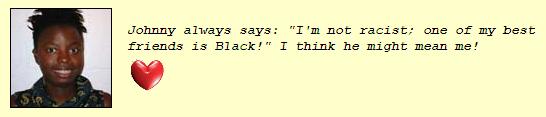
“Some of my best friends are black”
is a phrase whites use to prove they are not racist. They also use it when they are about to say something racist: “Some of my best friends are black, but….” As if that gives them a green light to say any racist thing they want.

My first reaction is to doubt the quality of said friendships. But giving them the benefit of the doubt, it has become clear that black friendship has little effect on white racism:

A white Boston police officer said this in an email about the arrest of Henry Louis Gates, Jr, a black Harvard professor:

If I was the officer he verbally assaulted like a banana-eating jungle monkey, I would have sprayed him in the face with OC.

Later he said in his apology:

I have so many friends of every type of culture and race you can name and I am not a racist.

A white high school student who went to a whites-only prom did not think he was racist either:

I have as many black friends as I do white friends. We do everything else together. We hang out. We play sports together. We go to class together. I don’t think anybody at our school is racist.

A white commenter, the first I kicked off this blog, only called black commenters names, never white ones. To one black commenter he said:

That’s right. Go play on train tracks and get hit by a train. No one wants you alive.

But he did not think he was racist either. To prove it he said:

Oh and by the way, four of my best friends have been black… My brother is married to a black a girl, too. So you really have no argument kiddo.

If anything the black-best-friend argument shows that the speaker does not know much about racism and is blind to it.

I used to think that whites who marry black or live in black neighbourhoods were not all that racist. But even that is not true! While they do tend to have less stereotyped views of blacks, they still hold onto their sense of whiteness and the racist views used to defend it. They still see things from a self-serving white point of view.

Come to think of it, even blacks can be racist against blacks!

So having a black best friend proves little.

Racism in America is built partly on a separation of the races and the stereotypes that fill in the lack of first-hand experience. Like the sea monsters on the old maps of the Atlantic. A black best friend can help remove some of those sea monsters, but not if you think your friend “is not like other blacks”.

But more than stereotypes racism is also built on the need for whites to feel good about themselves living in an unequal society where blacks get screwed. Black friends, neighbours and lovers will not make that need go away.

Sunday, August 9, 2009

embody familial norms

Writing this blog for over a year now has helped me become much more alert to something that most white Americans rarely notice, let alone think about -- the social fact that they and other white people are just that, "white."

For example, as I watched the latest edition of "Target Women with Sarah Haskin's," in which she critiques the depictions of "Doofy Husbands" in TV commercials, I did take in the humorously insightful feminist message. But as I did so, I also kept a close eye out for any husbands, or other family members, who were not white.


For those who understand something about how whiteness operates in American society, a basic truism is that, as Toni Morrison succinctly put it, "American means white." The ordinary, normal, all-American person is typically imagined in countless situations and circumstances as a white person.

That generalized norm can be broken down further. An "all-American" girl, for instance, is in most American imaginations a white person, as is an "all-American" boy. And, as Sarah Haskins' video suggests, a competent wife and her "doofy husband" are both very white conceptions as well. To my ear, that adjective, "doofy," sounds very white as well. Middle-class white, actually (I have working-class relatives who use other words to describe clumsy or useless husbands).

Here's my count of this video's racial landscape:

total white doofy husbands: 23
total non-white doofy husbands: 0
total white media analyzers (i.e., Sarah Haskins): 1
total non-white media analyzers: 0

I do my best to avoid TV commercials, so I'm not sure about something here -- is this 23:0 ratio in terms of race a function of TV commercials, or of the people at Current TV who put together this video with Sarah Haskins?

Either way, this norm of a doofy husband and his recognizable, "normal" family exist in an overwhelmingly white universe. A universe increasingly at odds, of course, with reality; white Americans now make up about 70% of the population, and within several decades, as we hear more and more often these days, they will no longer be the majority.

How long will this fantasized, unmarked, hegemonic norm of white centrality persist?

One thing that might hasten its decline is for white people to simply notice and label whiteness more often. Would it not, for instance, make for a more insightful comment on TV commercials if Sarah Haskins had talked throughout this video about, instead of "wives" and "doofus husbands," "white wives" and "white doofus husbands"?


h/t: Sociological Images

Friday, August 7, 2009

refuse to listen silently to racist remarks

This is a guest post by Filthy Grandeur, who writes of herself, "I'm a writer still trying to figure out what I'm doing, so I'm trying to do a lot of different things. I'm a daydreamer who hates being social. I'm afraid I fit the stereotype of angry, loner writer who enjoys sitting in the dark writing about things that piss me off."


No Safety for Racism

I work with one of those people who says racist things, but is clearly oblivious to her own racism. After all, she's perfectly comfortable speaking to other white people, nonchalantly exuding her ignorance with thoughtlessly racist remarks. She's referenced "the ghettos" with upturned nose, and in that non-thinking privileged manner, states that she stays clear of those places and those people who apparently choose to live there.

I've seen her jaw drop when I mention going home to the Detroit area, and seen her face twist into judgmental disgust at the mention that I listen to rap. I've heard that sneering accusation of, "Oh, so your brother thinks he's black."

But -- for whatever reason -- it seems her comfort level with me has increased, because today she insisted on telling me about how an obnoxious black girl (she made a point to specify) was acting "disgraceful" at a public pool, apparently ruining her and her boyfriend's good time. I interrupted her, and said that in no way is the girl's annoying behavior attributed to her skin color -- but she was hearing none of it. I don't think it really even registered in her mind that I, a fellow white woman, could be offended by what she was saying about an annoying young black woman. Despite my interruption, she continued: "I mean, don't black people know how to behave? Why do they act like that?"

Now, another co-worker was witness to this story, and he said nothing. We both sort of gave each other that awkward look before walking away into the next aisle. I figured interrupting her didn't work, so I'd try ignoring her. But that didn't work very well either, and she kept on with her racist rant until the subject was changed.

This exchange reminds me of something I read recently at Fugitivus:

Now anybody who’s been in a school setting knows that you do occasionally run into students who drive you up the fucking wall. But anybody who’s been one form of privileged class or another also knows (if you don’t, think on this some) that if that person who drives you up the fucking wall is black/gay/female/feminist/(insert minority label here), their otherness becomes one of the things that drives you up the wall. Instead of being a person who you thinks speaks uncomfortably loud, they become a loud black person, a shrill woman, an in-your-face gay person. Their minority status becomes an integral part of what they do that pisses you off. I’ve done this, you’ve done this; let’s not fuck about.

Why do we do this? Because it's easy.

As for the other co-worker who also heard her ignorance? I mentioned it to him later, when she wasn't around. I told him how uncomfortable she makes me, spouting her racism without thinking or caring that I might be offended. He told me he finds it offensive too, but just ignores it.

Well, that's too easy. I am normally quiet and reserved, but I've resolved that I might as well speak up -- she seems comfortable saying these things around lots of people at our workplace, even a couple managers, and no one says a damn thing (guess what? I work with a bunch of white people). If we're ever going to achieve this "post-racial" ideal, then we need to challenge racism -- point it out, expose it. We can't be afraid of confrontation. I think part of this silence is that since this is a majority white workplace, no one wants to be the "odd" or "sensitive" one by pointing out another white person's racism -- I mean, there's no POC around, so who's offended, right? But that shouldn't matter. People need to know that racism is not appropriate or acceptable anywhere at any time in any company. Ever.

I'm tired of this "safe" feeling white people get when they're in the company of other white people, where they whip out their racism and prejudices in a blinding example of their white privilege. I want white people to lose that safe feeling. I want them to stop and think about what they're planning to say, and then not say it because they know it won't be tolerated. Because they know it's ignorant and hateful and racist.

Ignoring it won't make it go away. Which is why I interrupted her, and why, when she decides to say something else racist (from her record, I know she will), I will confront her, and tell her I am offended, and what she's saying is racist and ignorant and I shouldn't have to deal with that when I'm at work. And I'll probably be accused of oversensitivity, but that's okay, because maybe I'll make her as uncomfortable as she makes me, and it'll eat at her until she realizes that she's wrong; and if not, at least she will know that I will not be party to her ignorance, despite what she thinks my skin-color represents.

Thursday, August 6, 2009

forget the whiteness of the bomb

Personally, the writer of this book would rather see his race and his civilization blotted out with the atomic bomb than to see it slowly but surely destroyed in the maelstrom of miscegenation, interbreeding, intermarriage and mongrelization. The destruction in either case would be inevitable -- one in a flash and the other by the slow but certain process of sin, degradation, and mongrelization.

--Senator Theodore G. Bilbo (D-Mississippi),
Take Your Choice: Separation or Mongrelization (1947)


On August 6, 1945, the United States dropped an atomic bomb named "Little Boy" on Hiroshima, Japan. On August 9, "Fat Man" destroyed much of Nagasaki. An estimated 220,000 people were killed by those attacks, about half of them on the two bombing days. On August 15, Japan announced its surrender to the Allied Powers. So far, no other nation has attacked another with nuclear weapons.

In 1964, Stanley Kubrick released Dr. Strangelove, a scathing cinematic satire about the effects on global politics of something new in the world: "The Bomb." In Kubrick's view, the fact that humanity could obliterate life on earth with the push of a button made the whole idea of life on earth sort of absurd.

Also absurd, he realized, was something especially white American about The Bomb. In Dr. Strangelove, he emphasizes this whiteness with the character of Major T. J. "King" Kong, the pilot who guides the crew that drops the bomb that sets off a nuclear winter.

Kubrick highlights American whiteness by having Slim Pickens play Major Kong as a cussing, cowboy-hatted, good ol' boy, who mispronounces "nuclear" the same way that George Bush, Jr. did, and who rides the bomb on its journey to earth as if he's riding a rodeo bull.


With the characterization of cowboy Kong, and with that of Dr. Strangelove as a trusted, Nazi-worshiping adviser to U.S. President Merkin Muffley (both played by Peter Sellers), Kubrick satirized the ironic whiteness at the core of America's identity during World War II and the subsequent Cold War period. The irony is that while this white nationalist core helped to guide American policy both at home and abroad, American propaganda during World War II had emphasized the racist ideologies of Germany and Japan as fundamentally evil features of their "evil empires."

As Ken Cooper explains in an essay entitled "The Whiteness of the Bomb," various features of the American mindset that led to the dropping of actual nuclear bombs, on Hiroshima and Nagasaki, also reflected the general assumption that America was a "white" country. Because the Japanese were "non-white," dropping the Bomb on them wasn't as morally troubling to most Americans as it might have been. As it might have been, that is, if the question were instead whether to drop it on a "white" country.

In Hiroshima: Why America Dropped the Bomb, Japanese American historian Ronald Takaki writes about the man who made the final decision to destroy two Japanese cities, President Harry Truman. This was the same man who, when he was younger, wrote the following in a letter to his future wife, Bess:

I think one man is as good as another, so long as he’s honest and decent and not a nigger or a Chinaman. My uncle Will says that the Lord made a white man of dust, a nigger from mud, then threw up what was left and it came down a Chinaman. He does hate Chinese and Japs. So do I. It is race prejudice I guess. But I am strongly of the opinion that negroes ought to be in Africa, yellow men in Asia, and white men in Europe and America.

Elsewhere in his book, Takaki shows that while Truman did not order the use of nuclear weapons for the express purpose of killing Japanese people because they were Japanese, the fact that America and other Allied nations considered their non-white opponents subhuman clearly played a significant role in that decision. And thanks to the dehumanizing depictions of Japanese people in war-time propaganda, most Americans found the decision to target the civilian populations of two entire cities easier to accept.

As Ken Cooper notes, though, not all Americans were blind to the racism of dropping the Bomb on Japan. For instance, an editorial cartoonist for a leading black newspaper, the Chicago Defender, found it significant that right after the war ended,

occupying forces aboard the Mississippi entered Japan with a Confederate flag flying and a band playing "Dixie." Langston Hughes wondered, by way of a conversation with his alter ego, Jesse ('Simple') Semple, whether America would have dropped the bomb on "white folks" like the Germans. Simple maintains that the United States has waited "until the war is over in Europe to try them out on colored folks."

Nowadays, it seems that the American keepers of the largest nuclear arsenal on earth still think of the Bomb in racial terms. While some non-white nations now have the Bomb, it would be useful to see the racial composition of nuclear arms bearing countries -- how many are primarily white versus non-white? Who has been "allowed" to have them, and who has done the allowing?

Apparently, among the many economic and geopolitical "concerns" of (primarily white) American leaders is the non-whiteness of those who might acquire nuclear weapons. Japan has not been allowed to have a nuclear weapon, perhaps because America fears retaliation, and George Bush breathed fire at "evil" North Korea when it threatened to build one (his administration later turned down the heat on North Korea, apparently because it went ahead and built one anyway).

The non-white countries of India and Pakistan now have nuclear weapons, as does the somewhat less non-white country of Israel, but they're American allies -- perhaps that's why drumming up a racist perception of them as a nuclear threat was therefore deemed unnecessary. The latest perceived non-white threat in these terms is Iran, a country that American leaders have lately been threatening to attack for the (perhaps ostensible) reason that it might acquire nuclear weapons.

Americans during World War II were likely more accepting of a Bomb drop on Japanese people than they would have been on German people because Japanese people were racially "different," and thus easier to dehumanize in propaganda efforts. Does today's new racist propaganda -- the endless stream of swarthy, grimacing, cartoonish Arab "terrorists" -- contribute to America's discontent with the idea of an Iranian nuclear state, by again dehumanizing an "enemy"?

As Americans remember the bombings of Hiroshima and Nagasaki and their people, will many at all remember how racist the decision to do so was? And how ironic and hypocritical that decision therefore was?

How "white," then, does the Bomb remain?


THE END


(an earlier version of this post appeared here)

Wednesday, August 5, 2009

help out disadvantaged black youth

Here's something to look forward to, or not -- a movie coming out this fall, about a promising young black man taken in by a nice, conservative white family.

Looks like Hollywood's White Savior industry is branching out.


The Blind Side reminds me of Dedicated Teacher movies, especially the ones that depict a goodhearted white teacher wading into some urban decay and becoming an even better person. This happens when the white person convinces some dark kids that there's a whole world of opportunity just waiting for them out there, if they'd only realize that they're not really condemned to life in the ghetto. (For me, the classic of that white genre is the Michelle Pfeiffer vehicle Dangerous Minds.)

Here's a description of The Blind Side that appears at imdb.com, a description that I assume was supplied by the studio that made this movie. Notice the submerged racial assumptions at work here:

A disadvantaged teenager is taken in by a conservative family who see tremendous promise in the young man. Despite certain obstacles, the attention and inspiration he receives helps him mature into an athletically and academically successful NFL prospect.

Hollywood usually panders to its targeted audiences by regurgitating money-making characters and situations. If some of these are racist, well, what the hell, they still make money, eh?
Or so the thinking seems to go. Or, maybe these moviemakers really don't realize that so many of their products are racist?

This is the kind of movie that brings tears to a lot of white eyes. But what do those tears really mean? What is it, really, that brings them on?

Does this movie look appealing to you?


h/t: swpd reader KM

Sunday, August 2, 2009

go on racially trouble-free vacations

It's vacation time for me, so I'll be posting lightly for the next week or so, and with more excellent and gracious guest posters than usual.

As I travel, I will not be taking a break from thinking about and trying to counteract whiteness -- my own, and maybe other forms of it around me. My racial status follows me everywhere, but unlike many non-white people, I can forget that most of the time, if I want to. I can forget that as I'm out fishing somewhere, that somewhere is a place that my ancestors basically stole from other people, and that the theft was in part justified by an unwarranted belief in racial superiority.

I'll also be taken differently by others just because I'm white. When I vacation in The Great American Outdoors, almost all of the people I encounter doing the same thing out there, or working for those doing the same thing out there, are white. That won't even occur to most of us, but it will occur to me.

I'll also be welcome everywhere I go, in part because I'm white, and I'll feel I have a right to go anywhere I like, for the same reason. It won't occur to most of my fellow white vacationers that many non-white people would feel less than welcome in many of the places I'll be going, but that will occur to me.

As I'm fishing, it's not likely that I'll encounter any problems brought about by my being white. Since I'm not black, the lack of anxiety I feel about traveling probably stems from racially trouble-free experiences that go all the way back to childhood travels with my parents. Because I'm white, I have no memories of travel that compare to those recorded a long time ago by Countee Cullen, in his poem "Incident":

Once riding in old Baltimore,
Heart-filled, head-filled with glee,
I saw a Baltimorean
Keep looking straight at me.

Now I was eight and very small,
And he was no whit bigger,
And so I smiled, but he poked out
His tongue, and called me, “Nigger.”

I saw the whole of Baltimore
From May until December;
Of all the things that happened there
That’s all that I remember.


Were I of, say, a traveling angler of Asian descent, I might have other things to worry about, such as roving gangs of white teenagers, who hope to find some fun in what they call "nipper-tipping":

Everyone in the area calls it the Blue Bridge. Formally called Mossington Bridge, it is a sturdy, small structure that leads to leafy and lavish Jackson's Point.

It's around these ostensibly bucolic parts that Torontonians -- Asians in particular -- have in recent years been driving up in droves to catch perch, rock bass or the occasional pike on Lake Simcoe's south shore. The angling here is best in the late evenings.

But the area around the Blue Bridge is one of those inevitable late-night magnets of teenage trouble that exist in almost any small town.

The long pier became the flashpoint of violence recently. Following three previous assaults involving Asians and anglers on a federally owned pier near the bridge, a confrontation last month left one young man in coma, another seriously injured and another in jail.

In reports that followed these events, an example of local vernacular emerged, a term teens in the area use to describe how they sneak up on Asian visitors, push them into the water and destroy their gear.

They call it "nipper-tipping" -- an amalgam of the Second World War-era epithet for a Japanese person and the practice of tipping over sleeping cows.

Outside a grim-looking tattoo parlour in the area, I asked a bunch of teenagers if any of them had ever heard of the phrase in question. One youth, who said the practice was for idiots, added he had seen it done to a white man.

Yet the impact of the "N" word has overshadowed the reality of the situation-- what residents say is a sense of lawlessness in the face of a day-tripping boom and bigoted, self-styled vigilantism.

In the past week, Mayor Robert Grossi, who represents the 42,000 residents in the area -- including the towns of Keswick, Sutton and Pefferlaw -- has been conveying his embarrassment to ethnic groups.

Still, he explained, racism is everywhere. "You can drill down into any community and find the same thing."

Though Mr. Grossi has been in serial-apology mode since the Sept. 16 attacks, there is evidence that not everyone in the town is so repentant.

Last week, swastikas, anti-Semitic and homophobic graffiti were spray-painted on houses and cars on a modest Keswick street. This week, just down the road at the Sutton District High School, a swastika was found on a wall and scrubbed off.

"It's seen as an isolated, singular act of mischief," said Ross Virgo, a spokesman for the York Regional District School Board. . . .

It may well be a great place to live, but there have been some, of late, who have found it not such a great place to visit.

Chinese Torontonians have been taking to local call-in shows, claiming that they have been victimized by Georginians.

One caller claimed he was threatened at gunpoint.

"What happens is locals see out-of-towners carrying coolers and coolers of rock bass, and they think it's coming from 'their' lake and that there are quotas," said Victor Wong, executive director of the Chinese Canadian National Council, who said there are no quotas.

"We really need a dialogue between the communities, and we're going to do that."


Maybe I should count my blessings because I don't have to worry about things like "nipper-tipping," nor other forms of harassment faced by non-white people in The Great American Outdoors.

I'll also be able to relax, if I want to, about the racism buried within the small, racially isolated, and largely white communities that I'll be passing through. Whiteness nurtured in relative isolation tends to be xenophobic in its own particular ways.

But then, I really can't relax about that anymore. As I've explained before, all-white places creep me out now. I know too much about how they got that way, and what kinds of racial attitudes fester in racially isolated places, and how non-white visitors could well be treated differently than myself.

At the same time, I'll be aware that merely being "aware" of these things isn't doing anyone but me all that much good. I'll most likely be riding the wave of my white, male, middle-class American privilege into a smooth, fun vacation, but couldn't I do another kind of vacation, one that somehow more actively counteracts such privilege?

Do any of you know of a better vacation for privileged people? for those among them who'd rather do something other than ride the wave comprised of their various privileges? I have family reasons for taking a fishing trip, but for future possibilities, I'd like to hear about options that are better in this sense.

And what about you? If you've done any vacationing this summer, was race a factor?

Actually, what I should ask is, how race is a factor. Because in anyone's vacationing experience, especially in the United States, it very likely is one.


UPDATE (8/23/09): Another maddening example of something that I don't have to worry about during my summer vacations: "76-Year Old MD Man Beaten While He Fished":

Three white men shouting racial slurs beat a 76-year-old black man while he was fishing in a river early Tuesday, said Baltimore police, who were investigating the attack as a hate crime.

The assailants also stole the man's sport-utility vehicle, said Anthony Guglielmi, a police spokesman. Police caught up with the vehicle and arrested 28-year-old Calvin E. Lockner.

Late Tuesday, police said Lockner was charged with hate crime, attempted murder, first-degree assault and carjacking. During his interview with detectives, Lockner "admitted he does not like African-American people," Guglielmi said.


Saturday, August 1, 2009

think that black people are paranoid

The person who posted this video on YouTube also wrote this about it: "Since the Harvard professor Gates says all black people are vulnerable in America, let's have some fun with that!"

The video is an attempt at humor, but I think it's humor with a point -- that is, satire. But then, I'm not quite sure what the point is.

What do you think?


For those who can't watch it, the video begins with a shot of Professor Gates explaining that his arrest made him realize how "vulnerable" all black and poor people are to "capricious forces like rogue policemen." Words are then superimposed on a freeze-frame of Gates that say, "Speak for yourself, Sissy . . . "

The rest of the video portrays a black man getting wired up for sound in front of a green screen by a white man. The black man gets nervous because he fears that the microphone wire will "shoot white people's instructions up my spine and take over my brain." He runs away and into a corporate setting full of white people, all of whom frighten him more and more. Especially when they turn into zombies, who say they want his "sense of rhythm," his "natural athletic ability," and so on. At the end of the video, the black man is found crouching and crying in a basement by another black man, who asks him what's wrong. He raises his head to choke out an explanation: "I see white people!"

Again, I don't think this video is just an attempt to "have some fun" with Professor Gates' point that black people (what happened to the "poor" people in his comment?) are "vulnerable." It's an effort to satirize that point, and to say that those who make it are paranoid "sissies." They must be sissies, you see, because white people (what happened to the "rogue policemen" in Gates' comment?) don't have anything against black people. I mean, come on, we're not like, freakin' flesh-eating zombies or something! Only a sissie would play the race card by claiming that in this post-racial society, things are any different for black people than they are for white people. Get real, bro!

By the way, this "humor" was produced by people working for an outfit with an explicitly political agenda -- Pajamas Media Television. This is the same crew that recently published an article by Roger L. Simon entitled "Gates and Obama’s nostalgia for racism." Simon's point is very similar to the one made by Pajamas Media Televsion.

Simon claims that all countries were racist in the past, including the U.S. However, because of its legacy of slavery, the U.S. has tried especially hard to eradicate racism, and it has succeeded. Nevertheless, some have found it difficult to accept this new reality:

. . . when the rules change, when values change, not everyone can adjust with it — not only the racist, but also those who depended on being victims of racism. For all his brilliance, Henry Lewis Gates is evidently such a man. Otherwise, why cry out about being victimized as a “black man in America” before there is any evidence that that is the case?

This is nostalgia for racism and our president probably suffers from it as well, although perhaps to a lesser degree, considering he clearly plunged into the fray without thinking [by saying that the Cambridge police acted "stupidly"]. The problem is that this nostalgia not only blames people unfairly, it also increases the very thing it pretends to oppose — racism itself. The unfair or inaccurate imputation of racism promotes racism.


This is, I think, a current, widespread conservative strategy for opposing a party that now has a black president. It has roots in real racism -- in common, long-standing white perceptions that black people are professional victimologists who can't think straight because they're so wrapped up in the past, and so on -- but I think there's something new about how this strategy is now playing out. In fact, conservatives seem to feel that they have to revamp their racial politics, because they're now faced with a black president.

Since we live in a society and power structure that is still, in an unspoken way, framed by white perceptions and attitudes, Barack Obama has continually backed away from contentious racial issues. I think he did so again in the Gates case, after initially pointing out, accurately, that racial profiling is still a problem, and I think he generally does so as a political necessity. And yet, conservatives keep stalking him with a giant tar brush, all the while claiming that he's the real racist.

The strategy now seems to be to convince America at large that racism is a thing of the past (and indeed, many white people do already believe that, and a few non-white people too), and that anyone who points to racism, of any sort at all, is therefore a paranoid race hustler. And more than that, not only are their claims that racism still matters unfounded -- to "cry racism" is itself racist.

I think this is what conservative crybaby Glenn Beck is basically up to, when he claims that Barack Obama is a "racist" with a "deep-seated hatred" for white people.


This is all sick, twisted stuff -- to not only deny a vast amount of evidence that racism still exists (let alone that it's a major problem), but then to add that those who point out that it does exist, and that it is a major problem, are doing so because they're nostalgic for the good old days of Jim Crow and slavery. And that they themselves are the "real racists."

I'm rarely speechless, but these claims, and the respectful attention they're given by the corporate media, are all just . . . wow.

Republicans are widely understood to be a largely white political party full of people who have little genuine interest in embracing people of color, the people that most Republicans suspect (sometimes unconsciously) are basically inferior, in a lot of ways.

Is this strategy -- of denying racial realities and trying to reverse things by affixing the label of "racist!" onto their opposition instead -- really going to work for them?

Where is all this craziness going?

hit counter code